



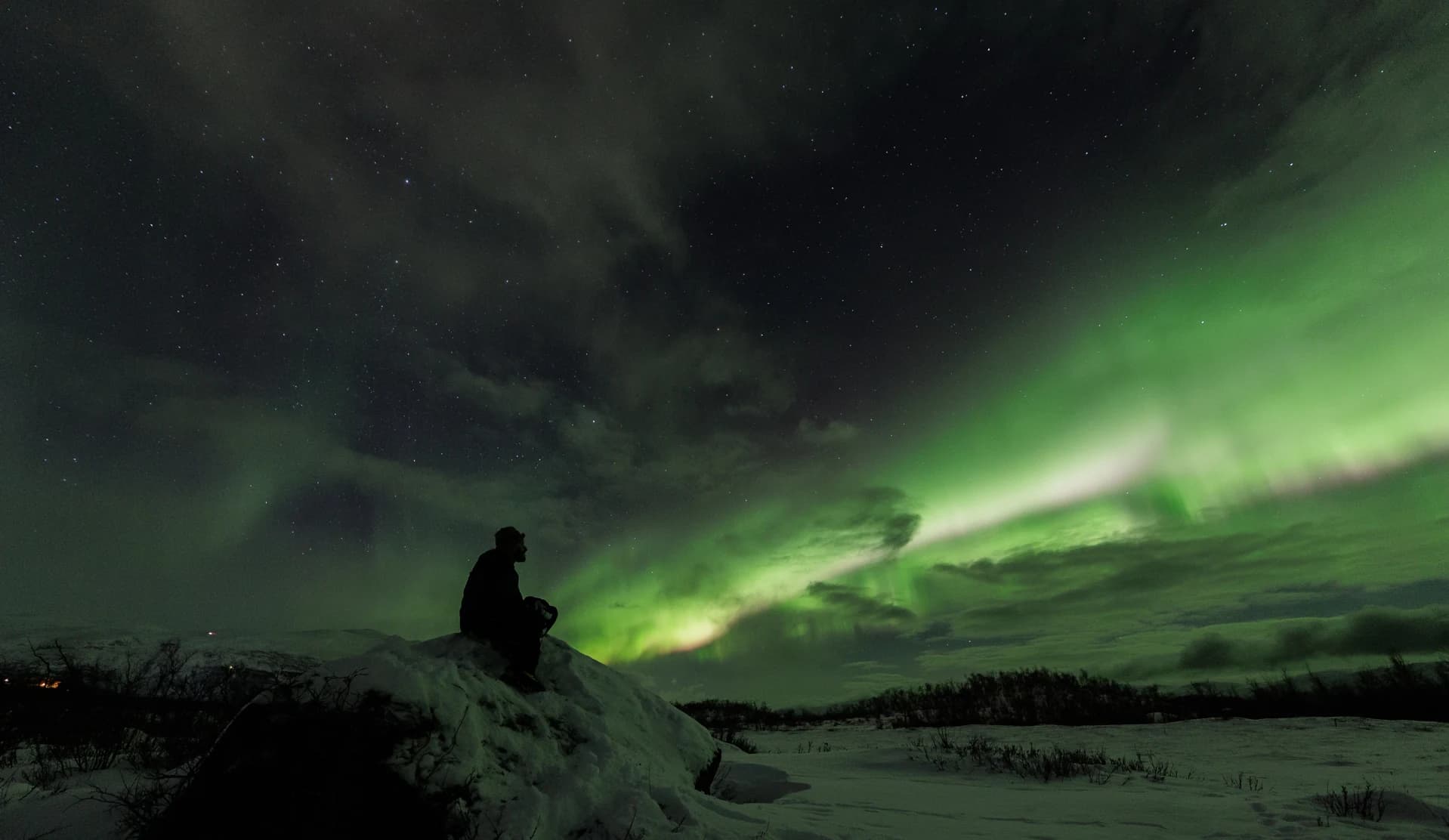
A CalenVoy guide
Abisko
or Kiruna?Which to choose, and when to do both
How the two really compare on the sky, the weather, the journey and the days in between, and how to split the nights if you choose both.
They are 93 kilometres apart on the same road, at almost the same latitude, under the same aurora. What differs is everything around the sky.
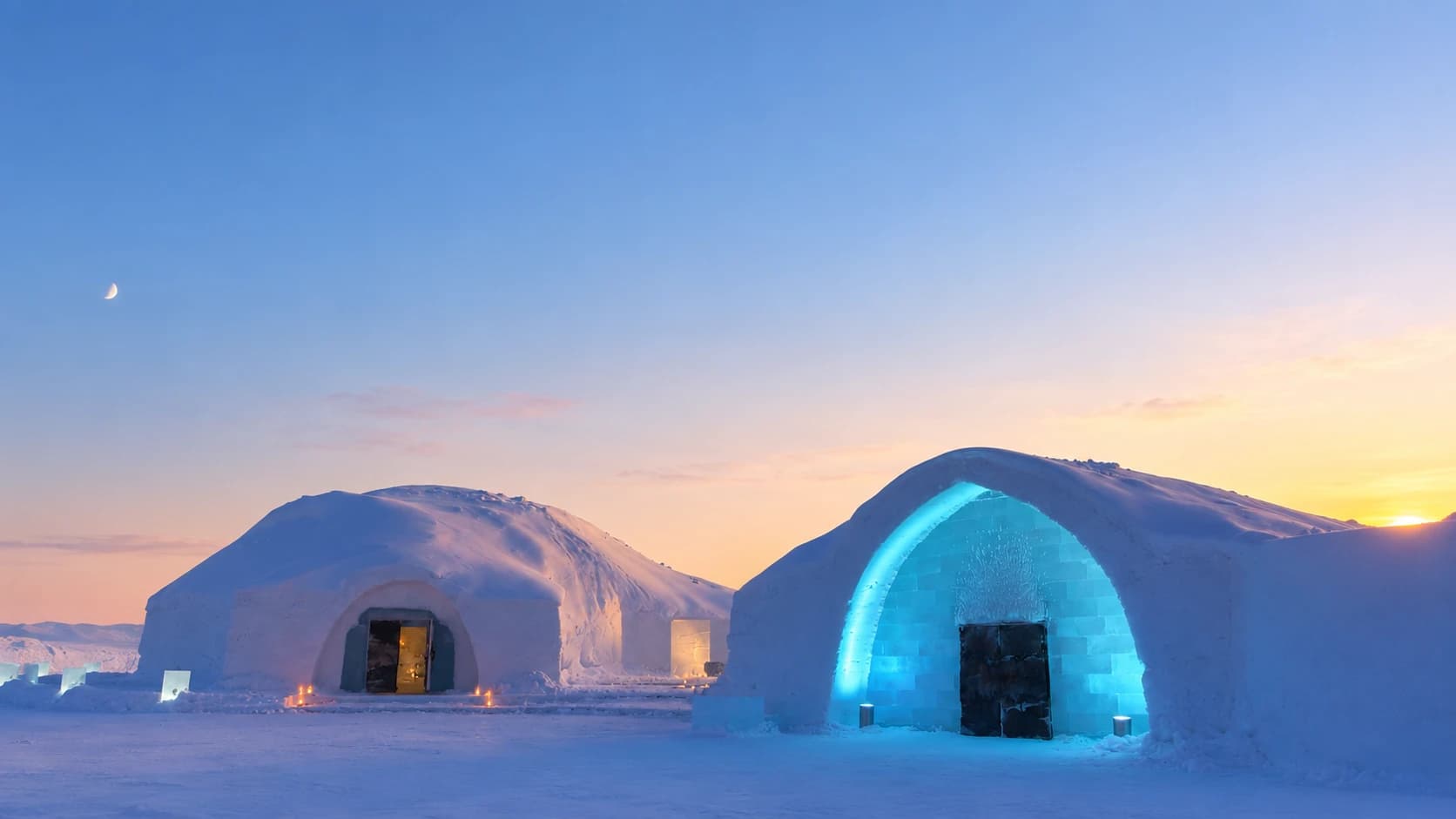

Updated · 12 min read
The short answer
Both, if you can:
two nights in Kiruna,
then three in Abisko
Choose Abisko for a small village in a mountain landscape: a national park at the door, the start of the Kungsleden, and dark ground a short walk from your lodge. Choose Kiruna for the airport fifteen minutes away, more hotels and restaurants, and more to do when the weather closes in: ICEHOTEL, the mine, Sámi hosts and dog teams. Neither has a stronger aurora. Both sit at about 68° north, under the same sky. For a first winter trip, give it five nights and use both: Kiruna first for the range, then Abisko for the landscape.
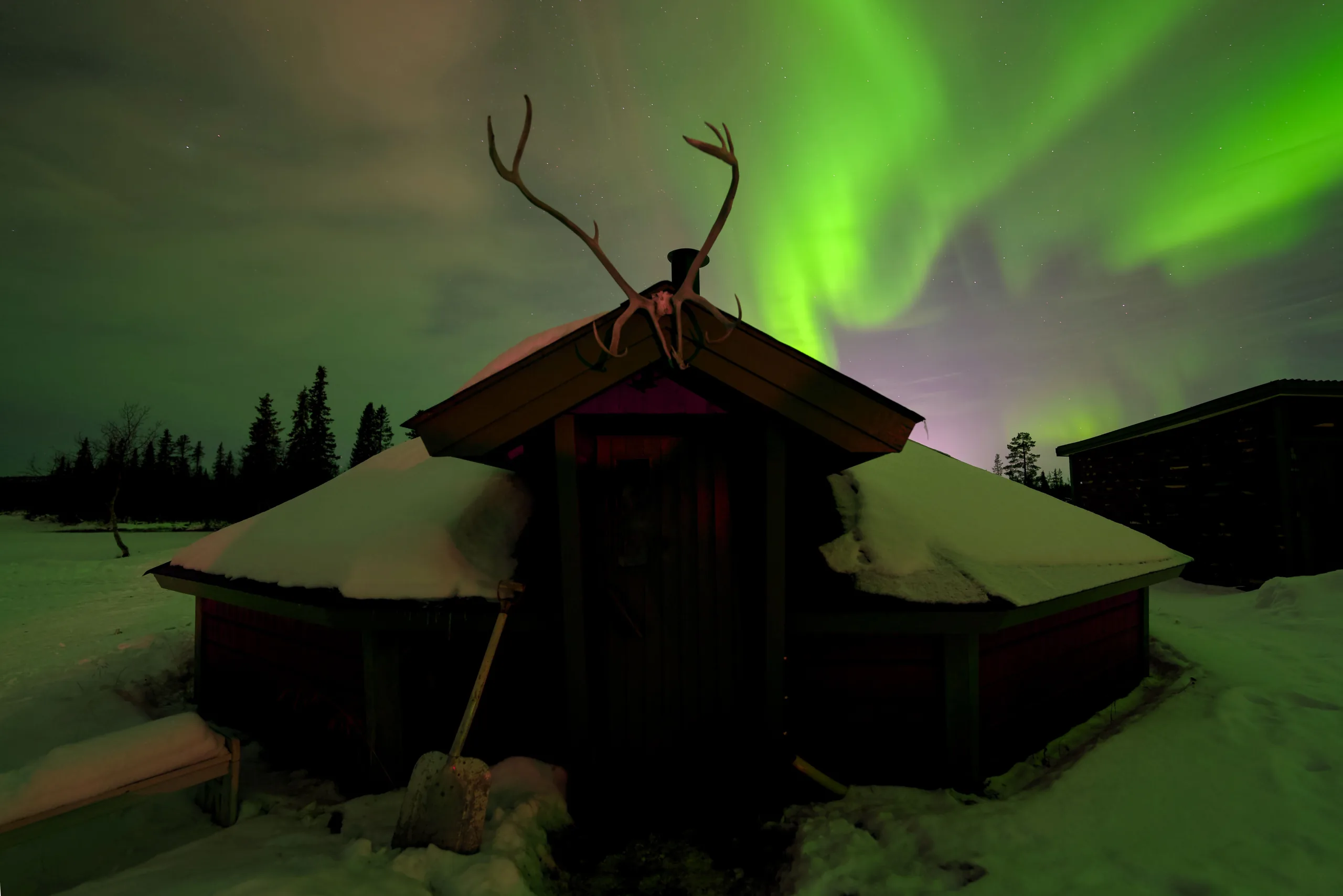
Abisko is barely half a degree north of Kiruna. Both lie under the auroral oval, and no study shows the lights are more frequent over either.
Same sky
Abisko is the drier: 347 mm of rain and snow a year on SMHI’s 1991–2020 normals, against 561 mm at Kiruna airport.
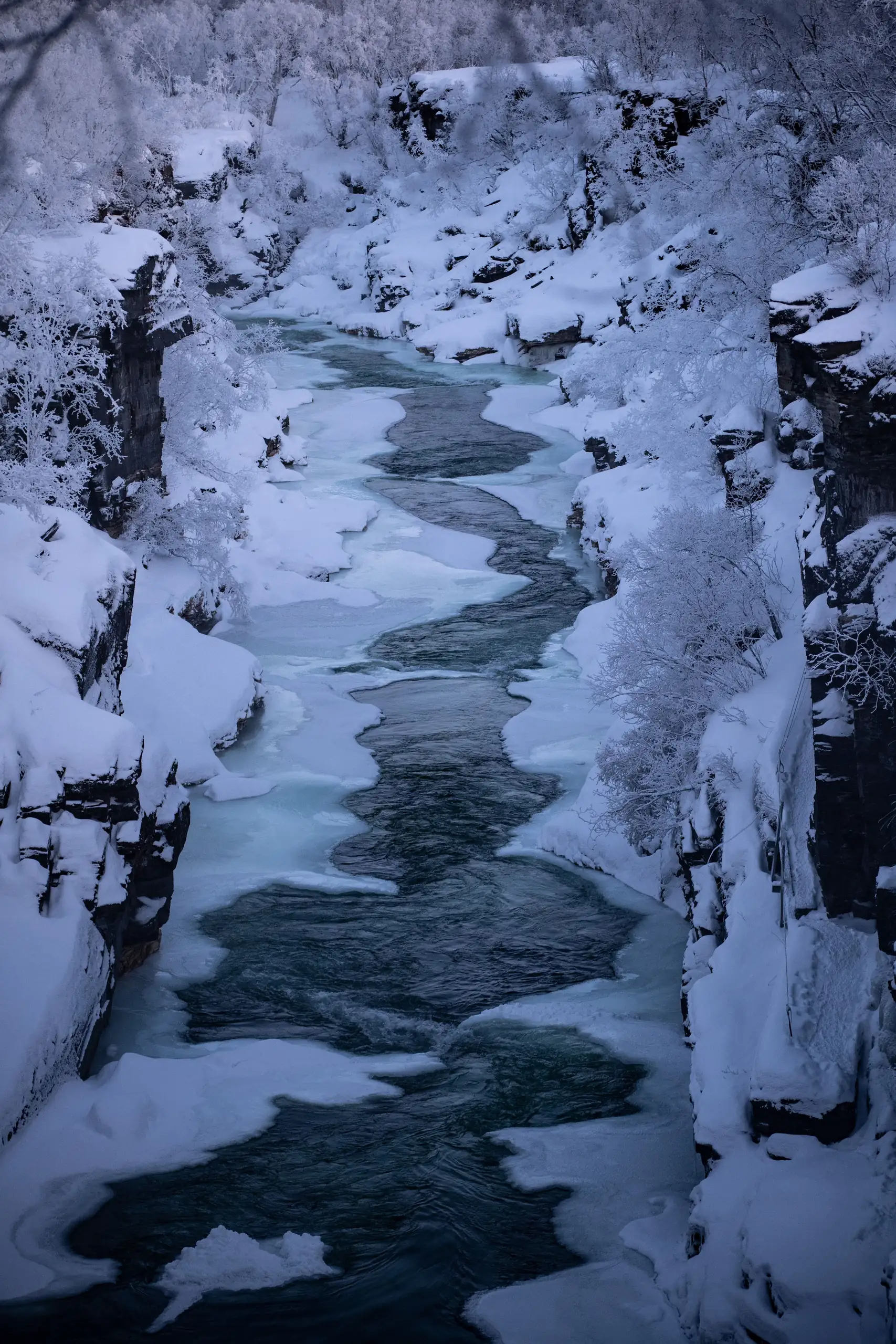
Kiruna logs about 177 more hours of sunshine a year. Drier does not mean clearer.
The real difference is the ground. In Abisko the dark is a short walk from the lodge; in Kiruna, a short drive out of town.
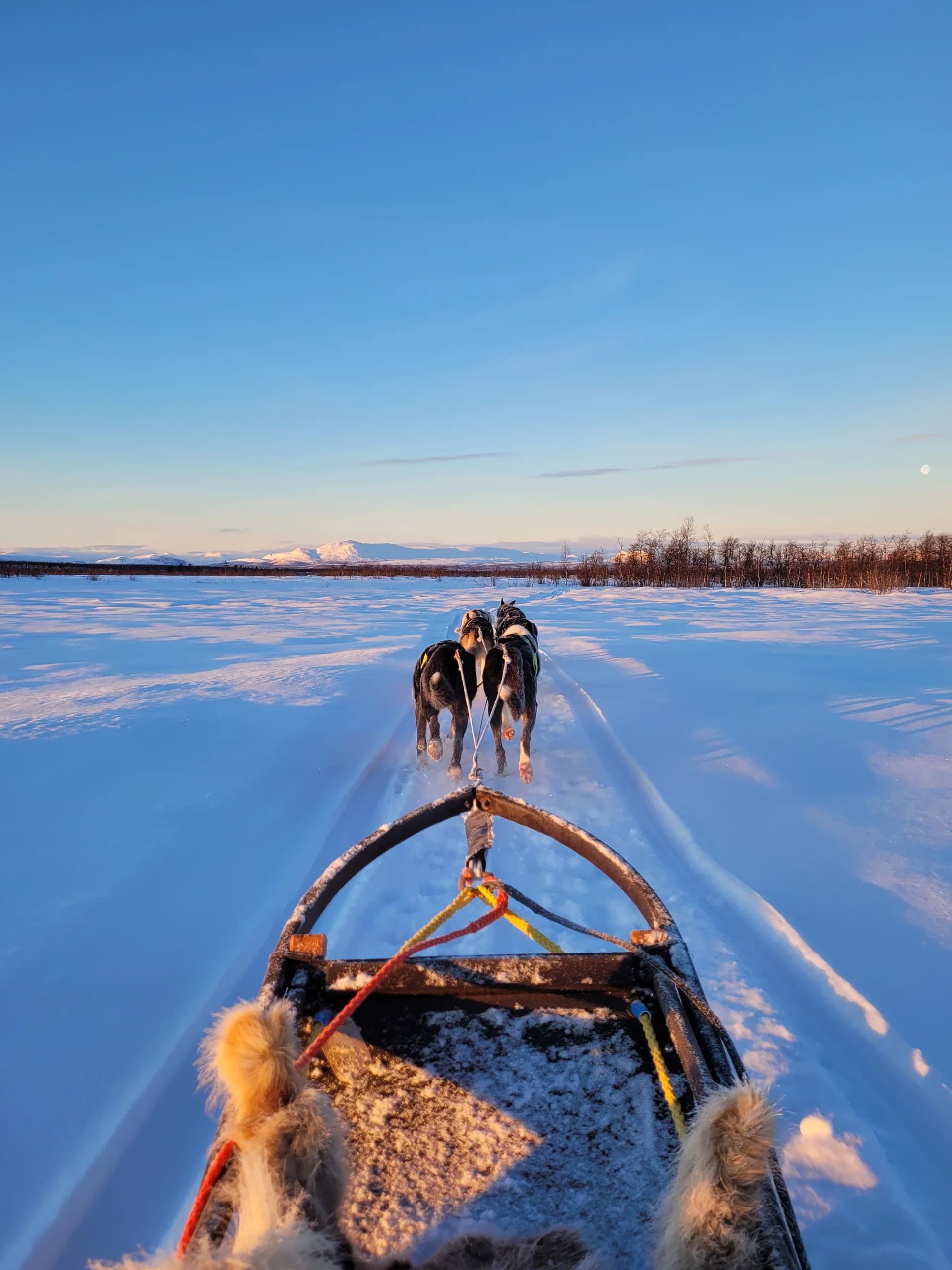
The same sky, 93 kilometres apart
Abisko and Kiruna sit on the same road, the E10, 93 kilometres apart, and at almost the same latitude: Abisko’s research station stands at 68.35° north, Kiruna at about 67.86°. That half a degree makes no difference to the northern lights. Both lie beneath the auroral oval, and the Swedish Institute of Space Physics treats a radius of about 300 kilometres around Kiruna as one area for its aurora alerts. No published study shows the lights are more frequent over one than the other.
What differs is everything around the sky. Abisko is a village of 149 people at the edge of a national park, on the shore of Torneträsk. Kiruna is a working mining town of about 18,000, with the region’s airport fifteen minutes from the centre. One gives you the landscape at the door. The other gives you choice.
The weather, honestly
On SMHI’s 1991–2020 normals, Abisko gets 347 mm of rain and snow a year, the lowest in Sweden, against 561 mm at Kiruna airport. It sits in a rain shadow from most wind directions, and its April is remarkably dry, at 11 mm. In midwinter Abisko is also slightly milder: a January mean of −9.6°C, against −11.3°C at the airport.
Dry is not the same as clear. Kiruna records about 177 more hours of sunshine a year than Abisko.
Sunshine hours are a daytime measure and say little about a winter night, so neither figure settles the argument. What they do rule out is the claim, repeated on many sites, that Abisko has the clearest skies in the world. Nobody has measured that, and the sunshine record, if anything, points the other way. The “blue hole”, a gap in the cloud said to sit fixed over Abisko, comes from tour operators rather than from SMHI or the research station. Local gaps in the cloud are real. A guaranteed one is not.
Darkness, and how far you go for it
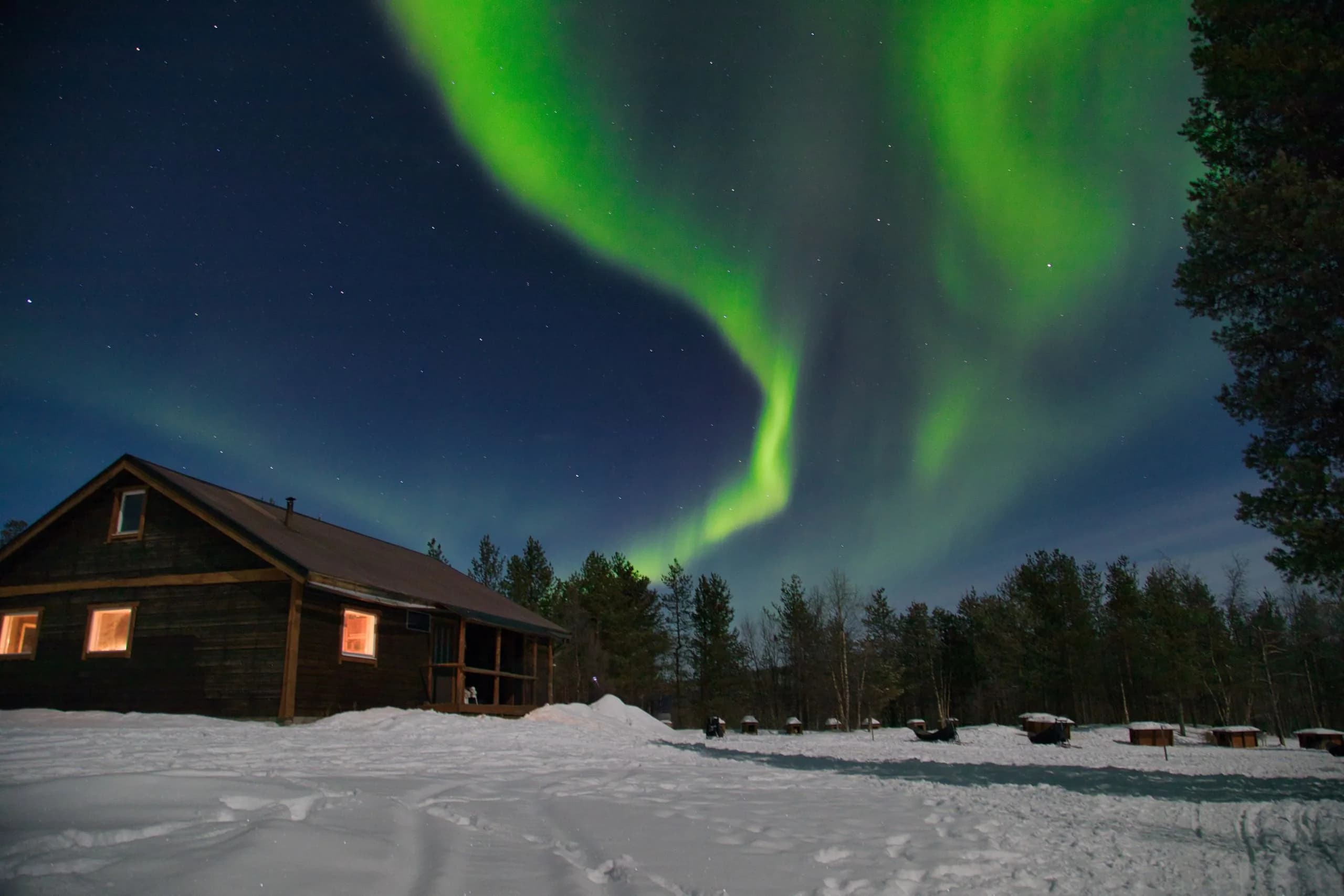
In Abisko a dark foreground is close: the lake and the edge of the park are a short walk from most lodges, and on a clear night the evening can start on foot. The Aurora Sky Station on Nuolja runs its night visit from 19 October 2026 to 27 March 2027, from 20:30 until 01:00 at the latest, for up to 40 guests. In bad weather the chairlift stops and the evening moves to a lavvu at ground level.
Kiruna is brighter, but not hopeless. Kiruna Lapland, the town’s own visitor board, says the lights can be seen from the centre on good nights, and points to darker ground on the Luossavaara side, beyond the street lights. Kiruna’s larger advantage is mobility: with a vehicle and someone watching the cloud map, it is a good base for driving to the gap. That is what our private aurora night is for.
Getting there, and between them
Kiruna airport is about ten kilometres, or fifteen minutes, from the centre. On the schedule published for winter 2026–27, almost every flight comes from Stockholm Arlanda, with a few direct flights from Copenhagen in midwinter. Abisko has no airport: from Kiruna it is 93 kilometres by road, a little over an hour in normal conditions. In winter, allow an hour and a half or more, and never build a tight connection to a flight.
SJ’s night train from Stockholm stops at Kiruna and at both Abisko stations, and from December 2026 it is contracted to run every day. Kiruna’s station is temporary, about six kilometres out of town, with a free shuttle timed to the trains. In Abisko, get off at Abisko Östra for the village, the shop and Abisko Mountain Lodge, or at Abisko Turiststation for the STF lodge, the national park, the Kungsleden and the chairlift. The two are about three kilometres apart: an easy walk in summer, a long one with luggage in the dark.
The regional bus between Kiruna and Abisko runs only in parts of the year, roughly February to May and June to September. In early winter, plan on a private transfer or the train.
What each one actually has
Abisko is small, and in winter it comes down to a few addresses. In peak season there are three main restaurants, in two lodges: Restaurant Kungsleden and Bistro Storstugan at STF Abisko Turiststation, and Brasserie Fjällköket at Abisko Mountain Lodge. There is one small grocery by Abisko Östra, and an outdoor shop with ski and snowshoe hire at the STF lodge. That is not a complaint. It means dinner is booked ahead, and that one closed kitchen on a given night matters.
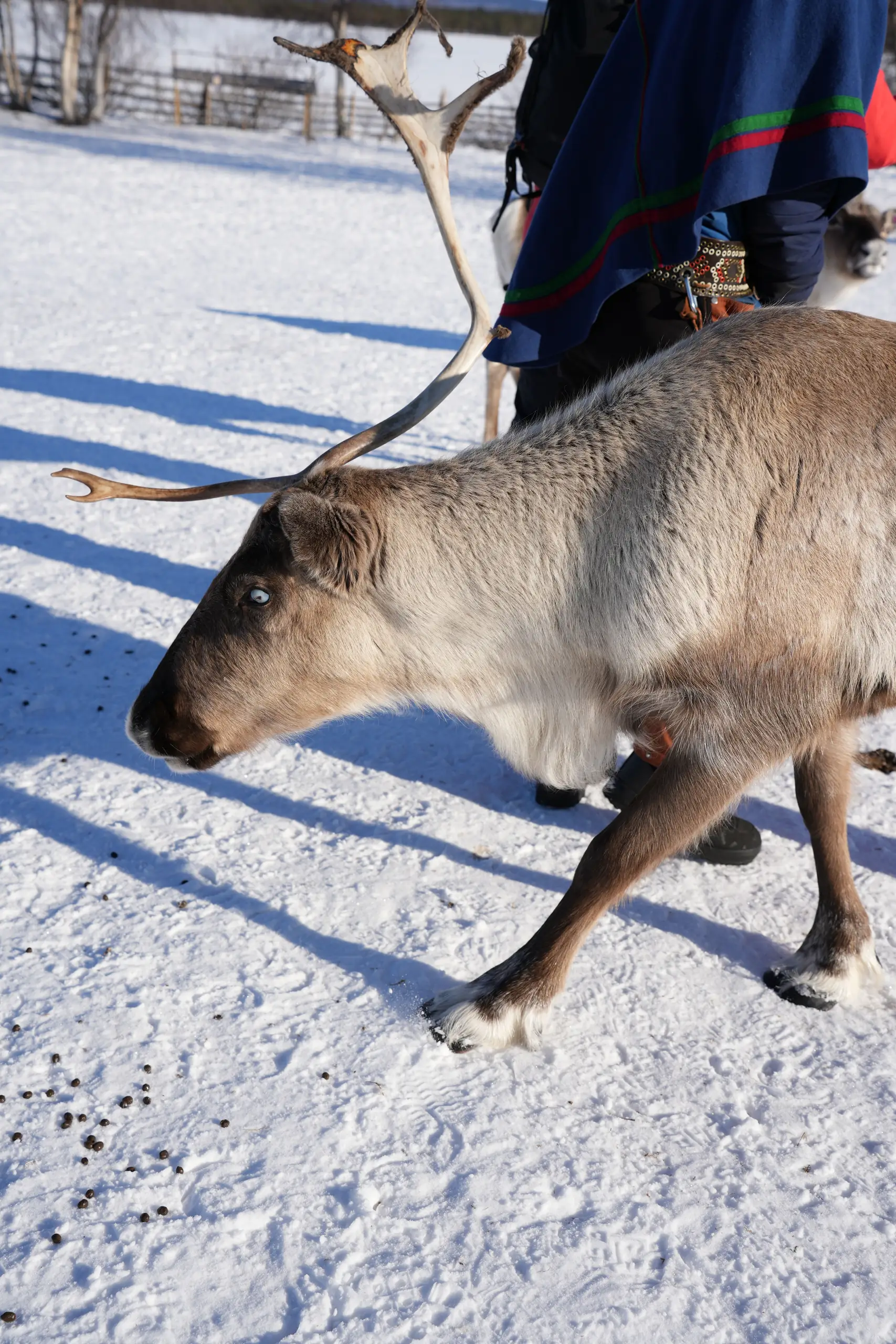
Kiruna has the range: a much wider choice of restaurants, cafés and bars across the town, and hotels from Camp Ripan’s cabins and spa to Elite Hotel Frost and Scandic in the new centre. About twenty minutes from the airport at Jukkasjärvi, ICEHOTEL 37 opens on 11 December 2026, and ICEHOTEL 365, its year-round building, stays open through the summer. Add the LKAB mine tour, dog teams, snowmobiles and Sámi herding families, and a cloudy day in Kiruna has more ways to still be a good day.
The town that is moving
The iron ore mine beneath Kiruna is deforming the ground above it, so the town is being moved, district by district. Formal planning between the municipality and LKAB, which runs the mine, began in 2004. The new City Hall opened in 2018, and the new centre, with its shops and culture house, on 1 September 2022. In the phase now under way, LKAB counts about 6,000 people and 2,700 homes affected over the next decade.
The most famous move is done. On 19 and 20 August 2025, Kiruna Church, all 672 tonnes of it, was moved about five kilometres to its new site in one piece; its bell tower followed on 26 August. It is closed while the restoration is finished, and until it reopens it is a building to see from outside. The rest of the change shows as new blocks in one part of town, cleared ground in another, and works around the growing centre. Few places let you watch a town relocate itself.
What Abisko really is
Abisko was a place of science before it was a place of tourism. A research station opened at Katterjokk, near the Norwegian border, in 1903, burned in 1910, and was re-established at Abisko, where measurements began in 1913. Its weather station is one of the World Meteorological Organization’s centennial observing stations. The national park is older still: it was founded on 24 May 1909, covers 7,700 hectares, and is where the Kungsleden begins. It is the valley our One Hundred Winters journey is built around.
Its name in Northern Sámi is Ábeskovvu, “the forest by the great water”, and with Torneträsk stretching away from the village it is easy to see why. It is not wilderness at every step: the railway, the E10 and the lodges run through the valley. But the park begins where the buildings stop.
Children, and anyone who would rather not walk far
Kiruna is usually easier. The airport is close, the hotels are full-service, and the indoor sights work in any weather; the mine tour takes children from six years and 110 centimetres. Abisko is lovely for snow play and short walks, and naturum and the canyon path have adapted routes and places to rest. But the evening most people travel for, the Aurora Sky Station night visit, has a minimum age of twelve, and sixteen for its dinner.
For reduced mobility, make Kiruna the base and check each excursion. The mine tour can take a folding wheelchair if the guest can board the bus on their own or with a companion. Abisko can work well when the lodge, the transfers and the routes are arranged in advance, though winter snow narrows what is really usable.
Season by season
Both work all winter. The tag says which base we would lean towards in each part of the year.
- SeptemberAbiskoAutumn colour on the fell, open trails, and dark nights returning by mid-month. The least settled weather of the season.
- OctoberKirunaThe park’s services thin out and the snow is only settling. Kiruna’s hotels and indoor sights make the shoulder weeks easier. The Sky Station night visit starts on 19 October.
- Nov – DecKirunaShort days, then polar night: in Kiruna the sun sets around 10 December and returns around 2 January. ICEHOTEL opens on 11 December. Christmas and New Year are the busiest weeks.
- Jan – MarBothThe best balance: deep snow, returning daylight and long dark evenings. Abisko for the park and the night sky, Kiruna for the mine, ICEHOTEL and the dogs.
- Apr – MayEitherLong light and often good snow for dog teams and late skiing. The aurora fades as the nights brighten, and from early May the park’s facilities close for the thaw.
- Jun – AugAbiskoThe midnight sun, 29 May to 17 July at Abisko and 1 June to 14 July at Kiruna in 2027, and the Kungsleden open for walking. Kiruna for ICEHOTEL 365, the mine and Sámi culture.
Seasons from Kiruna Lapland and Sweden’s National Parks; opening dates from the Aurora Sky Station and ICEHOTEL; polar night from SMHI; midnight sun from our own 2027 calculation, as in our midnight sun guide.
How to split
the nights
Fivenights: two in Kiruna, three in Abisko
Kiruna first, while the arrival is short and a late flight or a lost bag is easy to absorb. Then Abisko, where the value is in unhurried nights.
- KirunaFour nights on its own: a night for the lights with one spare, ICEHOTEL, and one big day out.
- AbiskoFour nights on its own: two or three chances at a clear sky, the park, and one guided day.
- BothFive: two in Kiruna, then three in Abisko. Fly home late, or spend the last night back in Kiruna.
Worth knowing
Six things people get wrong about Abisko and Kiruna
- “Abisko has the clearest skies in the world.”Abisko is Sweden’s driest place, and that is documented. A world ranking is not, and Kiruna logs more sunshine.
- “You can’t see the aurora from Kiruna.”You can, on good nights, even from town. Darker ground is a short drive away, on the Luossavaara side.
- “The lights are stronger over Abisko.”Both sit under the same auroral oval, 93 km apart. What differs is the cloud, the light and how far you can move.
- “There is nothing to do in Abisko.”There is a national park, the Kungsleden, the Sky Station, skiing and dog teams. What is thin is the indoor fallback.
- “ICEHOTEL only opens in winter.”The carved hotel does. ICEHOTEL 365, its year-round building at Jukkasjärvi, is open in summer too.
- “Kiruna Church is about to be moved.”It already has been, in one piece, in August 2025. It is closed while the restoration is finished.
What to bring
- Merino base layers, and a warm mid-layer
- Mittens over thin gloves you can work a camera in
- A hat that covers your ears, and a neck warmer
- Shoes with grip for town: the pavements ice over
- A headlamp with a red setting, for the walk out to the lake
- Spare batteries, kept warm inside your jacket
- Soft bags, not hard cases, for the train and transfers
- Heavy outer layers and boots: we provide these
Questions
Is Abisko or Kiruna better for the northern lights?
Neither has more aurora: both are under the same auroral oval. Abisko has drier weather and dark ground a short walk from the lodge. Kiruna is better for driving to a gap in the cloud, and has more to do on cloudy days. If the lights are the whole point, Abisko; if the trip needs range, Kiruna, or both.
Can I see the northern lights from Kiruna town?
Yes, when the activity, the darkness and the cloud line up. For better contrast get away from the street lights: Kiruna Lapland suggests the Luossavaara side. Or go with a guide who can drive to the clearest sky.
How far is Abisko from Kiruna?
93 km by the E10, a little over an hour by car in normal conditions. From Kiruna airport, allow about an hour and a half door to door, and more in winter weather.
Do I need a car?
No. The night train stops at Kiruna and at both Abisko stations, and private transfers run between the two. A driver adds flexibility. The regional bus only runs in parts of the year, so it is not a winter plan.
Which Abisko station should I use?
Abisko Östra for the village, the shop and Abisko Mountain Lodge. Abisko Turiststation for the STF lodge, the national park, the Kungsleden and the chairlift. They are about three kilometres apart.
Is two nights in Abisko enough?
Enough to see it, not enough to rely on it. Two nights give you two chances at a clear sky and no margin if the chairlift closes. Three is the right share of a five-night trip; four if Abisko is the whole trip.
Can I visit ICEHOTEL from Abisko?
Yes, as a day trip by road, but it costs well over two hours of winter driving there and back. If ICEHOTEL, the mine and Sámi hosts matter to you, stay in Kiruna or Jukkasjärvi for part of the trip.
Which is better with children?
Kiruna, usually: the short airport transfer, full-service hotels and indoor sights, and a mine tour that takes children from six. The Aurora Sky Station night visit in Abisko has a minimum age of twelve.
Is the road safe in winter?
The E10 is kept open through the winter, but snow, wind and poor visibility slow it, and avalanche control can close it for a while west of Abisko, towards Norway. Travel with winter-equipped transport, check Trafikverket before you leave, and keep a wide margin before a flight.
Is Kiruna worth staying in, or is it just the airport?
It is worth staying: the mine, the moving town, ICEHOTEL at Jukkasjärvi, Sámi hosts and dog teams all start here. The landscape is less dramatic than Abisko’s, which is why many trips use both.
Giron: Kiruna’s name in Northern Sámi, translated by the town’s visitor board as “mountain grouse”: the ptarmigan.
Sources for this guide
- SMHI — Climate normals 1991–2020
- SMHI — New precipitation normals: Abisko the driest
- SMHI — Midnight sun and polar night
- SMHI — Polar night over northern Norrland
- SMHI — The year’s first sunrise in Kiruna
- IRF — Aurora alert
- SITES — Abisko station metadata
- Swedish Polar Research Secretariat — Abisko Scientific Research Station
- Swedish Polar Research Secretariat — Data from Abisko
- Sweden’s National Parks — About Abisko National Park
- Sweden’s National Parks — Visiting Abisko
- Statistics Sweden — Small localities 2023
- Kiruna Municipality — Facts about the municipality
- Kiruna Lapland — Abisko
- Kiruna Lapland — Kiruna
- Kiruna Lapland — Northern lights
- Kiruna Lapland — Travel by train
- Kiruna Lapland — Getting around by bus
- Kiruna Lapland — Eat
- Kiruna Lapland — Accommodation
- Kiruna Lapland — Kiruna month by month
- Kiruna Lapland — Mine tour, before your visit
- Kiruna Lapland — Kiruna Church
- Swedavia — Kiruna Airport destinations
- Swedavia — Getting to Kiruna from the airport
- SJ — Night train
- Trafikverket — Night trains to upper Norrland from December 2026
- Trafikverket — Avalanche control near the E10
- STF — Train travel in the mountains
- STF — Food and drink at Abisko Turiststation
- STF — Aurora Sky Station night visit
- Aurora Sky Station — Night visit, 2026–27
- Aurora Sky Station — Northern Light Dinner
- Abisko Mountain Lodge — Brasserie Fjällköket
- Abisko.net — Local information
- Visit Abisko — Getting here
- ICEHOTEL — ICEHOTEL 365
- Kiruna Lapland — Opening of ICEHOTEL 37
- Kiruna Municipality — Background to the urban transformation
- Kiruna Municipality — Moving Kiruna Church
- LKAB — Updated impact area in Kiruna
- LKAB — The moving of Kiruna Church
Plan Abisko, Kiruna, or both.
Tell us when you can travel and what the trip is for, and we will tell you honestly which base suits it, and how to split the nights.