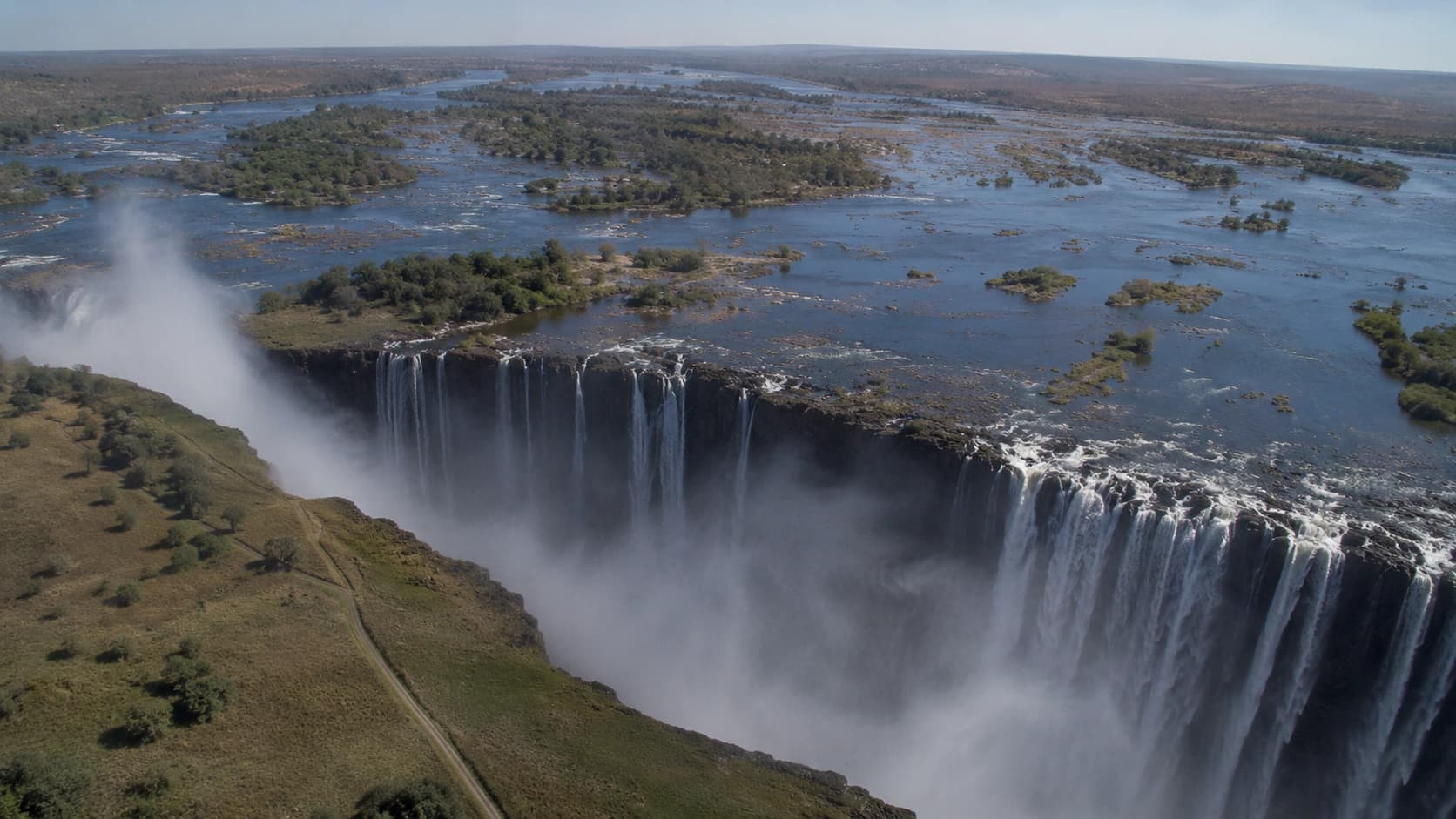
Almost everyone arrives in Zimbabwe for a single thing, and almost everyone leaves having seen only it. The falls are the largest sheet of falling water on earth, a mile and a half of the Zambezi dropping into a chasm in the basalt, the spray rising several hundred metres and visible, on the right morning, from a great distance away. The local name, Mosi-oa-Tunya, the smoke that thunders, is the more accurate of the two it carries. It is, by any measure, one of the genuine wonders of the planet, and the photograph everyone takes from the bridge is the photograph it deserves.
The trouble is the shape of the trip that has grown up around it. A night or two in the falls town, a helicopter loop, the bridge, the rafting if there is time, and a flight out, Zimbabwe reduced to a forty-eight-hour add-on bolted to the front or the back of a safari in some other country entirely. It is efficient. It delivers the wonder it promises. And it treats one of the most rewarding wildlife countries in Africa as a viewing platform with an airport attached.
The river that makes the falls runs for a long way before it reaches them and a long way after, and the country it runs through is the point. Upstream of the falls the Zambezi is broad, slow, and almost entirely undeveloped, long private stretches of frontage where the only traffic is elephant coming down to drink at dusk. To the west lies Hwange, one of the great elephant landscapes left on the continent. To the northeast, where the river has carved its valley below the escarpment, lies Mana Pools, a place you are permitted to walk, alone, among the largest animals in Africa, and one of the few places left where that is allowed. And running through all of it is the thing Zimbabwe does better than anywhere else on the continent: the guiding.
This is where this begins.
What the falls actually are.
It is worth being fair to the falls, because they are extraordinary, and because understanding them is the fastest way to understand what the rest of the country is not. The Zambezi, the fourth-longest river in Africa, runs nearly seventeen hundred metres wide here before it reaches the edge, then drops in a single curtain into a zigzag of gorges the river has cut backwards through the rock over hundreds of thousands of years. David Livingstone reached the spot in 1855 and gave it the name it carries in the wider world; it was inscribed by UNESCO in 1989. In the high-water months after the rains the spray is so dense it falls as rain on the far rim, and the falls themselves can disappear entirely inside their own weather. In the low-water months the curtain thins to its separate channels and the structure of the gorge becomes visible. Both are worth seeing. Neither takes more than a morning.
What the falls cannot show you is everything the river does on either side of them. And the decisive fact about the Zimbabwean side is access: the country holds long stretches of the upper river as private concession, vast tracts of frontage and bush held by a single lodge rather than shared by a dozen, so that the river above the falls can be had in a quiet that the falls town itself, a few kilometres downstream, never offers.
What the country actually is.
Hwange, in the country's northwest, is Zimbabwe's largest national park, nearly fifteen thousand square kilometres of Kalahari sand, teak woodland, and open pan, with no natural surface water for much of the year and a network of pumped waterholes that, in the dry season, draw one of the largest concentrations of elephant anywhere in Africa. The herds gather at the pans in the late dry months in numbers that are difficult to describe to anyone who has not stood at one, several hundred animals coming and going through an afternoon, families arriving in single file out of the heat haze, the whole social machinery of the species playing out a short distance from a hide. Hwange also holds lion, the painted wolf, the African wild dog, of which Zimbabwe carries one of the continent's most important populations, buffalo, giraffe, and the full southern-African cast, across a park large enough that even in season it is rarely crowded.
Mana Pools, in the far north where the Zambezi has spread into a string of old river channels and pools below the escarpment, is the other half of the argument. It is a UNESCO World Heritage Site, and it is one of the very few major parks in Africa where you are permitted to leave the vehicle and walk, and not merely walk, but approach, on foot and unhurried, the elephant, the buffalo, the big cats, in the open forest of winterthorn that defines the place. The elephants of Mana have become quietly famous for it: certain bulls that rise onto their hind legs to reach the high pods of the albida trees, watched from a respectful distance by people on foot. To canoe a section of the Zambezi here at dawn, the escarpment blue behind the water and hippo surfacing alongside, is one of the great quiet experiences of African travel, and it is the opposite in every respect of the helicopter over the falls.
“The largest sheet of falling water on earth. One of the last great elephant landscapes. A national park you are allowed to walk through, alone, on foot. The same river runs through all three.
What the guides carry.
The single thing that most distinguishes a Zimbabwean safari is the person standing next to you while it happens. The country's professional guiding qualification is among the most demanding in the world, a years-long apprenticeship and a final examination, including a walking and a firearms component, that fails the great majority of those who attempt it, and the men and women who hold the full licence are, by common agreement across the industry, the best-trained guides on the continent. The difference is not academic. It is the difference between being driven past wildlife and being walked, safely and knowledgeably, into its company; between a sighting narrated and a landscape read. In a country where so much of the experience happens on foot, the guide is not an amenity. The guide is the experience.
Behind the wildlife sits a deeper country. Great Zimbabwe, in the south, is the largest ancient stone structure in sub-Saharan Africa, the dressed-granite walls of a city built between the eleventh and fifteenth centuries by the ancestors of the Shona, the centre of a kingdom that traded gold and ivory to the Swahili coast and, through it, to Arabia, India, and China. It gave the modern country its name. For a great many years colonial authorities refused to credit that Africans had built it, an evasion the archaeology demolished long ago. To stand inside the Great Enclosure is to understand that the civilisations that shaped this part of the world were here, and substantial, long before the European arrival, and that the country is far older than the wildlife brochure ever suggests.
How it feels to be there.
The river sets the rhythm. On the upper Zambezi the day begins slowly, coffee on a deck above the water, the light coming up pink off the spray downstream, the first elephant of the morning already crossing a channel. The middle of the day belongs to the river itself: a slow boat, a fishing line if you want one, the bank sliding past. The falls, when you go to them, are a morning's excursion rather than the centre of the trip, and they are the better for it, seen properly, on foot, early, before the day-visitor coaches arrive, and then left behind for the quiet of the private river. Evenings are sundowners on a sandbank as the sky goes through its colours and the hippos begin to move.
Hwange and Mana run to the older safari rhythm, the early drive in the cold open vehicle, the walk with the guide reading the ground, the long middle of the day in the shade of camp, the second drive into the dusk. But Mana adds the thing almost nowhere else can: the walk that is not a sideshow to the game drive but the main event, hours on foot in genuinely wild country with one of the best guides in Africa, arriving at the animals slowly and on their terms. It recalibrates what a safari is. After Mana, the open roof of a Land Cruiser feels like watching through glass.
What we look for when we plan a stay here.
Zimbabwe rewards a trip that treats the falls as one chapter rather than the whole book, and that gives the river and the bush the days they deserve. The right week, though the best Zimbabwe trips run to ten days or more, and combine well with the Botswana delta next door, pairs a quiet stretch of the upper Zambezi with the elephant country of Hwange and, for those who want the experience at its purest, the walking country of Mana Pools. The connective tissue is the light-aircraft network and the calibre of the guiding, and getting both right is the difference between a trip that flows and one that does not.
What we look for here: private river frontage above the falls rather than a room in the busy town below them, so that the Zambezi can be had in quiet. Camps in Hwange placed for the dry-season elephant rather than for convenience. Access to the full walking experience in Mana Pools, with a fully licensed professional guide, which is the single thing the country does better than anywhere else. And the falls themselves arranged to be seen early and well, on foot, before the crowds, rather than queued for in the middle of the day.
Through our network we have access to arrangements across the Zambezi, Hwange, and Mana Pools that sit within this standard. Each is assembled personally, matched to the season and the temperament of the trip, and handled end-to-end, the falls arrival, the bush flights, the guiding, and any onward leg into Botswana or Zambia, by people on the ground who know the difference between the version of this country everyone sees and the one almost nobody does.
Who Zimbabwe is right for.
Not those who want the falls and nothing else. That trip is widely available, professionally delivered, and there is no real reason to improve on it if a photograph from the bridge is all the country is being asked to provide.
This is for travellers who have understood that the most extraordinary places are almost always larger than the single image that represents them, and who would rather meet a country than tick it. For families with children old enough to be changed by it: a waterhole in Hwange with three hundred elephant coming to drink, a first careful walk in the bush with a guide who has earned the right to lead it. For couples who have done the standard southern-African safari and want the version that happens on foot and on the water. For those drawn to the deep human past as much as the wildlife, who want to stand inside Great Zimbabwe and understand what was here before any of the rest of it. And for the traveller who has worked out that the best safari is rarely the busiest one.
The river has been cutting the gorge backwards through the rock for the better part of a million years, and is doing it still, a few metres a century. The elephants of Hwange have walked their paths to the pans for longer than the park has had a name. The walls of Great Zimbabwe were raised eight centuries ago by people whose descendants still farm the country around them. The falls themselves were a wonder of the world long before anyone arrived to photograph them and will be one long after. These timescales sit on top of each other along a single river, and the argument for going is the argument for following it past the one place everyone stops.
When to visit Zimbabwe
The country has a single wet season and a long dry one, and the dry season is the safari season. The rains fall roughly from November through March, greening the bush, dispersing the wildlife, and filling the pans, the green months are quiet, beautiful, and excellent for birds and newborn animals, though some bush camps close for the wettest weeks. The falls are at their most powerful from about March through June, swollen by the rains upstream, when the spray can obscure the falls themselves and the rafting season is closed; the low-water months from about August through January reveal the gorge's structure and open the rafting and the swimming. The prime game-viewing window is the dry season from about June through October, and within it the late dry months of September and October are the peak for Hwange's elephant and for Mana Pools, when the heat builds, the surface water shrinks, and the wildlife concentrates around what remains, the best camps in both booked many months ahead. The trade-off is straightforward: come in the dry for the wildlife and the falls at moderate flow, or in the green for the quiet, the price, and the river in full thunder.
How to get to Zimbabwe
Victoria Falls Airport (VFA) is the principal gateway for the river and the western parks, with direct regional connections from Johannesburg, Cape Town, Nairobi, Addis Ababa, and a growing number of other African hubs, and easy onward links from Europe and the Gulf; it is a short drive from both the falls and the private river upstream. Robert Gabriel Mugabe International (HRE) at Harare is the main national hub, useful for the eastern highlands and the south, and for Mana Pools via the charter network. Within the country the safari areas are reached by scheduled and private light aircraft, the strips at Hwange and the Mana Pools floodplain among them, in flights of an hour or so over genuinely wild country. The whole region also connects seamlessly by air to the Botswana delta and the Zambian side of the river, which is why so many serious trips combine them. We coordinate the international arrival, the bush flights, the cross-border legs, and the guiding ourselves.
Where to stay in Zimbabwe
A serious Zimbabwe itinerary works around three quite different settings, and the best trips use at least two. The upper Zambezi above the falls is the first, the place to base for the falls themselves and for the quiet of the private river, with the elephant coming down to the water and none of the bustle of the town downstream. Hwange is the second, the great dry-season elephant country, best in the late dry months, with camps placed for the pans. And Mana Pools is the third, the walking country, the UNESCO floodplain on the Zambezi, the one place to give over to the experience the country does better than anywhere else on the continent.
We do not publish a property list. The camps and lodges we arrange across the river and the parks are matched once the brief is clear, the private stretch of the upper Zambezi for the falls and the water, the Hwange camp for the elephant, the Mana camp for the walking, and the calibre of the guide is weighed as heavily as the calibre of the room. What we will say is that the right Zimbabwe trip is almost never the one that begins and ends at the falls. It is the one that follows the river past them.