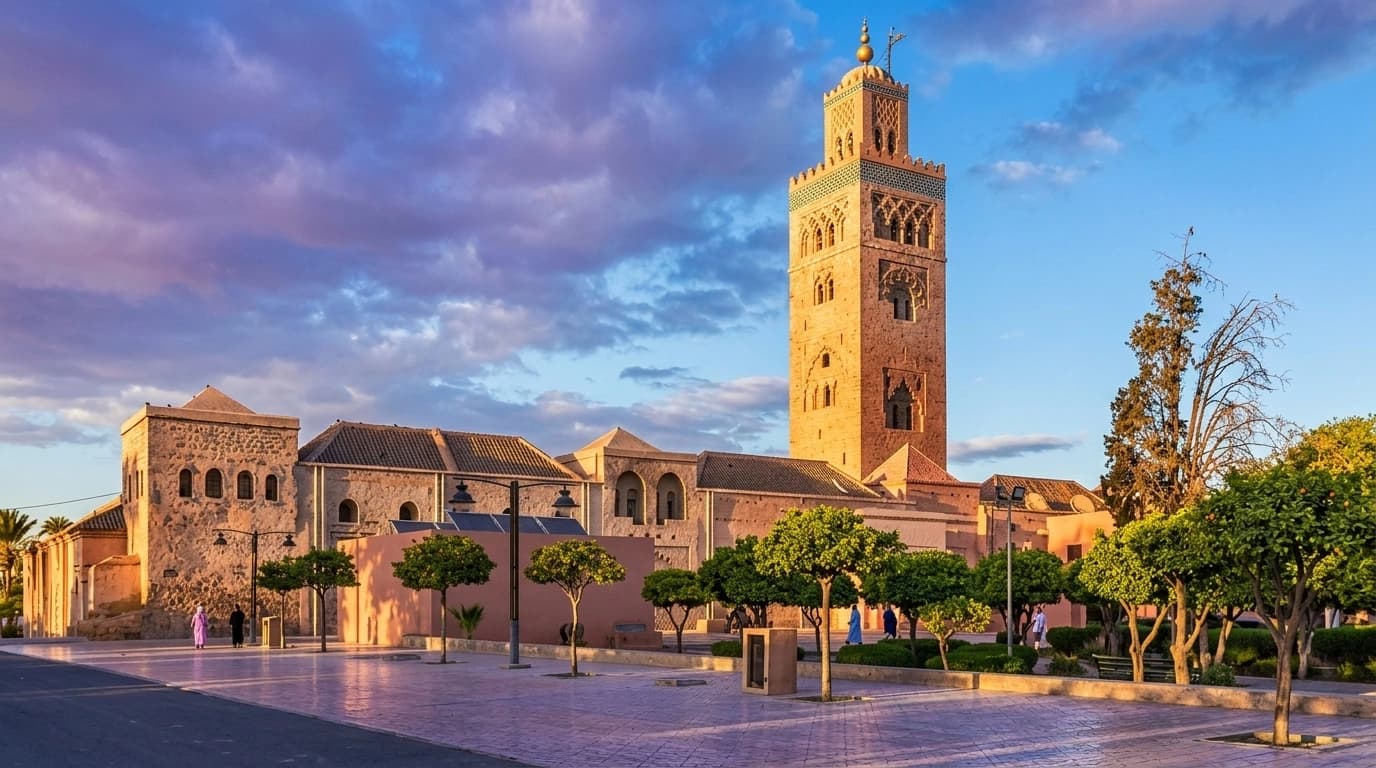
Marrakech arrives for most visitors as an intensity. The call to prayer at five in the morning, the orange sellers in the Jemaa el-Fna, the medina's warren of lanes and the riads hidden behind nail-studded doors, the silver and the leather and the spice pyramids and the long, slow, theatrical hospitality of the mint tea that arrives whether you asked for it or not. The city is genuinely wonderful, and it earns every guidebook superlative that has been written about it.
It is also, for most travellers, essentially the whole of Morocco.
Two hours south of the city, the road begins to climb. The olive groves thin, the red earth of the Haouz plain gives way to grey rock, and the first ridges of the Atlas rise ahead of the windscreen. By the time the road reaches the Tizi n'Tichka, the highest paved pass in North Africa, at a little over two thousand two hundred metres, the air is cool, the peaks ahead are still snow-covered into May, and the Morocco on the far side is not really the same country as the one you left behind. This is where the old caravan routes ran south to the desert. This is the Morocco that the country itself calls the deep south. And this is the landscape that almost no one who flies into Marrakech for a long weekend ever gets to see.
This is where this begins.
What the mountains actually are.
The Atlas is the longest mountain range in North Africa, running for nearly two and a half thousand kilometres from the Atlantic coast in Morocco across Algeria and Tunisia to the Mediterranean. In Morocco the High Atlas is the dominant spine, a range that reaches its highest point at Jebel Toubkal, four thousand one hundred and sixty-seven metres, which is the highest peak in the Arab world and almost five hundred metres higher than any mountain in the continental United States east of the Rockies. These are serious mountains. In winter they carry snow that closes the passes. In summer they stay cool enough that the valleys below become the preferred retreat of every Marrakech family that can afford one.
The culture of the mountains is older than the culture of the cities. The Berbers, who call themselves the Amazigh, the free people, have lived in North Africa for somewhere between ten and twelve thousand years, considerably longer than the Arab populations who arrived in the seventh century. In the High Atlas valleys, the Berber way of life has continued more or less uninterrupted since long before Morocco was a kingdom or an idea. The villages are made of the same red-brown pisé earth as the land they sit on, built into the hillsides in terraced tiers, each village organised around a communal granary that may be five hundred years old. The walnut and almond trees in the valleys were planted by the great-grandfathers of the men who still prune them. The irrigation channels, the seguia, follow contour lines that were surveyed by eye by people who died centuries ago, and still carry the snowmelt from the peaks to the fields exactly as they were designed to.
Tamazight is the language on the streets of the mountain villages, not Arabic. The tea is poured from higher. The hospitality is older than Islam itself, and follows codes that predate the modern country by several thousand years. In parts of the range, the handshake between two men who have just met still involves touching one's own heart afterwards, which is an Amazigh gesture, not an Arab one, and it tells you precisely where you are.
“Peaks above four thousand metres. Villages that have been here since before the Arab arrival. A country that begins where the tour coaches turn back.
What the valley gives.
On the southern side of the Atlas, the land changes again. The Drâa Valley runs for roughly two hundred kilometres from Ouarzazate to the desert town of M'hamid, following the course of the Drâa river, which in most seasons no longer reaches the Atlantic, but which has, for more than two thousand years, supported one of the most sustained oasis cultures in the world. The palm groves along the Drâa contain an estimated two million date palms. The qsour, the fortified mud-brick villages that rise from the palmeries every few kilometres, were built between the fifteenth and nineteenth centuries as waystations on the trans-Saharan caravan routes, and many of them are still inhabited by families whose ancestors were granted the land by Saadian sultans in the 1500s.
At Aït Benhaddou, closer to the mountains, the ksar has been a UNESCO World Heritage Site since 1987. It is the most cinematic piece of earthen architecture in North Africa, and if it looks familiar it is because it has been the backdrop of a long list of films, from Lawrence of Arabia onward. But the films are incidental. What matters is that the structure itself, a cluster of fortified adobe towers rising from the riverbank, represents a building tradition that has stood, essentially unchanged in its vocabulary, for somewhere between seven hundred and a thousand years. The buildings are made of earth. They are rebuilt each generation. They have outlasted the empires that briefly ruled them.
Further south, past Zagora, where a road sign, placed half in jest and half in earnest, still reads Timbuktu, 52 days by camel, the valley thins and the desert begins. The caravan routes that ran from here across the Sahara to the gold and salt markets of Mali were operational into the twentieth century. Some of the older men in the villages remember their fathers making the crossing. The last serious caravan from this region left in the 1950s, which in historical terms is the day before yesterday.
What the dunes do.
Morocco has two significant dune fields, erg is the Arabic word for a sand sea, on its desert edge. Erg Chebbi, near Merzouga in the east, is the more famous and consequently the more visited: a narrow strip of dunes accessible by a short drive from a paved road, well served by tourist camps of varying quality. Erg Chigaga, at the southern end of the Drâa Valley, is the one to go to. It is larger, wilder, and accessible only by several hours of off-road driving from the last town, which keeps the numbers low in a way that Merzouga no longer can. The dunes themselves rise to more than three hundred metres. They shift position with the wind. They are pink at dawn, white at noon, and at sunset turn through every shade of orange that exists before settling into the deep red that lasts until the moon rises.
A night in the desert, in a private, properly arranged camp rather than a group operation, is one of the short list of experiences that genuinely justifies the word extraordinary. The silence is the thing. In most parts of the modern world, true silence no longer exists; there is always the hum of a distant road, a plane overhead, the background noise of electricity itself. In the Sahara, at a camp set several kilometres into the dunes, there is nothing. A Berber fire crackles. Someone plays a gimbri, quietly, from the next tent. The stars above are the stars that the caravans navigated by for a thousand years, and on a moonless night there are enough of them to cast shadows.
How it feels to be there.
The days on the south side of the Atlas are structured by light and by temperature. The right season, October through April, is cool enough in the middle of the day to walk, warm enough at night for dinner outside, and clear enough most of the time that the horizons stay open. Mornings begin early, because the light at dawn in the palmeries and on the kasbahs is the light the place was made for. Afternoons, in the hotter months, are for the shade of the gardens, Moroccan architecture understands heat in a way that very few other building traditions do, and a well-designed kasbah holds ten degrees of coolness inside its thick earth walls all afternoon. Evenings are for the roof terraces, which are where the region's life has always happened at the end of the day. The stars here are, by any measurement, among the best in the inhabited world. Ouarzazate hosts one of the largest observatories in North Africa because of it.
Food, in the south, is different from the Marrakech version. Slower, simpler, more vegetable-heavy, more deeply spiced. Tagines that have been cooking since mid-morning on a low fire. Mechoui, whole lamb roasted in a covered earth pit, for the occasions that deserve it. Khobz, the daily bread, cooked in a communal oven where each family's dough carries a mark so it can be collected after baking. Oranges and pomegranates from the valley. Dates in thirty varieties from the palmeries, each with its own name and its own use. Mint tea poured from a height, three times, the first bitter as life, the second strong as love, the third sweet as death, according to the Moroccan proverb that everyone in the country knows.
What we look for when we plan a stay here.
The south of Morocco rewards a structure that combines rather than choosing. The right week moves: a base in a kasbah in the valley, genuinely old, genuinely restored, with land around it and real privacy, and from there, day trips further afield, and at some point, an overnight in the desert in a private camp. Not a coach itinerary, but a set of movements organised around a central place you come back to, and arranged at a pace that allows the region to reveal itself rather than performing for you.
What we look for here: a kasbah or an estate that belongs to the regional tradition, earth walls, courtyard plan, gardens organised around water, rooms that understand the climate, rather than a resort built in the vocabulary of somewhere else. Staff from the surrounding villages, because the knowledge of the valley is what makes the difference between a good stay and a transformative one. A kitchen that cooks from the region rather than from a hotel catalogue. A private Berber guide who knows the trails through the palmeries, the families in the villages, the trails into the dunes. And the right arrangement for the desert extension, a private camp in the correct location, properly staffed, with the correct 4x4 support rather than the mass operation.
Through our network we have access to properties in the Atlas valleys and the Drâa that sit within that standard, and to desert operations that are genuinely private rather than shared. Each is assembled personally, matched to the group and the season, and handled from the Marrakech arrival onward.
Who the south is right for.
Not those who came to Morocco for a long weekend in a riad. Marrakech on its own is a complete, substantial, rewarding trip, and there is no obligation to extend it. But there is a much deeper version of the country that begins on the south side of the mountains, and it requires several days to do properly, and it is not for travellers who need familiar infrastructure at every stop.
This is for travellers who have understood that the most rewarding landscapes in North Africa are the ones that require crossing something to reach. For families who want a week that takes children through several entirely different countries within the country, snow in the mountains, palms in the valleys, dunes in the desert, in a way that very few other destinations can offer within a week's drive. For couples who have done Marrakech and want the version of Morocco that begins where the medina ends. For those who have learned that the genuine heart of most countries is almost never where the airport is, and who are prepared to cross a two-thousand-metre pass to find out what that means.
The caravans stopped crossing the Sahara from here seventy years ago. The dunes have been in the same place for considerably longer. The people in the villages along the valley have been there the whole time, and will be. The only question is how slowly you are prepared to arrive.
When to visit southern Morocco
The window south of the Atlas is October through April. Within it, the months are not interchangeable. October and early November carry the last of the warmth, comfortable in the desert, still mild in the mountain valleys, and the date harvest in the Drâa runs through this period. December and January are the coldest months: snow closes the Tizi n'Tichka pass at intervals, the high mountain villages run to freezing at night, and the desert nights are genuinely cold under clear skies. February brings the almond blossom into the Atlas valleys, one of the more beautiful and underused moments of the year. March and April are the most reliably good months: comfortable temperatures across the south, wildflowers in the valleys, the dunes warming back up after winter. May through September are the hot months, daytime temperatures in the Drâa can exceed forty-five degrees by July, and most of the better kasbahs adjust their offering to the season. Ramadan, which moves through the calendar by roughly eleven days each year, changes the rhythm of the trip considerably; planning around or into it is a deliberate choice rather than an oversight.
How to get to southern Morocco
Marrakech Menara (RAK) is the principal gateway for the south, with direct flights from across Europe, the Middle East, and seasonal connections from North America. Casablanca Mohammed V (CMN) is the country's larger hub, useful for intercontinental routings, with a domestic onward flight or a three-hour train service south to Marrakech. From Marrakech, the road south is the standard route: about four hours by car to Aït Benhaddou and Ouarzazate over the Tizi n'Tichka pass; a further three to four hours into the Drâa Valley to Zagora; another two hours to M'hamid and the edge of the desert. Ouarzazate (OZZ) and Errachidia (ERH) are the small regional airports on the south side of the mountains, useful for shortening the journey when the timing matters. Private jets route most easily into Marrakech and Casablanca directly. We coordinate the driver, the routing across the mountains, the timing of the desert overnight, and the kind of 4x4 support the deeper south requires ourselves.
Where to stay in southern Morocco
The south divides into three broad zones, and a properly arranged trip usually combines them. The Atlas valleys closest to Marrakech, Ourika, Ouirgane, Asni, are the easiest access, with the mountains directly above and a return to the city possible within a couple of hours; this is where the city's own families have their summer places. The Aït Benhaddou and Ouarzazate region, on the southern side of the pass, holds the most famous kasbah landscapes and the easiest pivot between the mountains and the desert; some of the most considered renovations of the regional architecture sit in this corridor. The Drâa Valley itself, further south, is the deep south, palmeries, qsour, the slower rhythm of the oasis country, and the gateway to Erg Chigaga. The desert camps are a separate proposition, almost always combined with a kasbah stay rather than treated as the only base.
We do not publish a property list. The kasbahs and camps we arrange across the south are matched once the brief is clear, a single base for a week of stillness, a triangle through the regions for a deeper read of the country, or a desert overnight as a careful extension. What we will say is that the right kasbah in Morocco is one where the architecture is older than the renovation, and the people who run it are from the valley it sits in.