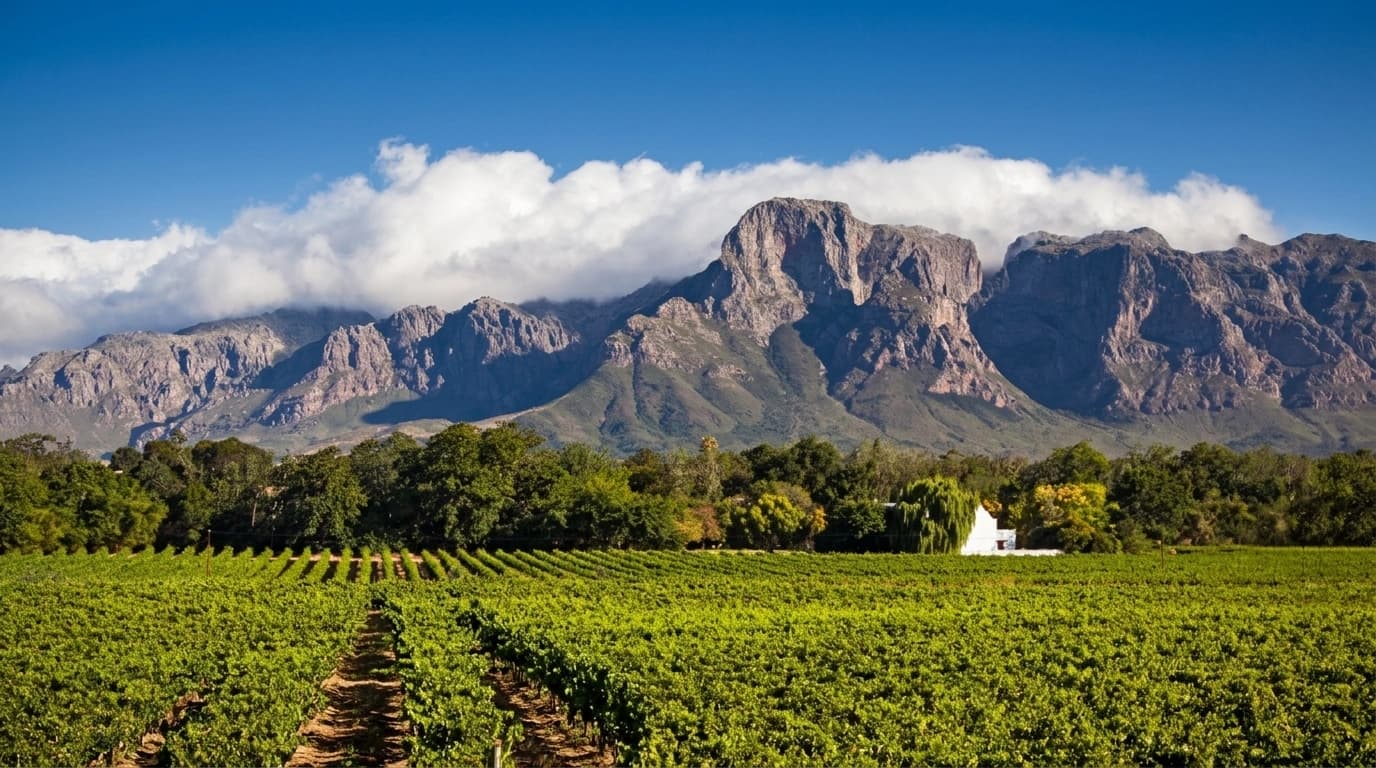
Table Mountain is one of the most photographed pieces of rock on the planet, and every photograph of it undersells what is actually there. The mountain reaches one thousand and eighty-six metres above the sea. The sea below it is the point where two great oceans, the cold Atlantic running up the west coast from Antarctica, and the warm Indian running down the east from the equator, collide in a turbulence of water and weather that shapes everything about the climate of the land behind it. The city at its foot sits on a peninsula that projects fifty kilometres into that collision, one of the most dramatic geographic situations any major city has ever been built into. And the country that begins where the peninsula ends is, by any honest measure, one of the most extraordinary pieces of land in the world.
Most visitors arrive in Cape Town for three or four days, take the cable car up the mountain, eat at two or three of the restaurants the concierge recommended, drive out to a wine estate in Stellenbosch for a long lunch, and fly on, usually to a safari further north. This is a good holiday, and it is not wrong. But it is a skim across the surface of a place that has considerably more to offer than a long weekend can reach.
The Cape worth understanding sits in the hour beyond the city, in the valleys that the mountains created, and along a coast that most people never get to because the cruise ships and the tour buses do not go there.
This is where this begins.
What the peninsula actually is.
The Cape Peninsula is a narrow strip of mountain running due south from Cape Town into the Southern Ocean, ending at Cape Point, the southernmost tip of the peninsula itself, which is not the same thing as the southernmost tip of Africa, although almost everyone gets this wrong. That distinction belongs to Cape Agulhas, a further hundred and seventy kilometres east, where the oceans actually meet. Cape Point has the better view. Agulhas has the geography.
The peninsula contains, within its fifty-kilometre length, one of the highest concentrations of plant diversity on earth. The Cape Floral Kingdom is the smallest of the world's six floral kingdoms, and in the small area the continent's southwestern corner occupies, it contains nearly nine thousand plant species, of which almost seventy per cent exist nowhere else. The fynbos that covers the mountainsides is older, in evolutionary terms, than anything in the Amazon, and the ecosystem is protected as a UNESCO World Heritage Site. It is the reason the Cape looks the way it does, the low, textured scrub that turns the slopes silver, green, and purple through the seasons, and that has no real equivalent anywhere else in the world.
The southern end of the peninsula holds most of the Cape's best-kept material. Kalk Bay is a working fishing village on the False Bay coast where the boats still come in every morning at eight and sell the catch on the harbour wall, and where the antiques dealers in the main street have been there long enough to remember each other's grandfathers. Simon's Town, a few kilometres further, holds a colony of African penguins at Boulders Beach who live there in large numbers and take very little interest in the humans who visit them. Cape Point itself, the national park that covers the bottom third of the peninsula, contains more species of indigenous plants than the entire United Kingdom, on a landmass one-seventy-seventh the size.
“Two oceans, a mountain that ends a continent, and a flora older than the Amazon. Most visitors see a tenth of it in four days.
What the valley grows.
An hour east of Cape Town the mountains open into a series of valleys whose climate was discovered, more or less by accident, by French Huguenot refugees who arrived in the 1680s. They had been promised land by the Dutch East India Company in return for their religious expertise; they were agricultural people, mostly from the Languedoc and the Loire, and they understood vines. What they found in the Franschhoek valley, the name translates as French corner, was a latitude, an altitude, and a Mediterranean climate that turned out to be essentially identical to the regions they had left behind. They planted. Within a generation the valley was producing wine, and within two centuries the Cape Winelands had become one of the world's most serious wine regions, improbably located on the southern tip of an African continent.
Stellenbosch is the academic centre of South African wine, with the university's viticulture department that has trained most of the country's winemakers for a century. Franschhoek is the culinary one, with a concentration of restaurants in a single valley that is genuinely unusual anywhere in the world, the kind of density that allows serious eating across several days without repeating a neighbourhood. Constantia, back on the peninsula itself and roughly twenty minutes from Cape Town, is the oldest of them: the original vineyards were planted in 1685 by the Dutch governor Simon van der Stel, and the sweet wines the estate produced in the eighteenth century, Vin de Constance, were exported to the courts of Europe and praised specifically in the letters of Napoleon, Jane Austen, and Frederick the Great. The estate still produces the wine today, using the original grape variety, pressed in the original cellar. Continuity of this length is rare in wine. In the New World it is essentially unique.
What the winelands also produce, and this is less famous than it should be, is the cooking. The cuisine of the Cape is its own thing, built over three and a half centuries from a collision of Dutch, Malay, French, and indigenous Khoi ingredients and techniques. Cape Malay curries, bobotie, koeksisters, snoek cured and smoked in the old way, the bredies that use everything from tomato to waterblommetjie, the indigenous water lily that grows in the winter rains. And on top of that heritage, a generation of restaurants, mostly in Franschhoek and the peninsula's southern suburbs, that are doing cooking as serious as anywhere on the continent, at prices that travellers from Europe or the United States find genuinely difficult to believe.
What the coast does.
The two coasts of the peninsula are almost entirely different places. The Atlantic side, facing west, is cold, the Benguela current brings water up from Antarctica, and even in February the sea at Camps Bay is unsuited to swimming for anyone not genuinely committed. What the cold water gives in return is clarity, kelp forests of astonishing scale, and a light quality in the late afternoon that has drawn photographers and filmmakers for a century. The sunsets on the Atlantic side are not modest.
The Indian side, facing east, is the opposite, False Bay is warm, protected from the Southern Ocean swells, and the beaches at Muizenberg and St James are the ones that actually work for swimming. The water at Fish Hoek in February reaches twenty degrees. And further east, past Cape Point on the N2 toward Hermanus, the coast produces one of the best-kept secrets in global wildlife travel: between June and November, southern right whales come into Walker Bay to calve in numbers that exceed any other coastline on earth. The town of Hermanus has a whale crier, an official employed by the municipality to blow a kelp horn whenever whales are sighted from the cliff path, who walks the seafront daily in season. This is not a tourist performance. It is a civic service that has been running since 1992 and has its own coded horn patterns for different parts of the coast.
How it feels to be there.
The Cape has a climate that belongs to the Mediterranean in every respect except its hemisphere. Summers, December to March, are dry, hot, and long, with the south-easterly wind they call the Cape Doctor sweeping the peninsula clean on most afternoons. The winelands heat into the thirties. The coast stays cool. Winters, June to August, are wet in a way that is deeply unfashionable and genuinely wonderful; the fynbos blooms, the mountains hold snow on the higher peaks, and the restaurants and the wine estates are at their best without the summer crowds. Spring and autumn, on either side, are perhaps the best of all: March, April, September, October.
The days themselves are structured around light and distance. Mornings are for the mountains or the peninsula, the early light on Table Mountain is the light the photographs were taken in, and the paths up Lion's Head or along the contour of the Twelve Apostles are at their best in the cool of the first hour. Middays belong to the vineyards or the coast. Evenings are long and warm, and dinner happens late in the summer because the sun does not set until after eight. The wine that comes with dinner will, in most places, have been grown within thirty kilometres of where you are sitting.
The country's recent history is not something the Cape hides, nor should it. The modern South Africa is thirty years old, and the weight of what preceded it is visible in the geography of the city, in the townships that stretch across the Cape Flats between the airport and the mountain, in the memorials and museums in the city centre, in the ongoing work of a country that is still becoming itself. A Cape trip that ignores this entirely is a Cape trip that has not really been there. The best way to handle it is directly, a morning in a township with a guide who actually lives there, a visit to the District Six Museum, a conversation with the people who work at the estates and the hotels about the country they are building. These things are not difficult to arrange, and they are part of what the Cape has to offer.
What we look for when we plan a stay here.
The Cape rewards a combination. The city has a great deal to offer, the restaurants, the galleries, the working harbour, the paths up the mountain that begin three minutes from the centre, but staying entirely in the city means missing the winelands, and the opposite means missing the coast. The right structure is usually a few days in the city or on the Atlantic seaboard, followed by a week or so on an estate in the winelands, with excursions out to the peninsula and further east along the coast. Everything within an hour's drive of everything else.
What we look for here: a property in the winelands that is a working estate rather than a hotel in a vineyard, there is a difference, and the first kind is considerably rarer, with land that gives real privacy, interiors that read as Cape Dutch or Cape contemporary rather than international, and a kitchen that takes the regional produce and the historical cuisine seriously. A base on the peninsula that places the mountain and one of the oceans within sight from the principal rooms. The right staffing, which in South Africa means people from the region who know the Cape in the way only locals can. And the kind of private arrangement, for the whale coast, for the peninsula's harder-to-reach parts, for the townships and the history, that allows the trip to move at the pace the group wants rather than the pace the tour coaches set.
Through our network we have access to properties in the Cape that sit within that standard, on estates in the winelands, in private houses on the peninsula, and along the coast toward Hermanus. Each is arranged personally, matched to the season and the group, and handled in full from the moment of arrival at the airport.
Who the Cape is right for.
Not those who want South Africa as a safari with a city appendage. The bush is a different trip, and a genuine one, and anyone combining it with the Cape should give the Cape the better part of a week on its own, not three days at the end of the safari before the flight home.
This is for travellers who have understood that some of the world's most substantial places sit at improbable coordinates. For families who want a trip that gives children several entirely different experiences within a fortnight, mountain, vineyard, ocean, penguin colony, the scale of a continent ending at their feet. For couples who have done the short version of Cape Town and want the longer one that fills in what the first trip missed. For those who have learned that the most serious wine regions in the world are worth spending real time in, and that a valley in the southern hemisphere can hold its own against anything northern France or Tuscany offer. For anyone who arrives in Cape Town and finds, as most people do, that three days is not remotely enough.
The oceans have been meeting off Cape Point for twenty million years. The fynbos has been growing on the mountain for considerably longer. The vines in the valleys have been there for three hundred and forty years. The country is thirty years old, and the version of itself that it is becoming is a version worth watching closely. All of it is here. The only question is how much of it you let the trip include.
When to visit the Cape
The seasons run on the southern hemisphere calendar, which is the first thing to internalise. November through March is the Cape summer, hot, dry, long. December and January are the busiest weeks of the year locally, with Cape Town families on the peninsula and international visitors arriving for the holidays; the better houses in the winelands and on the seaboard for those weeks are typically booked six to nine months ahead. The shoulders, March and April, September and October, are the most reliably good months: the heat has moderated, the south-easterly wind has settled, and the light is at its best. The wine harvest runs from late January through April and is at its most active in March, when the estates are working and the cellars are open. June through November is the southern right whale season along the Cape coast, with September and October as the densest weeks for sightings at Hermanus and Walker Bay.
How to get to the Cape
Cape Town International (CPT) is the principal gateway, with direct long-haul flights from London, Frankfurt, Amsterdam, Doha, Dubai, Addis Ababa, and São Paulo, and seasonal connections from North America. The alternative is via Johannesburg (JNB), with a two-hour onward flight, useful particularly for travellers continuing to a safari in the bush. From the airport, the city centre and the Atlantic seaboard are about twenty minutes by road; Franschhoek and Stellenbosch are an hour east into the winelands; Hermanus and Walker Bay are an hour and a half south-east along the coast. Private jets route most easily into Cape Town directly, with smaller aircraft also accommodated at the regional airfield at Stellenbosch. We coordinate the airport arrival, the transfers between the city, the winelands, and the coast, and the timing of the inland and whale-coast movements ourselves.
Where to stay in the Cape
The Cape divides into three settings, and the choice between them shapes the trip. The city and the Atlantic seaboard, Camps Bay, Bantry Bay, Clifton, place the group close to the restaurants, the harbour, and the paths up Lion's Head and the Twelve Apostles, with views directly onto the cold Atlantic. The winelands an hour east are the more contemplative base, on a working estate with land and vineyards rather than hotel grounds: Constantia closest to the city, Stellenbosch in the middle, Franschhoek the densest for restaurants. The coast east of the peninsula, toward Hermanus and the Walker Bay coastline, is the third option, quieter still, set up for the whale season and the inland excursions through the Overberg. The most considered Cape trip uses two of the three, sometimes all three, with the routing arranged so the movement between them is part of the experience rather than against it.
We do not publish a property list. The stays we arrange across the Cape are matched once the brief is clear, a vineyard estate or a seaboard house, sometimes both, occasionally with a third base on the coast for the whale weeks. What we will say is that the right house at the Cape is rarely the one with the most-photographed view. It is the one with the most quiet, on a piece of land that has been worked for the longest.