Most international visitors experience Egypt in a sequence that has been tightened and optimised across decades. A day or two in Cairo, the pyramids on a morning tour, the museum in an afternoon. A short flight south to Luxor for a day of temples. Then either a large cruise ship between Luxor and Aswan, or a flight onward to one of the Red Sea resorts where the programme is a different kind of programme entirely. Seven or eight days, ten thousand years of civilisation, a reasonable number of photographs. Home on the Friday night flight.
There is nothing wrong with this as an introduction. But it is an introduction, not the country itself.
The Egypt that the Egyptians themselves still consider their heartland, the Egypt that was, for more than three thousand years, the actual centre of the ancient world, sits a long way south of Cairo. Upper Egypt: the counterintuitive name given to the part of the country that is further up the river, even though it lies to the south, because the Nile flows from south to north and everything in this civilisation has always been measured by the river's own direction. The ancient capitals were here. The temples that define the visual inheritance of Egyptian civilisation were built here. The tombs that held the most important material culture of the ancient world were cut into the cliffs here. And the version of Egypt that most visitors pass through in forty-eight hours is the version where all of it actually happened.
This is where this begins.
What the river actually was.
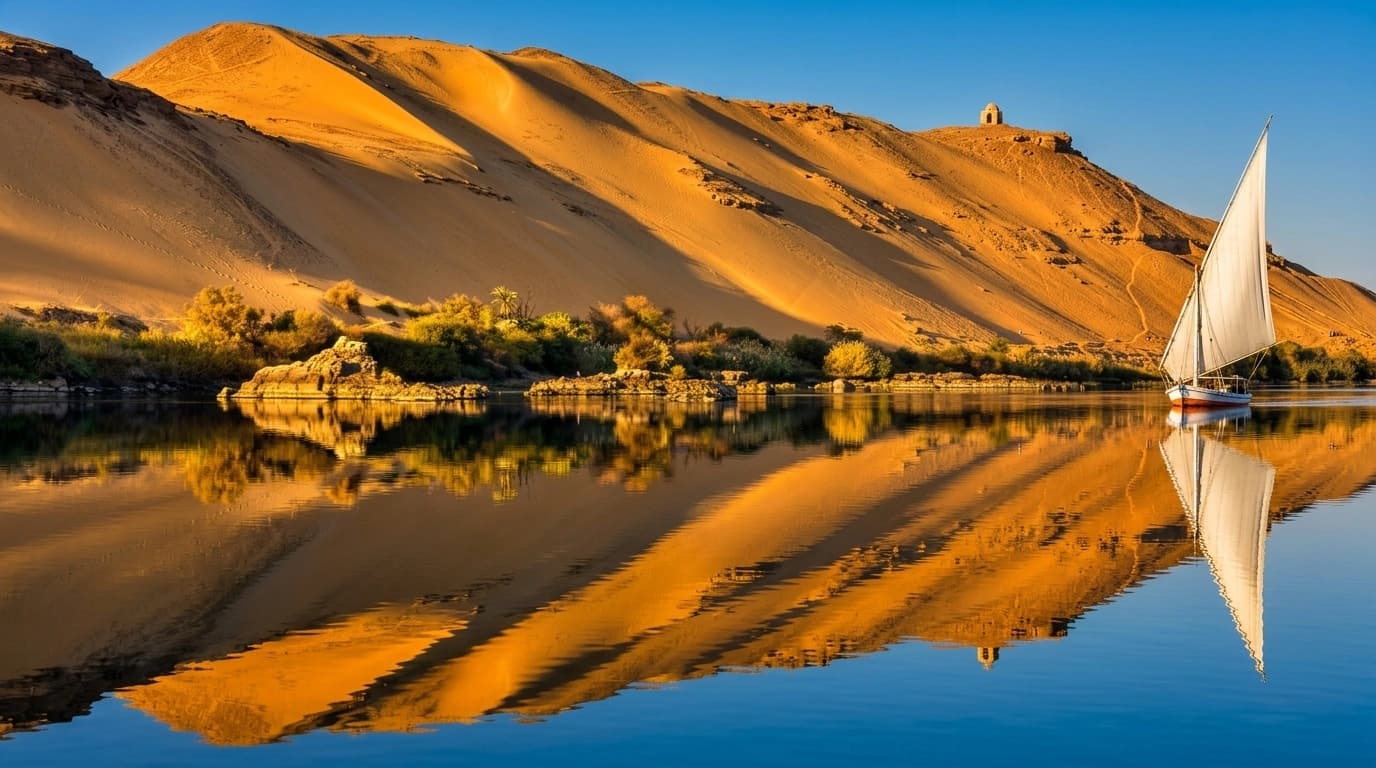
The Nile is six thousand six hundred and fifty kilometres long, the longest river on earth by most measurements, and the entire civilisation of ancient Egypt was arranged along a narrow green ribbon that sat on either side of it, rarely more than a few kilometres wide. Everything else was desert. This is the unusual geography of the country: not a plain with a river through it, but a river with a country pressed against its banks, and beyond the banks, on both sides, the Sahara and the Arabian Desert extending for thousands of kilometres in either direction. The view from the river has not essentially changed in five thousand years. Palm groves. Water buffalo. Children on donkeys. The occasional feluccas drifting past on the same winds that brought the stone for the temples upstream. And behind all of it, on the horizon, the beige edge of the desert that the civilisation was built against.
The stretch between Luxor and Aswan, roughly two hundred and twenty kilometres of river, is where the river's density of history becomes something close to continuous. The temple complex at Karnak, which was the most important religious site of ancient Egypt for almost two thousand years, sits at the northern end. The temple at Philae, moved stone by stone in the 1970s to save it from the waters of the new dam, sits at the southern. Between them: the Valley of the Kings on the west bank at Luxor, Dendera downstream, Esna, Edfu, Kom Ombo. Each of them built by different dynasties, to different gods, with different architectural intentions, and all of them still standing in the condition the dry climate has kept them in for two and a half millennia.
The temple at Abydos, a short drive north of Luxor and almost never included on the standard itinerary, holds the most complete list of pharaohs ever found, carved into a single wall by Seti I around 1290 BC. Seventy-six names in two rows, running from the first king of the first dynasty to Seti himself. It is the closest thing the civilisation left to an official record of itself, and it sits today in a temple that sees a fraction of the visitors of any other major site in Egypt, because the cruise boats do not stop there and the day tours from Luxor are inconvenient.
“A civilisation that lasted three thousand years, and a river that has not changed its view in five. Almost nobody sees them the way they were meant to be seen.
What the slow boat does.
The standard cruise between Luxor and Aswan runs on a large ship with two hundred or more passengers, and the rhythm it operates on is a rhythm of queues. A coach at each port, a guided tour in a group of forty, an hour for photographs, back to the boat for the buffet. The scenery that passes outside the window, the scenery that is, in several important senses, the actual point of coming to Egypt, becomes background to a programme that has been designed around throughput.
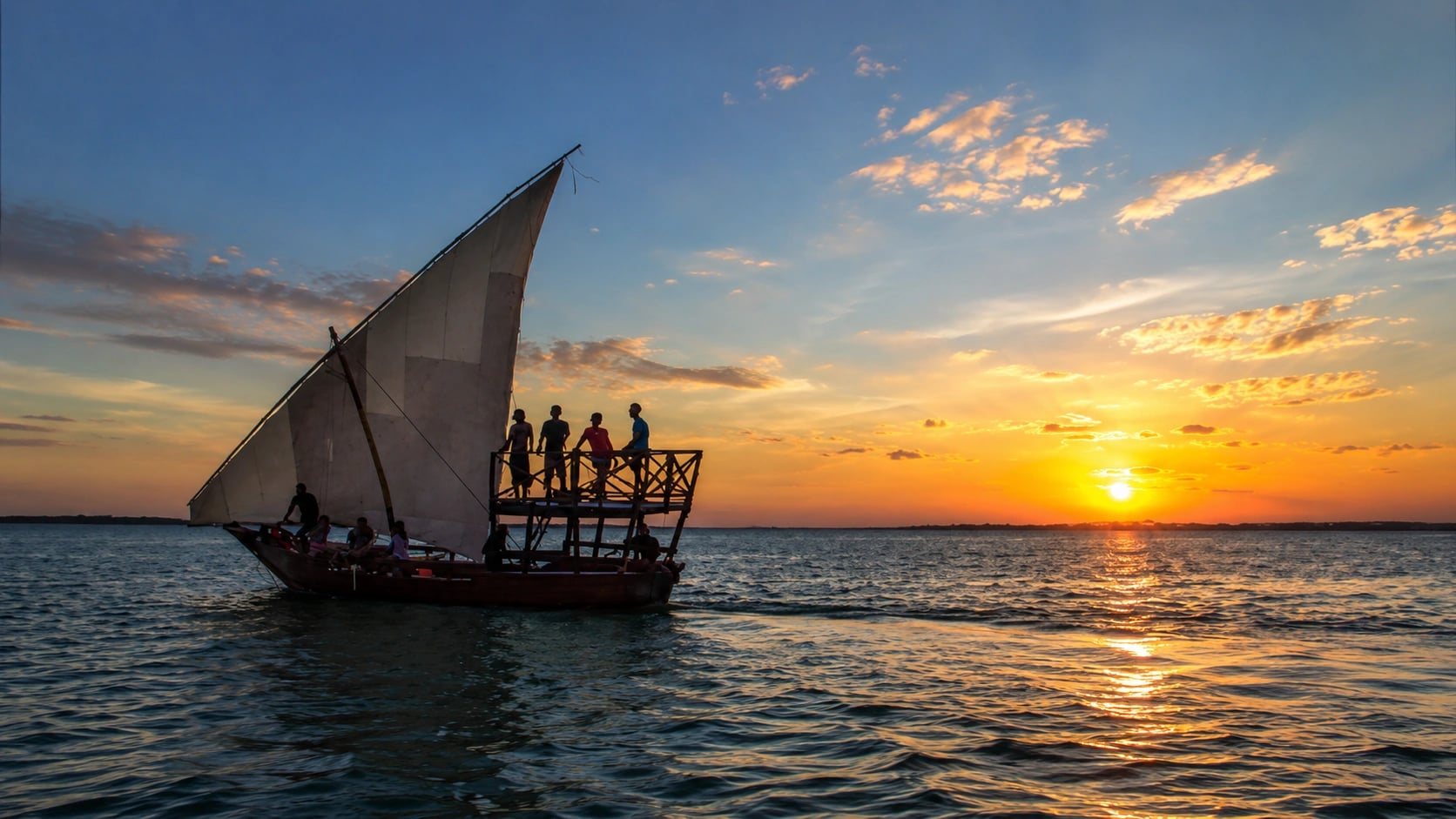
There is an older way of seeing this river, and it is making a quiet and careful return. The dahabiya is the traditional Nile sailing vessel, a shallow-drafted wooden boat with two tall lateen sails, a covered deck, and a small number of cabins. They were the preferred transport of the nineteenth-century European travellers who opened Egypt to the outside world, Flaubert and Florence Nightingale among them, and they fell out of use in the twentieth century as the cruise ships took over. A small number of them have been rebuilt in recent decades, to the original specifications, and they operate now as private charters. Eight or ten guests. A crew that belongs to the villages along the river. A route that moves at the speed of the wind and stops at the places the cruise ships cannot, the small temples, the sandbanks for lunch, the villages where the children still swim out to greet the boats as they have for centuries.
What the dahabiya gives you is a version of the Upper Nile that is essentially unavailable any other way. The evenings are the thing, the boat moored to the bank, the sun dropping behind the palms on the west side, dinner on the deck as the river turns dark and the stars appear in numbers that only exist above empty country. The pace is the correct one. The scale is the correct one. And the temples, when you reach them, arrive without the filter of a mass arrival, a few people on a small boat, walking into a hypostyle hall in the early morning before the tour coaches have left Luxor.
What the desert holds.
West of the Nile, past the green strip that the river's irrigation can reach, the Western Desert begins, and it extends, without significant interruption, to the Atlantic Ocean. Roughly two thousand kilometres of the Sahara, sparsely populated, essentially unvisited by tourism, and containing landscapes that are among the strangest and most beautiful on earth. The White Desert, a plateau of wind-eroded chalk pillars that rise from the sand in shapes no sculptor would have dared invent. The Black Desert, further north, where iron-rich volcanic rock has broken down over millennia to leave a landscape the colour of charcoal. The Great Sand Sea, seventy-two thousand square kilometres of dune country that has not been comprehensively mapped and in which the old caravan routes to the oases are still visible in places from the air.
The oases themselves are worth the journey. Siwa, in the far northwest near the Libyan border, has been inhabited continuously for more than two thousand years and retains its own language, its own customs, and the ruined temple of the oracle that Alexander the Great travelled to in 331 BC to ask the gods whether his campaign would succeed. Bahariya, Farafra, Dakhla, Kharga, a chain of oases that supported the Roman trade routes, and that now offer the kind of silence that even the Upper Nile cannot produce.
A short detour from a Nile journey, by four-wheel drive into the White Desert for an overnight under the stars, adds a dimension to the Egypt experience that the temples alone do not. The civilisation was built along a river. But it was also defined by what the river was not, by the enormous, silent country on either side of it, which the Egyptians themselves called the Red Land, the land of the dead, and which they sited their tombs and their mortuary temples in for three thousand years.
How it feels to be there.
Days in Upper Egypt arrange themselves around the temperature and the light. The winter months, October through April, are the right time to come, when the air is warm in the middle of the day and cool at night, and the sun's angle is low enough that the carvings on the temple walls throw shadows deep enough to read. Mornings begin early: the temples are at their best in the first hour after opening, when the cruise groups have not yet arrived and the light is still horizontal. Afternoons are for the boat, for the river, for the slow movement of the country past the deck. Evenings are long and cool, and dinner happens outside, because the air is the right temperature for it and the stars above the Nile are, at this latitude and this distance from any city, some of the most unobstructed in the northern hemisphere.
The food of Upper Egypt is different from the Cairo version. Simpler, older, closer to the fellahin tradition, the cooking of the river villages that has not essentially changed in centuries. Flatbread from clay ovens. Fuul, the fava bean stew that is the country's oldest dish. Fresh river fish grilled over charcoal. Fruit from the orchards along the banks, dates in season, guavas, mangoes, pomegranates. Hibiscus tea, hot or cold. Coffee with cardamom, strong and unhurried.
What we look for when we plan a stay here.
Egypt rewards a different kind of arrangement than most destinations do. The historical density of the country is such that almost any week spent here will involve at least some movement, and the right structure is usually a combination: a few days in Luxor on the west bank for the Theban necropolis and the Valley of the Kings, several days on a private dahabiya down the river to Aswan, and, for groups willing, a short expedition into the Western Desert for the oases and the White Desert stars. The logistics of this kind of programme are not straightforward, and the difference between a trip that works and one that does not is almost entirely in the hands of the people on the ground.
What we look for here: a base on the west bank at Luxor that is set away from the main tourist strip, with real privacy and real quiet, because the west bank at dawn is one of the great experiences of the country and it cannot be had from a hotel that empties its guests onto coaches. A dahabiya chartered exclusively for the group rather than shared with other passengers, because the point of this kind of boat is that the rhythm is yours. An Egyptologist who travels with the group, not the guide who meets each tour at the temple gate, but someone the group eats dinner with, who reads the walls at the pace the group wants to read them. And the right support for the desert extension, which requires local knowledge that is genuinely not available to ordinary tour operators.
Through our network we have access to arrangements in Upper Egypt that sit within that standard. Each is assembled personally, matched to the group's interests and pace, and handled end-to-end from Cairo arrival to final departure.
Who Upper Egypt is right for.
Not those who want Egypt as a checklist of monuments and a Red Sea beach at the end. That version is widely available, reasonably priced, and delivers what it promises. This is not that version.
This is for travellers who have understood that the most extraordinary places in the world reward patience and a willingness to do them slowly. For families who want a trip that gives children something entirely outside their frame of reference, a temple at dawn, a boat moored on a sandbank, a night under Saharan stars, and who have reached the stage where those things will matter more than a water park. For couples who have done the short version of Egypt and want the long version. For those who have learned that the civilisations that shaped the modern world deserve more than forty-eight hours of coach travel, and who have the time and the interest to take them at the pace they were meant to be taken.
The river has been flowing north for forty million years. The temples have been standing for three and a half thousand. The cruise ships pass through in four days. The rest of us, if we know how to come, can stay as long as the country deserves.
When to visit Upper Egypt
The window is October through April. Within it, the months are not interchangeable. October and November carry the last of the warmth, comfortable on the river, hot in the temples at midday, cool at night. December and January are the coolest months and the busiest weeks of the season, particularly the Christmas and New Year fortnight, when the better dahabiyas are typically booked nine to twelve months ahead. February and March are perhaps the most reliably good months: cool enough in the desert for the oasis extensions, warm enough on the river, the light at its most useful. The Abu Simbel sun alignment, when the rising sun illuminates the inner sanctum of the great temple of Ramesses II, an event built into the original architecture and preserved after the temple was moved to higher ground in the 1960s, happens on the 22nd of February and the 22nd of October each year, and is one of the more genuinely extraordinary moments on the Egyptian calendar; the surrounding days at Aswan are heavily booked well in advance. April is the last comfortable month before the heat returns. May through September is essentially out of season for the interior, daytime temperatures in Upper Egypt regularly exceed forty degrees, and most of the better dahabiyas pause their summer operations. Ramadan, which moves through the calendar by roughly eleven days each year, changes the rhythm of the trip considerably and should be planned around or into deliberately.
How to get to Upper Egypt
Cairo International (CAI) is the principal gateway for the country, with direct flights from across Europe, the Middle East, and a growing list of intercontinental hubs. From Cairo, the domestic flight south to Luxor (LXR) takes about an hour and runs several times daily; Aswan (ASW), at the southern end of the cruising stretch, is a further forty minutes by air. Some European routes, particularly from London and a handful of charter operations, fly directly into Luxor, which can shorten a Nile-only itinerary considerably. Hurghada (HRG) on the Red Sea is occasionally used for travellers combining Upper Egypt with the coast. The overnight sleeper train from Cairo to Luxor remains a workable option for those who want the journey itself to count, with first-class cabins running on most nights of the week. Private jets route into Cairo and Luxor most easily. We coordinate the Cairo arrival, the domestic onward, the transfer to the dahabiya at Luxor, and the routing back from Aswan ourselves.
Where to stay in Upper Egypt
A considered Upper Egypt trip uses three settings, sometimes more. A base on the west bank at Luxor, set well back from the cruise dock area on the east bank, ideally in a property that looks onto the Theban hills and gives access to the necropolis at dawn before the day's groups arrive. A private dahabiya for the river leg between Luxor and Aswan, taking five or six days at the speed of the wind rather than the four-day cruise-ship rush. And, for those willing, a desert extension west into the Western Desert, a flight or long drive to one of the oases, a four-wheel-drive expedition into the White Desert, an overnight in a private camp under the stars. Each piece serves a different part of the country. The combination describes an Egypt that the standard itinerary cannot reach.
We do not publish a property list. The arrangements we put together in Upper Egypt are matched once the brief is clear, the right west-bank base, the right dahabiya for the season and the group size, the right desert team for the extension. What we will say is that the right Egypt trip is the one where the temples arrive without a crowd around them, and the river is the version of itself it has been for five thousand years.