Kenya arrives, for most of the world, as the original safari. The word itself is Swahili, and the images it summons were very largely made here: the lion under the flat-topped acacia, the red-cloaked figure on the horizon, the wildebeest pouring across a river in their hundreds of thousands, the sundowner poured on a plain that runs unbroken to the edge of the sky. It is the country of Out of Africa and the white-hunter romance that came before it, and at the centre of all of it sits the Maasai Mara, the reserve in the country's southwest that is, for a great many people, simply what the word safari means. The Mara earns it. In the months of the migration it holds one of the greatest concentrations of large animals left on the planet, and a week there at the right time is a week few people forget.
But the Mara is also the part of Kenya that most resembles the country next door. The herds that cross its rivers are the same herds that spend the rest of the year in the Serengeti; the ecosystem does not recognise the border, and neither, in any real sense, does the experience. The Kenya that is genuinely its own, that exists nowhere else, and that has done something with its wildlife no other country has quite managed, lies in the opposite direction. It lies to the north.
North of the capital, beyond the green shoulder of Mount Kenya, the land dries out and opens into a vast arid frontier: the Laikipia plateau, and beyond it the true desert country of Samburu, running on towards the deserts of the far north and the inland sea of Lake Turkana. This is the second-richest wildlife landscape in Kenya after the Mara, and almost none of it is a national park. It is held, instead, on private ranches and, increasingly, on land that the communities who live there own and run themselves. It is the home of the rarest large animals in Africa: the last two northern white rhinos on earth, guarded around the clock; the largest surviving population of the endangered Grevy's zebra; and a suite of arid-country species, the reticulated giraffe, the gerenuk, the beisa oryx, the Somali ostrich, that the famous southern parks simply do not have. And it is the place where the safari, over the last forty years, has been quietly turned into something other than what it was.
This is where this begins.
What the famous Kenya is.
It is worth being fair to the Mara, because it is genuinely extraordinary, and because understanding it is the fastest way to understand what the north is not. The Maasai Mara is the northern tip of the Serengeti ecosystem, the same grassland, the same animals, divided only by a colonial border drawn across open plains. From roughly July to October the wildebeest and zebra of the migration push up across the Mara River, and the crossings, the massed herds, the waiting crocodiles, the dust and the panic, are the single most photographed event in African wildlife. The Mara holds extraordinary numbers of lion, cheetah on the open plains, and the whole machinery of the classic game drive operating at a very high level. For a first safari, in the right season, it is hard to better.
Its drawback is its fame. In the high season the better-known parts of the reserve can carry more vehicles than animals at a good sighting, and the experience, superb as the wildlife is, becomes a shared and managed one. It is also, as a landscape and an ecosystem, essentially continuous with the Tanzanian Serengeti immediately south of it. To see the Mara is to see something magnificent. It is not, on its own, to see the part of Kenya that Kenya alone can show you.
What the north actually is.
The Laikipia plateau begins where the farmland north of Mount Kenya gives out. It is high, dry, open country, a mosaic of savannah, acacia bush, and rocky hill at around seventeen hundred metres, with the snow and ice of Mount Kenya filling the southern horizon and the heat of the true desert building to the north. By area it holds the second-greatest concentration of large mammals in the country, and the highest numbers of several species, the most black rhino in East Africa, much of Kenya's remaining wild dog, large and growing elephant herds, but the decisive fact about it is administrative rather than ecological: almost none of it is national park. Laikipia is a landscape of private holdings, old cattle ranches, conservancies, and community land, and that single difference shapes everything about how it is experienced.
Beyond Laikipia, the land falls into Samburu, the country of the Samburu people, pastoralists closely related to the Maasai, who have kept their cattle and their ceremonies across this semi-desert for centuries. Here the Ewaso Ng'iro river runs green through red rock and doum palm, and the wildlife shifts to the specialists of the arid north: the Grevy's zebra, the largest and most endangered of the zebras, narrow-striped and round-eared, of which perhaps two and a half thousand survive in the world and the great majority in this corner of Kenya; the reticulated giraffe, with its sharp-edged map of a coat; the gerenuk, the long-necked antelope that stands on its hind legs to browse; the beisa oryx; the Somali ostrich. Guides here speak of the special five, the northern counterparts to the southern Big Five, and to find them is to understand that you have travelled not just to a different park but to a different Africa.
What the communities did.
The most important thing to happen to Kenyan wildlife in two generations did not happen in a national park. Kenya banned big-game hunting outright in 1977, earlier and more completely than almost anywhere else on the continent, and in the decades that followed a question hung over the land the hunting economy had paid for: if the wildlife could no longer be shot, what was it now worth to the people who lived alongside it? The answer that emerged in the north has been studied around the world. On Laikipia, large ranches, Lewa foremost among them, a family cattle operation turned wildlife conservancy in the 1990s, proved that protecting wildlife could pay for itself, and pay the surrounding communities, through tourism and the careful management of the land. Then the model went further than anyone expected: out of Lewa grew the Northern Rangelands Trust, an umbrella under which more than thirty community conservancies have now been established across the north, land the pastoralist communities own and govern themselves, where the revenue from a handful of small lodges and the management of the rangeland flows back to the people who live there.
The results are concrete. Elephant poaching has fallen; the Grevy's zebra and the reticulated giraffe are stable or recovering on conservancy land; communities that a generation ago saw wildlife as competition for grazing now employ their own rangers to protect it. Samburu communities have established the first community-run rhino sanctuary in East Africa, and a community-owned elephant orphanage where the keepers are local people raising orphaned calves to return to the wild. It is not without its critics or its difficulties, and it would be wrong to present it as simple. But it is, at its core, the rarest thing in modern conservation: a place where protecting wild animals has become something the local people choose, own, and benefit from, rather than something done to them. And it produces, for the traveller, a quite different kind of safari, because on private and community land, away from the national-park rulebook, you may do what the parks forbid: walk the country on foot with a Samburu guide, drive after dark to find the animals of the night, cross the plains on a camel or on horseback, and sleep out under a sky with no other light in it.
“The last two members of a species, guarded around the clock. The largest population of the rarest zebra on earth. A safari the people who live there own outright. Almost none of it is in a national park.
What is guarded here.
On a conservancy in central Laikipia live the last two northern white rhinos in existence. Their names are Najin and Fatu, a mother and her daughter, both female, and since the death of the last male in 2018 they have been, between them, the entire remaining population of their kind. They are watched over every hour of every day by armed rangers, and the effort to save the subspecies has moved into the laboratory: embryos created from the daughter's eggs, and the hope of one day carrying a northern white calf in a southern white surrogate. To stand a short distance from them, in the ordinary morning light, and to grasp that you are looking at all that is left of an animal that once ranged across central Africa, is one of the strangest and most affecting experiences travel can now offer. It is not a sad place, exactly. It is a place where the stakes of everything else are made suddenly, physically clear.
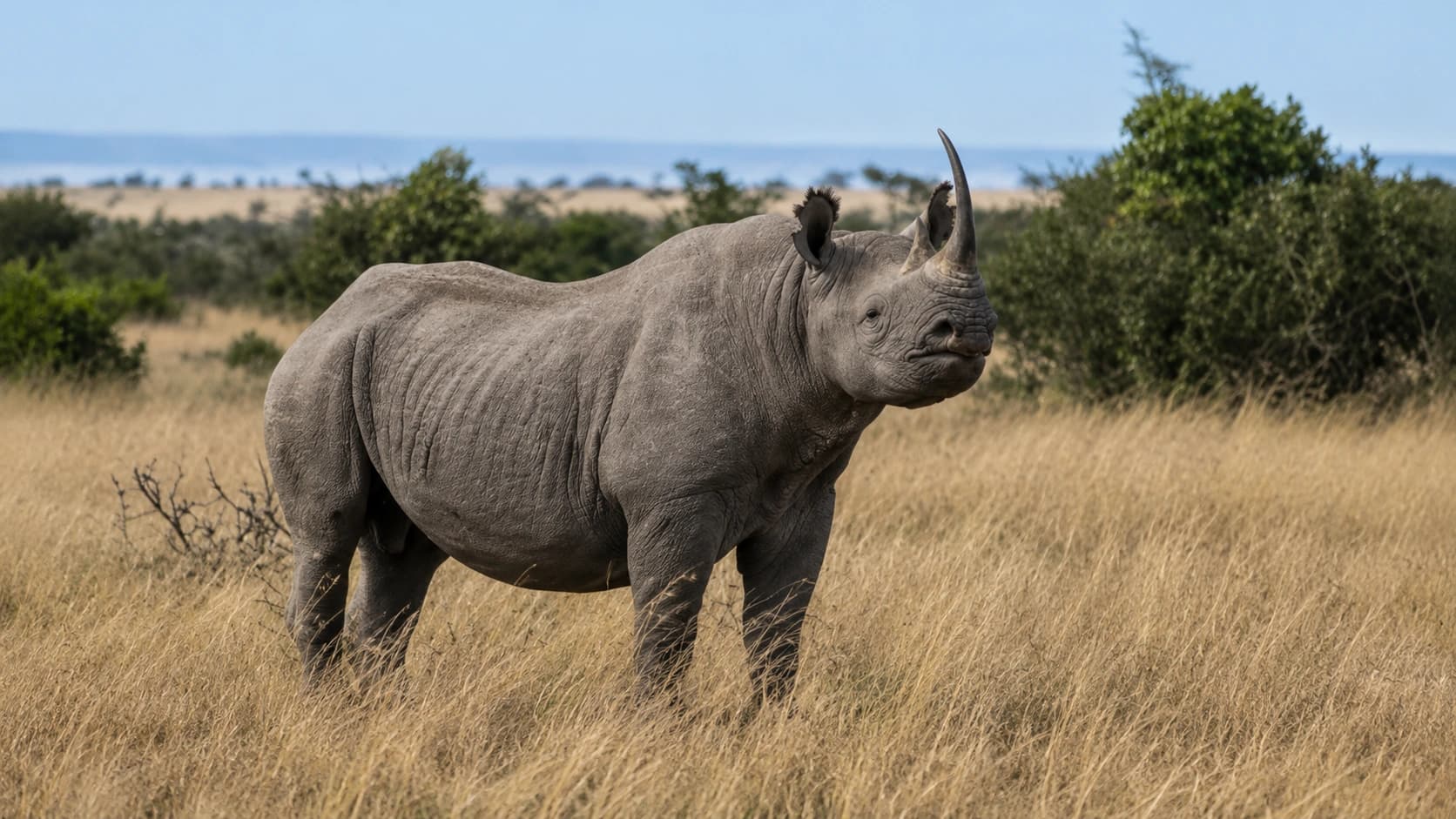
Around them, the better news. The same conservancy is the largest black rhino sanctuary in East Africa, and the wider Laikipia and Samburu landscape now holds a recovering rhino population that is among the conservation success stories of the continent, black rhino and southern white brought back from the edge by exactly the model the north has built, often with the snowfields of Mount Kenya on the horizon behind them. The rhino is the animal these conservancies were largely built to save, and to see them here, on open ground rather than behind a fence, is the clearest possible argument for the whole enterprise.
What the mountain and the valley hold.
Two great features frame the northern country. To the south stands Mount Kenya, the second-highest mountain in Africa, an extinct volcano rising to a little under five thousand two hundred metres, with the last equatorial glaciers in the world still clinging, for now, to its summit; they are retreating fast, and a child born today may live to see the mountain lose its ice entirely. It is a sacred mountain, in Kikuyu tradition the dwelling place of Ngai, and a UNESCO World Heritage Site, and its presence on the southern horizon, snow on the equator above the dust of the plains, is the defining view of Laikipia. To the west runs the Great Rift Valley, the continental wound along which Africa is slowly tearing itself in two, with its chain of lakes strung along the floor: Naivasha, fresh and fringed with papyrus and hippo; Nakuru and Bogoria, soda lakes that turn pink with flamingo; the long escarpments rising on either side. A northern journey that begins in the capital can take in the Rift lakes, the mountain, the rhino country of Laikipia, and the desert of Samburu in a single unhurried arc, each a wholly different landscape from the last.
How it feels to be there.
The north moves to the rhythm of the heat and the light, and rewards those who let it set the pace. Mornings begin early, in the cool before the sun has cleared the hills, with a drive or a walk out across country that, on a conservancy, you very often have entirely to yourself; the privilege of the north is not that the wildlife is denser than the Mara's, because it is not, but that you meet it alone. A Samburu guide reads the ground, the broken twig, the alarm call, in a tradition older than any guiding qualification. The middle of the day is for shade and the river and the slow heat; the late afternoon for the second drive, or a string of camels walking out across the plain, or a high place to watch the light go. After dark, which the parks do not permit but the conservancies do, a quiet drive turns up the animals the daytime never shows: the aardvark, the porcupine, the leopard moving through the dark on business of its own. And the evenings end under a sky that, this far from any town, holds the whole arch of the southern stars.
The Samburu themselves are present throughout, not as performance but as the people whose country this is, and increasingly whose conservancies these are, and the best of the northern experiences are the ones arranged with that relationship at the centre: the visit to a settlement on the community's own terms, the day spent learning the land from people who have never not known it. There is a Nairobi arrival, too, that has become a small institution in its own right, a house on the edge of the city where a herd of endangered Rothschild's giraffe puts its heads through the breakfast-room windows, and it makes, for many, the gentlest possible doorway into the country before the flight north.
What we look for when we plan a stay here.
Northern Kenya rewards a trip built on the conservancies rather than the parks, because the conservancies are where the rare wildlife, the community story, and the freedom to experience them on foot and after dark all come together, and because they are where the country can still be had alone. The difference between an ordinary Kenyan safari and an extraordinary one is, here more than anywhere, a matter of access: to the right conservancy, to the rhino sanctuaries, to the Samburu guides and the communities whose land it is, and to the small, well-run camps the wider circuit never reaches.
What we look for here: lodges and camps on the private and community conservancies of Laikipia and Samburu, not the crowded national-park circuit, where staying is itself a contribution to the model that protects the land. Genuine community-led and Samburu guiding, and access to the conservation work itself: the rhinos, the elephant orphanage, the rangers who run it all. The activities the conservancies alone allow, walking, night drives, camel and horseback safaris, fly-camping, which turn a safari from something watched through glass into something walked into. And the arc handled as a whole: the Nairobi arrival, a Rift Valley lake, the rhino country under Mount Kenya, the desert of Samburu, with the bush flights between them timed and coordinated rather than left to chance.
Through our network we have access to camps and conservancies across Laikipia, Samburu, and the wider north that sit within this standard. Each is arranged personally, matched to the group and the season, and handled from the Nairobi arrival to the last airstrip onward.
Who the northern frontier is right for.
Not those for whom the safari means the single great river-crossing of the migration. That is a real and magnificent thing, it happens a short flight to the southwest from July, and it is exactly what the Mara is for.
This is for travellers who have understood that the most interesting wildlife places are rarely the most famous ones, and who would rather meet the country alone than share a sighting with twenty vehicles. For families with children old enough to be changed by it, the last two of a species, a rhino on open ground, a night drive, a morning walking the bush with a Samburu tracker. For couples who have done a first safari and want the one the first safari does not reach. For those drawn to conservation not as a backdrop but as the actual subject, who want to see, and to support, the rarest experiment in the field, the one that put the wildlife into the hands of the people who live with it. And for anyone who would rather their travelling did some good in a place that has worked out how to let it.
Mount Kenya has carried ice on the equator for longer than there have been people to look at it, and within a generation it may carry none. The Grevy's zebra has run this country since long before it was a country, and there are now fewer of them than there are people in a small town. The northern white rhino once crossed Africa in its millions, and is down, this morning, to two. Kenya banned the hunting of all of it in 1977, and built, in the decades since, a way for the people of the north to keep it. These timescales do not sit easily on top of each other, the very old and the very nearly gone, the deep past and the decision being made right now, and that is exactly the point of going. This is not a landscape to see while it is unchanged. It is a landscape to see while the choice about what becomes of it is still, just, open.
When to visit northern Kenya
The north is arid, and its calendar is set by rain rather than heat. The two dry seasons are the prime windows: the long dry from late June through October, the coolest and most reliable stretch, when the wildlife concentrates along the Ewaso Ng'iro and the other permanent water and the viewing is at its best, and, conveniently, the same months as the Mara migration to the southwest, for those combining the two; and the short dry from late December through March, hot and clear, with excellent viewing and the newborn animals of the year. The long rains, roughly April and May, green the country and quieten it, with some camps closing for the wettest weeks; the short rains around November are lighter, often little more than an afternoon storm, and bring a brief, beautiful flush to the desert. The heat of the north is real and builds through the dry months, but the altitude of Laikipia keeps the mornings and evenings cool. Booking lead times for the better conservancy camps run six to nine months in the high seasons, and for the smallest and best of them, there are only ever a handful of beds on a conservancy, by design, considerably more.
How to get to northern Kenya
Jomo Kenyatta International (NBO) at Nairobi is the gateway, with direct connections from across Europe, the Gulf, and a growing number of Asian and North American hubs, and it is where almost every northern itinerary begins. From Nairobi, the north is reached by air: the safari bush-flight network runs from Wilson Airport (WIL), the city's smaller domestic field, out to the airstrips of the conservancies, Lewa, Loisaba, Ol Pejeta, Samburu, and the rest, in flights of an hour or so over the Rift and the foothills of Mount Kenya. These light-aircraft transfers are the connective tissue of the whole region, and the flights themselves, low over the changing country, are part of the experience rather than merely the means of it. Private jets route into Nairobi and onward to the conservancy strips. We coordinate the international arrival, the bush flights, the ground handling, and the timing of the whole northern arc, along with any onward leg to the Mara or the coast, ourselves.
Where to stay in northern Kenya
The northern country works as an arc, and the best weeks travel along it. Nairobi is the arrival, a city worth a night or two in its own right, with the only national park on earth that borders a capital, the elephant orphanage on its edge, and the house where the giraffes come to the window, before the flight north. The Rift Valley lakes, Naivasha foremost, make a gentle first stop, on the water among the hippo and the birds. Laikipia is the heart of the rhino country and the conservancy model, the plains rolling out under Mount Kenya, and the natural base for the rhinos, the walking, and the wider wildlife. And Samburu, further north, is the deep desert, the Ewaso Ng'iro, the doum palms, the specials, and the strongest of the community conservancies. A week takes in two or three of these; a longer trip, the whole arc.
We do not publish a property list. The camps and conservancies we arrange across the north are matched once the brief is clear, the Rift lake for the gentle start, the Laikipia conservancy for the rhino country and the freedom to walk it, the Samburu camp for the desert and the specials, the Nairobi house for the arrival and the giraffes. What we will say is that the right base in northern Kenya is almost never in a national park. It is on a conservancy, private or community-owned, because that is where the rarest wildlife, the deepest quiet, and the whole point of the place are to be found.