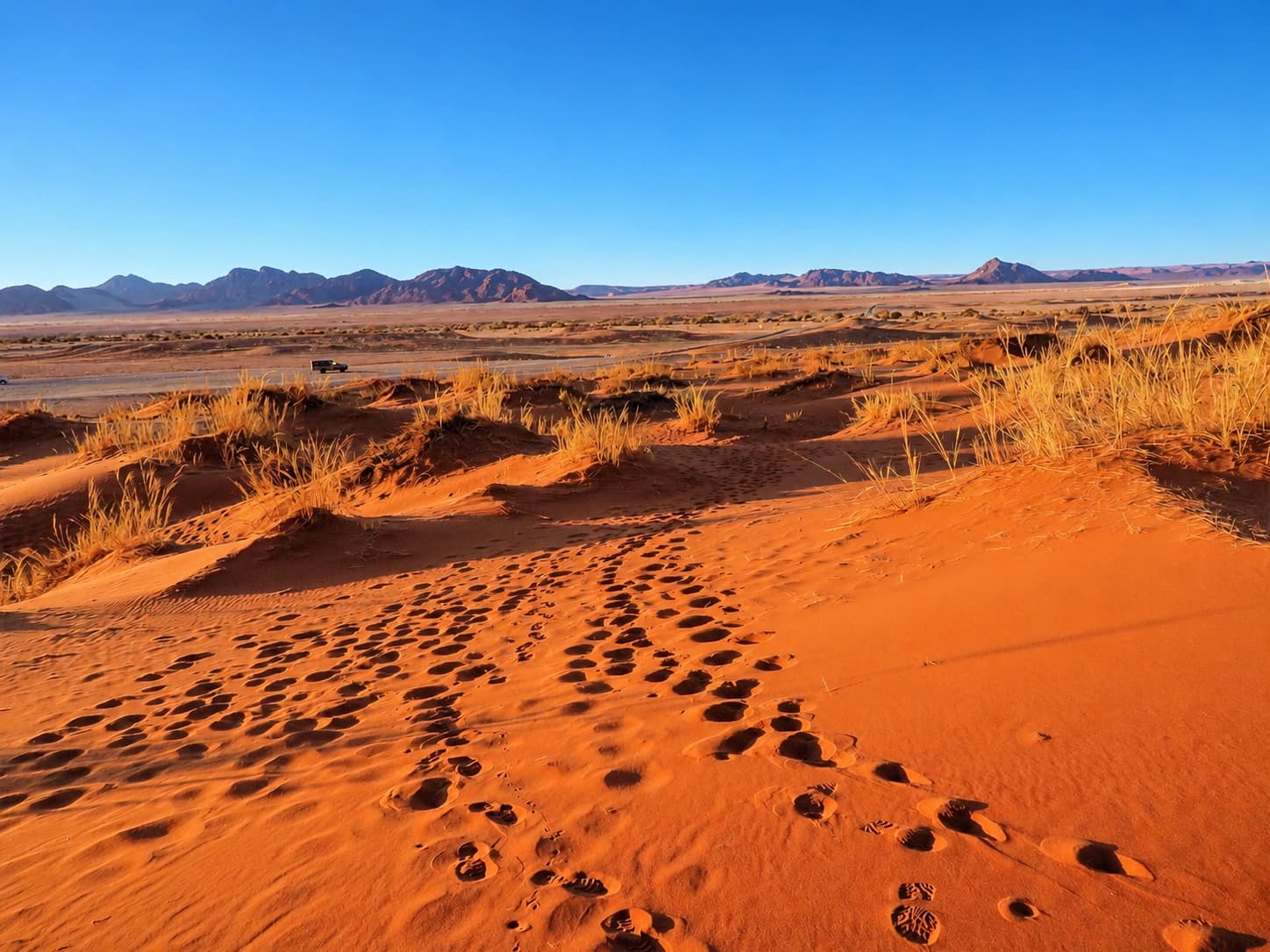
Namibia arrives, for most of the world, as a single photograph: a wall of rust-red dune rising behind a white clay pan, the skeletons of long-dead camelthorn trees standing black against it, the light at an angle no other desert seems to manage. It is one of the most reproduced landscapes on earth, and the reproduction is honest, the place looks exactly like that, and standing in it at dawn is one of the genuine sights of the continent. People plan whole trips around reaching it, photograph it, and fly home.
The photograph is true and the trip built around it misses the country almost entirely. Because the dunes are not the subject. The dunes are the most photogenic expression of the subject, which is emptiness, vast, ancient, almost unpopulated space, and Namibia has more of it, more completely, than almost anywhere left on the planet. This is the second least densely populated country on earth, after Mongolia: a land larger than France and Germany combined, holding fewer people than a single mid-sized European city. You can drive for hours and pass no one. The silence at night is total. The night sky, with no town for a hundred kilometres in any direction, is among the darkest and most complete that travel can still offer. The dunes are where people point the camera. The emptiness is the thing they have actually come to.
And the emptiness is not uniform. It runs from the oldest desert in the world on the coast, through a stone country in the centre where elephant and rhino have learned to live without rivers, to a great salt pan in the north that fills with game in the dry season, and down into a deep south almost no visitor reaches at all, a country of canyon, river, and silence on the edge of the continent.
This is where this begins.
What the dunes actually are.
The Namib, which gives the country its name, is the oldest desert on earth, arid in some form for fifty-five to eighty million years, since before the modern continents had finished arranging themselves. The dunes at Sossusvlei, the ones in the photograph, are among the tallest in the world, the highest rising more than three hundred metres from the pan floor, coloured by the iron in the sand that oxidises, literally rusts, over the immense age of the place. The dead trees of Deadvlei have been standing in their dried pan for somewhere around nine hundred years, too desiccated in the rainless air to rot. It is a place of genuine wonder, and a dawn climb of one of the high dunes, the wind erasing the footprints behind you, is worth every early start it demands.
But the dunes are a single landscape in a country full of them, and the visitor who gives Namibia only its most famous image is making the same mistake as the visitor who gives Egypt only the pyramids. The reason to come is not to see the one place everyone sees. It is to cross the emptiness between the places, and to reach the parts of it that the standard fly-in-fly-out circuit never does.
What the rest of the country is.
Where the desert meets the Atlantic, the Skeleton Coast runs for hundreds of kilometres of fog-bound shore, named for the whale bones and the wrecked ships that litter it, where the cold Benguela current collides with the hot desert air to produce a near-permanent bank of fog that is, improbably, the only reliable water the coastal ecosystem has. Desert lions have been recorded hunting seals on its beaches. It is one of the most desolate and atmospheric coastlines on the planet, and almost entirely closed to casual visitors.
Inland, Damaraland is a stone country of red rock, dry riverbeds, and ancient volcanic ranges, and it holds one of the strangest stories in modern conservation: desert-adapted elephant that walk enormous distances between scattered water, and a recovering population of black rhino that range free across unfenced communal land, the last truly free-ranging black rhino on earth, tracked and protected by rangers drawn from the communities whose land it is. Twyfelfontein, in the same region, holds thousands of rock engravings made by hunter-gatherers over several thousand years, and is the country's first UNESCO World Heritage Site. Further north still, in the Kunene, the Himba, semi-nomadic pastoralists who have kept their way of life largely intact, live in one of the remotest corners of the country.
Etosha, in the north, is the great wildlife park: a salt pan so large it is visible from space, fringed by waterholes that in the dry season pull elephant, lion, rhino, and great herds of plains game into concentrations as reliable as anywhere in Africa, game viewing by simply waiting at the water and letting the desert bring the animals to you. And in the deep south, almost forgotten by the itineraries, the country falls towards the Orange River along the border with South Africa: the Fish River Canyon, the second-largest canyon in the world; vast private reserves of arid plain and rocky range; and a river country of extraordinary stillness, where the emptiness is at its most complete and the dark skies at their most absolute. It is the least-visited corner of an already empty country, and for the traveller who has understood that the emptiness is the point, it is the heart of the matter.
“The oldest desert on earth. The last free-ranging black rhino left anywhere. The second-emptiest country on the planet. The dunes are only the part that photographs well.
What the country did with its wildlife.
Namibia did something at independence in 1990 that almost no other country has: it wrote the protection of the environment directly into its constitution. What followed has been studied around the world. The country handed communities the legal right to manage and benefit from the wildlife on their own land, and out of that grew a network of communal conservancies that now covers roughly a fifth of the country, land where the people who live alongside the wildlife have a direct stake in its survival, where poaching has fallen and populations of the rarest species have recovered, and where a handful of small, carefully sited lodges turn the presence of the wildlife into a livelihood. It is not without its difficulties, and it would be wrong to present it as simple. But it is, like the model in northern Kenya, among the rarest things in modern conservation: a place where protecting wild animals has become something the local people choose and own, rather than something done to them, and it is the reason the desert elephant and the free-ranging rhino are still here to be seen at all.
How it feels to be there.
The country moves at the pace of the distances it asks you to cross, and the great luxury of travelling it well is to cross them by light aircraft, low over the dune sea, the Skeleton Coast, the dry rivers of Damaraland, so that the scale of the emptiness becomes the experience rather than an obstacle to it. Days in the desert begin before light, when the dunes are still cold and the colour is at its best, and ease through the heat of the middle of the day into long, slow afternoons. There is very little to do, in the conventional sense, and that is the offer. The activity is the landscape: a drive across a gravel plain that runs unbroken to the horizon, a walk among the elephant-scarred trees of a dry riverbed, an hour spent simply watching a waterhole, a dinner under a sky so thick with stars that the familiar constellations are hard to find inside it.
What the country gives, more than any single sight, is a recalibration of scale and silence. There is almost nowhere left on earth where a person can be so completely alone in so large a space, in such quiet, under such a sky. For the traveller who arrives often exhausted and overstimulated, that, far more than the photograph of the dunes, is what Namibia is actually for.
What we look for when we plan a stay here.
Namibia rewards a trip that treats the emptiness as the subject and the famous dunes as one stop within it, and that crosses the distances by air rather than spending the days behind a windscreen. The right week, though serious Namibia trips usually run to ten days or more, strings together two or three of its very different emptinesses: the dune sea, the stone country of Damaraland or the wildlife of Etosha, the Skeleton Coast, or the deep silence of the south. The logistics of moving between them at the right standard are entirely a matter of the aviation and the people on the ground.
What we look for here: properties sited for the emptiness rather than the convenience, a camp with a dune to itself, a lodge on a private reserve large enough to hold its own silence, a base from which the rhino or the desert elephant can be tracked on foot with the community guides whose land it is. Exclusive-use space in the deep south, where the Orange River and the canyon country offer the most complete quiet in the country and almost no one to share it with. And the whole thing connected by light aircraft, so that the crossing of the country is part of the trip rather than the price of it.
Through our network we have access to arrangements across the Namib, the coast, the conservancies, and the southern river country that sit within this standard, including private reserves in the deep south held on an exclusive-use basis, where a single party has the silence to itself. Each is matched personally to the season and the temperament of the trip, and handled end-to-end, from the arrival through every bush flight to the last airstrip.
Who Namibia is right for.
Not those who want a dense, action-filled safari with a great sighting every hour. The country's wildlife is real and, at Etosha and on the conservancies, excellent, but Namibia is a desert, and its rewards are spread across distance and stillness rather than packed into a reserve.
This is for travellers who have understood that emptiness is itself a luxury, perhaps the rarest one left, and who want space and silence more than they want a full itinerary. For couples and solo travellers seeking somewhere that asks nothing of them. For families with children old enough to be moved by genuine wilderness: a free-ranging rhino tracked on foot, a night under a sky with no light in it, the sheer scale of a country they will not soon find again. For photographers, for whom the country is among the most rewarding on earth. And for the seasoned traveller who has seen the famous places and has reached the stage of wanting the empty ones instead.
The desert has been here, in some form, for the better part of eighty million years, older than the primates, older than the grasses, old enough that the iron in its sand has had time to rust the dunes red. The engravings at Twyfelfontein were cut by people several thousand years ago. The constitution that protects the wildlife was written in 1990, younger than most of the country's visitors. The rhino it protects may or may not still range free in another generation; the dark skies may or may not survive the spread of light. These scales do not contradict each other. They sit, like everything else in Namibia, across an enormous and almost empty space, and the argument for going is the argument for standing inside that space while it is still this empty.
When to visit Namibia
Namibia is a desert country, and its calendar is set by a short, unreliable rain rather than by heat. The dry season, roughly May through October, is the prime window: clear skies, cool mornings, and, decisively for the wildlife, shrinking water that draws the game of Etosha and the conservancies to the waterholes, with the late dry months of August through October the peak for game viewing. It is also the most comfortable time for the desert, and the busiest, with the best camps booked many months ahead. The hot months of November through March bring the chance of rain, usually brief afternoon storms rather than sustained weather, which greens the desert, brings the migratory birds, fills the pans, and produces the dramatic skies the photographers prize; the wildlife disperses and some find the heat demanding, but the country is quieter and the light extraordinary. The coast is cool and fog-bound year-round, a relief from the interior heat. The dunes photograph best in the low, raking light of early morning and late afternoon in any season. The deep south is at its most rewarding in the cooler dry months, when the canyon country and the river are comfortable to explore.
How to get to Namibia
Hosea Kutako International (WDH), outside the capital Windhoek, is the country's principal gateway, with direct connections from Frankfurt and a number of African hubs, Johannesburg, Cape Town, Addis Ababa, and others, and easy onward links from across Europe and the Gulf. Windhoek is where almost every itinerary begins. From there, the country is best crossed by air: a well-developed light-aircraft network runs from Windhoek's smaller field out to the airstrips of the desert lodges, the coast, the conservancies, Etosha, and the deep south, in flights that are, over this country, as much an experience as a transfer. The deep south also connects conveniently by air to Cape Town, which is why a Namibia trip pairs so naturally with the Cape. Private jets route easily into Windhoek and onward to the lodge strips. We coordinate the international arrival, the inter-region flights, the ground handling, and the timing of the whole route ourselves.
Where to stay in Namibia
A serious Namibia itinerary works as a string of contrasting emptinesses, and the best trips travel along it. The dune sea is the famous opening, the place to base for Sossusvlei, Deadvlei, and the dawn climbs. Damaraland is the stone country of the desert elephant and the free-ranging rhino, tracked from a camp on communal conservancy land. The Skeleton Coast is the fog desert and the wrecks, for those who want the most desolate of it. Etosha is the great wildlife pan, for the waterhole game viewing. And the deep south, the Orange River, the Fish River Canyon, the private reserves on the edge of the continent, is the quietest and least-visited of all, the place to give over to the silence and the dark sky, and the natural bridge to the Cape.
We do not publish a property list. The camps, lodges, and private reserves we arrange across the country are matched once the brief is clear, the dune camp for the photograph, the conservancy for the rhino and the desert elephant, the southern reserve, on an exclusive-use basis, for the silence and the stars. What we will say is that the right Namibia trip is almost never the one that flies in for the dunes and flies out. It is the one that crosses the emptiness, and gives the emptiest corners the days they deserve.