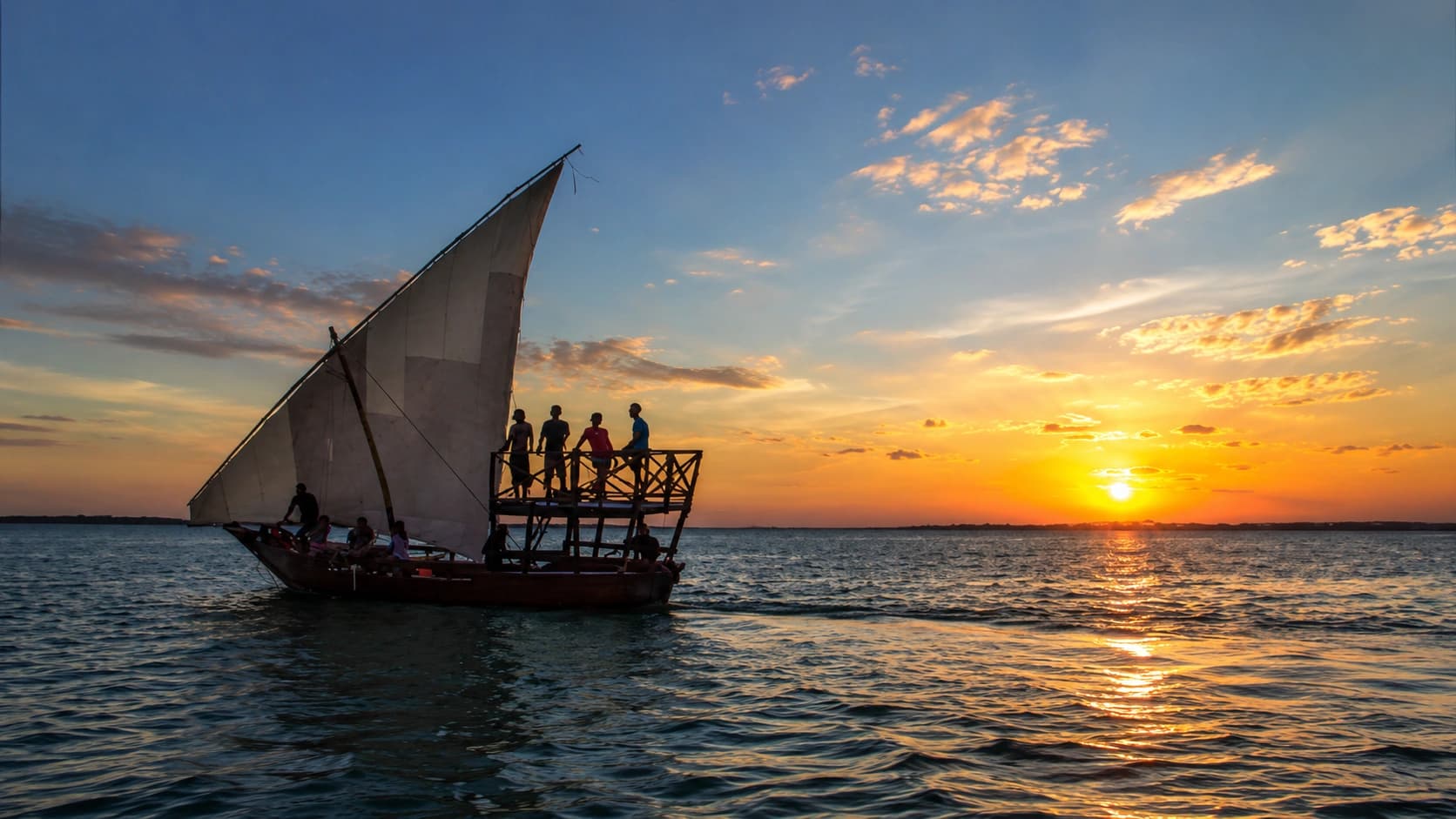
Tanzania arrives for most international travellers as a sequence of images that have been in circulation for so long they have become a kind of substitute for the country itself. A wildebeest crossing a river in slow motion. A lion under an acacia. A red-robed figure on a ridge against the dawn. A white-sand beach with a dhow on the horizon and the spire of an old mosque somewhere behind it. Each of these images is real. Each of them is, in its way, exactly what it appears to be. And each of them, taken alone, gives almost no sense of the country it was photographed in.
There is a version of Tanzania that fits inside these photographs. Six days on a safari circuit, three or four on Zanzibar, two flights, a tight itinerary, and a great deal of wildlife seen through the open roof of a Land Cruiser. It is widely available, professionally delivered, and it produces exactly the holiday it has been engineered to produce. The problem is that almost everyone who travels to Tanzania this way leaves having seen what they came to see, and almost nothing else.
The country those images come from is one of the oldest places on the continent in nearly every sense that matters. The geological cradle of the human species, where the Leakeys pulled hominid fossils from a gorge that turned out to be the earliest record of our own evolution. A Rift Valley landscape that has nothing else to compare to. A pastoral culture, the Maasai, the Hadzabe, the Datoga, that has been continuous in the same country for centuries and now shares it with Africa's most famous wildlife population. A coast that traded with Arabia, India, and China for more than a thousand years before Europeans had any sustained presence in the region at all. And a set of islands, immediately offshore, that held the centre of the Swahili world for several centuries and that still, behind their resort coastline, do.
This is where this begins.
What the Northern Circuit actually is.
The Serengeti ecosystem covers roughly thirty thousand square kilometres of grassland, woodland, and riverine forest that straddles the Tanzania-Kenya border. The Tanzanian half, the Serengeti National Park, gazetted in 1951 as the country's first protected wilderness, is about fifteen thousand square kilometres on its own, larger than several European countries and held essentially intact since the colonial conservation efforts that established it. What this single ecosystem supports is one of the largest concentrations of large mammals anywhere on earth. Roughly one and a half million wildebeest, between two and three hundred thousand zebra, several hundred thousand Thomson's gazelle, and the predator populations the ungulates support, the densest lion population in Africa, the most reliable cheetah viewing, the leopard, the spotted hyena, and the African wild dog at the edges of the range.
The Great Migration is the annual circular movement of those wildebeest and zebra around the ecosystem, in pursuit of the rains and the new grass they produce. The calving takes place between late January and early March on the Ndutu plains in the southern Serengeti, with roughly half a million calves born in a window of three weeks, the largest synchronised birth event in the natural world. From April the herds move west and north through the woodland, crossing the Grumeti River in May and June, and reaching the northern Serengeti and the Mara River from July onward. The river crossings, the photograph everyone has, happen from late July through October, with the herds shuttling back and forth across the river depending on rainfall on either side. By November they begin the return south, and the cycle resumes. Knowing where in the ecosystem the herds are likely to be in any given month is the single most important piece of safari planning, and it is what separates a serious itinerary from one that has placed a group in the wrong part of the park.
South of the Serengeti, the land rises sharply into the Crater Highlands, a series of volcanic peaks that includes Empakaai, Olmoti, and the still-active Ol Doinyo Lengai, the only carbonatite-erupting volcano in the world. At their centre sits the Ngorongoro Crater itself: the largest intact volcanic caldera on earth, six hundred metres deep, with a floor of two hundred and sixty square kilometres holding what is essentially a self-contained ecosystem. The crater contains all of the Big Five, lion, elephant, buffalo, leopard, and the critically endangered black rhino, of which the Ngorongoro population is among the last in East Africa, within a single morning's drive. UNESCO inscribed the area in 1979 as both a natural and cultural site.
Olduvai Gorge, a long cut through the Serengeti plain south of the Mara, is where Mary and Louis Leakey worked for four decades and where, in 1960, the fossil that defined the genus Homo habilis was recovered. The exposed sediments of the gorge contain a near-continuous record of human evolution stretching back almost two million years. The site is unobtrusive, a small museum, a viewpoint over the gorge, a working excavation that continues to this day, and it is one of the places in Africa where the layers of time on the continent are most clearly readable.
“The largest single birth event in the natural world. The largest unbroken caldera on earth. The deepest continuous record of human evolution. All within a few hours' drive of each other.
What the people brought to the land.
The wildlife is one half of the country. The cultures that share it with the wildlife are the other, and any safari that ignores them is reading the landscape with one eye closed. The Maasai, the Nilotic pastoral people who arrived in the region in the seventeenth and eighteenth centuries from the north, still inhabit the Ngorongoro Conservation Area and much of the country surrounding the Serengeti. The relationship between Maasai cattle and the wildlife of the ecosystem is one of the more interesting examples in modern conservation: continuous human pastoral presence inside what is otherwise a protected area, on the basis that the two have coexisted in this landscape for centuries and the wildlife appears to have adapted accordingly. A visit to a working boma, not a tourist village built for visitors, but the genuine homestead of a pastoral family, is one of the more grounding experiences of a serious Tanzania trip, and arranging the difference between the two requires people on the ground who know what to look for.
Further south, around Lake Eyasi, the Hadzabe, one of the last genuine hunter-gatherer societies on earth, perhaps a thousand people in total, still live the way their ancestors have for tens of thousands of years. Their language contains the click consonants of the Khoisan family of southern Africa, though linguistically the Hadza language is now classified as an isolate, related to nothing else surviving. Their material culture is essentially what hunter-gatherer life looks like before any of it was adapted away. Their genetic lineage is among the most ancient on the continent. A morning spent walking with a Hadzabe hunting party, strictly with the right permissions and the right introductions, on the community's own terms rather than as a spectacle, is one of the rare experiences in modern travel that does not feel like a performance.
Between them, around the lake and into the highlands, live the Datoga, pastoralists and blacksmiths, related linguistically to the Maasai but with their own distinct traditions, and the people who have for generations forged the arrowheads the Hadzabe still hunt with. Three peoples, three radically different ways of inhabiting the same landscape, all within a few hours of the safari country, all still living the lives the photographs of them suggest they live.
What the islands held.
Forty minutes by flight from the safari country, on the other side of the Tanzanian mainland, the Zanzibar archipelago sits in the western Indian Ocean. Three principal islands, Unguja, which the international visitor calls Zanzibar; Pemba to the north; Mafia to the south, and a constellation of smaller ones around them. The archipelago has been, for most of the last thousand years, the operational centre of the Swahili civilisation: the trading society that linked the East African interior to Arabia, Persia, India, and as far east as China for centuries before European arrival, and that produced one of the great cosmopolitan port cultures of the medieval and early-modern world.
Stone Town, the historic capital of Unguja, is the most complete surviving example of a Swahili coastal city, a tight grid of narrow stone-and-coral-rag streets, lined with two- and three-storey merchant houses whose architecture absorbed Arab, Persian, Indian, and European influences across centuries of trade. The carved wooden doors of Stone Town, more than five hundred original examples still in place, are themselves a documented art form, each one marked by motifs whose meaning records the trade, faith, or origin of the family that commissioned it. The town was inscribed by UNESCO as a World Heritage Site in 2000. It is not preserved as a museum; it is the living urban centre of an island that is still, in most of its rhythms, what it has been for a long time.
The Omani sultanate ruled Zanzibar from the early nineteenth century, Sultan Said bin Sultan moved his capital from Muscat to Stone Town in 1840, through to the 1964 revolution that produced the current union with the Tanzanian mainland. The Sultans built the palaces and ceremonial buildings whose silhouettes still define the Stone Town waterfront. They also presided, until the British abolition of 1873, over the largest slave market on the East African coast, a piece of the islands' history that is held openly, with the Anglican Cathedral built directly on the site of the old market and a memorial that does not look away from what happened there. Any serious week in Zanzibar that ignores this entirely is, like any serious Cape week that ignores the apartheid past, a week that has not really been on the islands at all.
Beyond Stone Town, the island opens out. The north coast at Nungwi and Kendwa is where most resort development has concentrated, and is the busiest end of the island. The east coast, Matemwe, Pongwe, Bwejuu, Paje, has longer and quieter beaches, with the tidal flats stretching half a kilometre out at low tide and the dhows of the local fishing villages still working from the same harbours they always have. The south coast, around Kizimkazi, is quieter still, with whale shark and dolphin populations in the channel offshore. Jozani-Chwaka Bay National Park, in the centre of the island, holds the last fragment of indigenous forest on Unguja and is the only surviving population of the Zanzibar red colobus, a primate found nowhere else on earth.
Pemba, north of Unguja, is the green island, less developed, agricultural rather than touristic, the centre of the country's clove production, and the location of one of the more dramatic underwater drop-offs in the Indian Ocean. The diving and free-diving along the Pemba Channel is taken seriously by people who take both seriously. Mafia, south of Unguja, is the marine reserve, a quieter island, smaller in scale, with one of the most reliable whale shark seasons in the world running from October through February each year, when the great fish gather off the southern coast to feed in numbers that elsewhere in the world have become rare.
How it feels to be there.
Days on the mainland arrange themselves around the light. Game drives begin before sunrise, when the air is cold enough for a blanket in the open vehicle and the animals are at their most active; the first hour after the sun rises is the hour the photographers wait for, and it is also the hour when the predators that have been working through the night are still visible before the heat sends them to shade. Mid-mornings are for slower movement, for stopping properly when something is happening, for the long conversation with a guide whose knowledge of the ecosystem genuinely repays the time. Lunches are taken in camp or out on a rocky outcrop with the country stretching to the horizon. Afternoons return to the vehicle as the heat fades; the second drive runs until last light. Evenings are around the fire under one of the densest night skies in the world, the Serengeti has essentially no light pollution and is one of the great dark-sky regions of Africa, with the sounds of the surrounding country coming in clearly.
The islands run on entirely different rhythms. The pace on Zanzibar is closer to the pace of a quiet Indian Ocean island anywhere, long mornings on the beach before the heat builds, afternoons in the shade or in the water, evenings on a terrace as the dhows return on the same tide their grandfathers came in on. The food shifts entirely too: from the camp kitchens and the open-fire cooking of the safari country to the Swahili coastal cuisine of the islands, coconut and seafood, the spices the islands grew rich exporting, biryani and pilau and the small-plate octopus dishes that are the genuine local table. The two halves of the trip are not interchangeable. They are not even of the same country in any practical sense. That is the point of doing both.
What we look for when we plan a stay here.
Tanzania rewards an arrangement that takes both halves of the country seriously rather than treating one as the main event and the other as a beach decompression. The right week, though serious Tanzania trips usually run to ten or twelve days, combines a properly structured mainland circuit (the right park in the right month, with the migration in the right corner of the ecosystem) with several days on the islands at a pace that respects what they are. The logistics of moving between the two are not straightforward at the right standard, and the difference between a trip that flows and one that does not is almost entirely in the hands of the people on the ground.
What we look for here: on the mainland, camps and lodges that sit within the migration's path in the month the group is travelling, which is a different camp in March than in August than in November, rather than fixed properties that require driving for hours to reach the wildlife. Private vehicles and private guides; the difference between a private safari and a shared one is the difference between the country opening to the group and the country being shown to a group. Real cultural arrangements where they are wanted, visits to working bomas, time with the Hadzabe on the community's own terms, the protocols of these encounters handled by people who know them, rather than the staged village experience that the standard itinerary sometimes substitutes. On the islands, a base set away from the busier strip of the north coast, with direct beachfront, with food that respects the Swahili tradition, and with the right access into Stone Town and into the quieter corners of the archipelago.
Through our network we have access to arrangements across Tanzania and the Zanzibar archipelago that sit within this standard. Each is assembled personally, matched to the group, the season, and the rhythm of the country they want to read. Each is handled end-to-end, from the Kilimanjaro arrival through to the final departure from the islands.
Who Tanzania is right for.
Not those who want a six-day safari built around photographs they have already seen. That trip is widely available, professionally delivered, and there is no real reason to improve on it if that is all the country is being asked to do.
This is for travellers who have understood that the most extraordinary places on earth are almost always larger than the photographs suggest. For families who want a trip that gives children something genuinely outside their frame of reference, a wildebeest crossing seen at the right month, a morning with the Hadzabe, a dhow leaving a fishing harbour on the same tide it has left on for centuries, and who have reached the stage where these things will matter more than a water park. For couples who have done the standard East African safari and want the version of Tanzania that the standard itinerary cannot reach. For those who have understood that the civilisations that shaped the modern world include several this one carries quietly, and who have the time and the interest to take them at the pace they deserve.
The Serengeti has been functioning as an ecosystem for somewhere around a million years. The Hadzabe have been in their corner of it for tens of thousands. The Swahili have been on the coast for at least a thousand. The Sultans built their palaces a few hundred years ago. The country was a single nation only after 1964, which makes it younger than most of its visitors. None of these timescales contradict each other. They simply exist on top of each other, across a country that is older than all of them and will outlast them all. The argument for going is the argument for seeing it whole.
When to visit Tanzania
The country has two rainy seasons and the rest of the year is dry to varying degrees. The long rains run from late March through May and are the wettest period, with many of the mobile safari camps repositioning or pausing operations during the heaviest weeks. The short rains run through November and into early December and are considerably lighter, afternoon showers rather than days of weather, and many of the better operators continue running through them. The high safari season is June through October, when the country is dry, the animals are concentrated around water sources, and the migration is in the western and northern Serengeti for the river crossings; July through early October is the peak window for the Mara River crossings, with the better camps in the northern Serengeti booked nine to twelve months ahead. The calving season is the other peak, late January through early March on the Ndutu plains in the southern Serengeti, when roughly half a million wildebeest calves are born in a three-week window and the predator activity is at its most concentrated. December through early February is the green season on the southern circuit, with newborn antelope, migratory birds, and lower visitor numbers. On the coast, the climate is more consistent, warm year-round, with the same long and short rains, and the best beach weather running from June through October and December through February. Mafia Island's whale shark season runs from October through February.
How to get to Tanzania
Kilimanjaro International (JRO), between Arusha and Moshi in the north, is the principal gateway for the Northern Circuit, direct flights from Amsterdam, Doha, Istanbul, Addis Ababa, Dubai, and a number of African hubs, with onward connections from across Europe and North America. Arusha (ARK) is the smaller domestic field used for connections into the parks. Julius Nyerere International (DAR) at Dar es Salaam is the larger national hub, useful particularly for travellers continuing to Zanzibar or the southern parks. Abeid Amani Karume International (ZNZ) on Zanzibar receives a growing number of direct international routes, currently from Doha, Dubai, Istanbul, Addis Ababa, and several European hubs, and is the most efficient arrival when the trip is islands-first or islands-only. Within the country, the safari country is reached by scheduled light aircraft from Arusha to the various airstrips inside the parks, Seronera in the central Serengeti, Lobo and Kogatende in the north, Manyara, Ndutu, and several smaller fields. Private jets route most easily into Kilimanjaro and Zanzibar; the deeper airstrips inside the parks are accessible by smaller aircraft. We coordinate the international arrival, the inter-park flights, the safari ground handling, and the transition between the mainland and the islands ourselves.
Where to stay in Tanzania
A serious Tanzania itinerary works around three quite different settings, and the best ten-to-twelve-day trips use all of them. The safari country itself is the first, and the right base shifts with the season. The southern Serengeti and Ndutu region in January through March for the calving; the central Serengeti through April and May; the western corridor along the Grumeti in May and June; the northern Serengeti and Kogatende area for the Mara crossings from July through October. The Ngorongoro Conservation Area sits adjacent to all of this and is usually paired with the Serengeti for the crater visit, the Olduvai stop, and the Crater Highlands cultural country. The second setting is Stone Town on Unguja, where two or three nights properly placed make sense of what the islands actually are. The third is the coast, the east coast of Unguja for the quieter beaches and the working fishing villages, Pemba for the diving and the green island country, Mafia for the whale sharks and the marine reserve, with the choice between them shaped by the temperament of the trip and the season.
We do not publish a property list. The arrangements we put together across Tanzania and the islands are matched once the brief is clear, the camp in the right corner of the ecosystem for the month, the Stone Town stay that places the group within the city's older streets, the coastal property that respects what the archipelago is. What we will say is that the right Tanzania trip is the one that treats the country as three landscapes rather than one, and the one that gives the islands the proper days rather than tacking them on. The migration is the photograph. The country around it is the reason to go.