Most extraordinary places on earth are extraordinary by degree, older, larger, emptier, wilder than the rest. Madagascar is extraordinary by kind. It is the fourth-largest island in the world, lying in the Indian Ocean off the southeast coast of Africa, and it has been on its own for an almost unimaginable length of time: it broke from Africa around a hundred and sixty million years ago and finally separated from the Indian landmass around eighty-eight million years ago, before the primates had appeared, before a great deal of the modern living world existed at all. Everything that reached it after that arrived by sea or by air, against long odds, and then evolved in isolation for tens of millions of years into things that exist nowhere else.
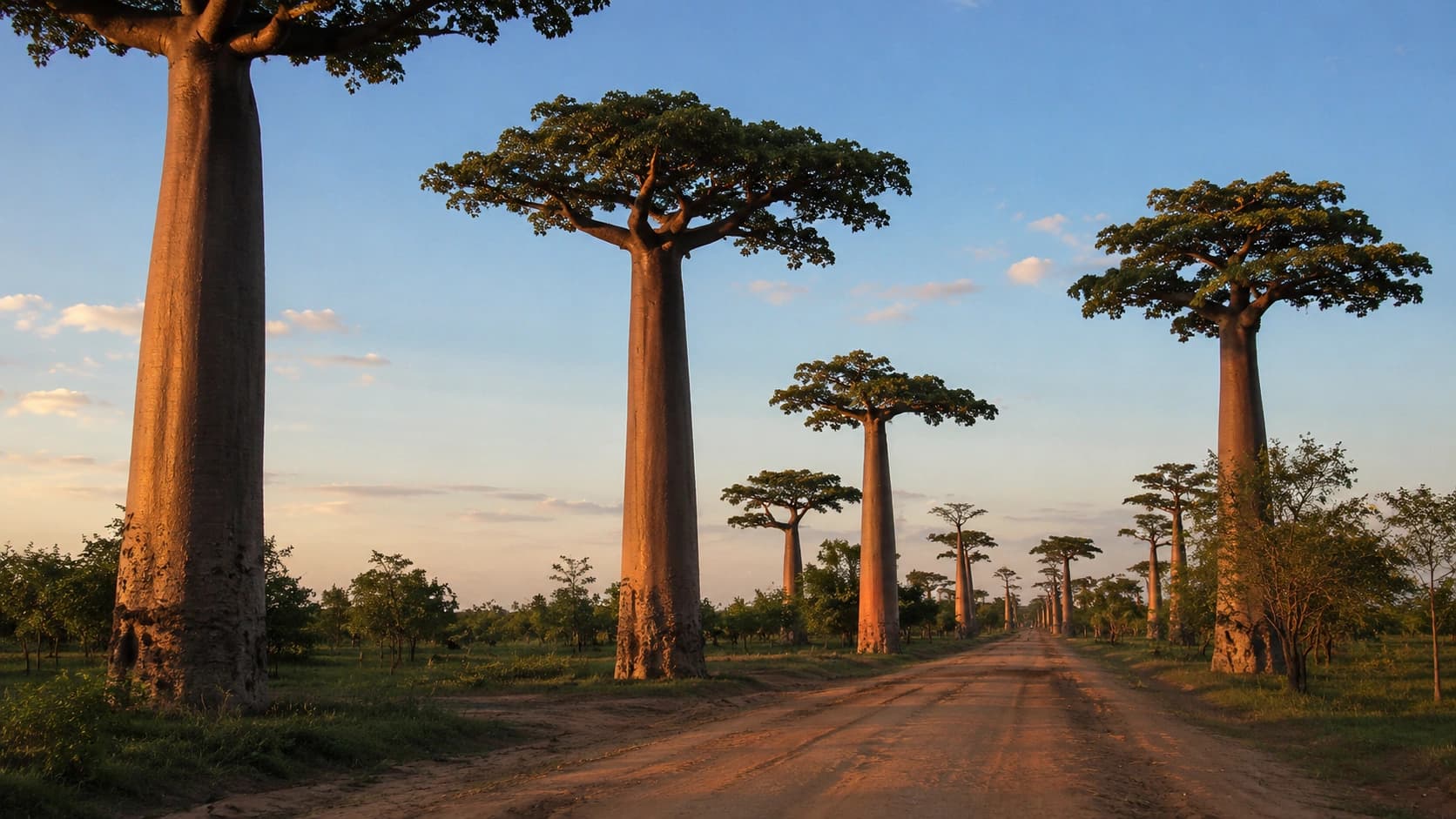
The result is a place that is best understood not as a part of Africa but as a kind of parallel world running alongside it. Somewhere around ninety per cent of the wildlife on Madagascar is found on Madagascar and nowhere else on the planet. The lemurs, more than a hundred species, from the largest down to a primate that could sit in a teaspoon, are the island's alone, the whole branch of the primate family that survived here and died out everywhere else. Roughly half the world's chameleon species live here, including the smallest vertebrates ever recorded. Six of the world's eight species of baobab, the great bottle-shaped trees that look like they have been planted upside down, grow only here. The list runs on through almost every order of life. To travel in Madagascar is to spend a fortnight among living things you will not have seen before and will not see again outside it.
And almost nobody goes. The country sees a tiny fraction of the visitors of the famous African safari nations next door, it is harder to reach, harder to travel, and overshadowed in the imagination by the mainland it is named beside. Which is precisely the point. The one country on earth that evolved its own world is also one of the least-visited places a serious traveller can reach.
This is where this begins.
What the island actually holds.
Madagascar is not one landscape but several, arranged by the way the rain falls across it, and the great trip moves between them. The eastern flank, where the trade winds drop their rain against the escarpment, is rainforest, humid, dense, dripping, and home to the largest of the lemurs, the indri, whose extraordinary, whale-like song carries for kilometres through the canopy at dawn and is one of the strangest and most affecting sounds in nature. The protected forests of the east are where most travellers have their first encounter with the lemurs, often within touching distance, watched from a forest path at first light.
The west is drier, deciduous forest and open country, the land of the baobabs, where the famous avenue of the great trees near the western coast glows red at sunset and has become the single image most people carry of the island. The far west holds one of the strangest landscapes on earth: the tsingy, a forest of limestone pinnacles eroded into a field of stone blades so sharp the name means, roughly, where one cannot walk barefoot, a UNESCO World Heritage Site, crossed on suspended walkways above the spires, with lemurs leaping between the pinnacles. The deep south is drier still: the spiny forest, an arid woodland of thorned and bottle-trunked plants found nowhere else, as alien a vegetation as any on the planet. And ringing all of it is the coast and the islands, coral reef, white sand, and a scatter of small islands off the northwest and northeast that are among the least-developed in the Indian Ocean.
It is, ecologically, one of the most precious places on earth, and one of the most threatened: much of the original forest is gone, cleared over centuries of subsistence farming, and the remaining wildlife survives in fragments. That fragility is part of what makes the intact pieces so affecting. To walk in one of the protected forests, the indri calling overhead, is to stand in a remnant of something that took eighty million years to make and may not have another century.
“Drifted alone for eighty-eight million years. Nine in ten of its living things found nowhere else. An entire branch of the primate family that survived only here. And almost no one comes to see it.
What the people brought across the ocean.
The human story of Madagascar is as singular as the natural one. The island was among the last large landmasses on earth to be settled by people, not until somewhere between fifteen hundred and two thousand years ago, and the first settlers came not from nearby Africa but from across the entire Indian Ocean, from the islands of what is now Indonesia, in one of the most remarkable open-water migrations in human history. The Malagasy language is, astonishingly, an Austronesian one, most closely related to a tongue spoken on Borneo, thousands of kilometres to the east. To that Austronesian foundation were added, over the centuries, African, Arab, and later European influences, producing a culture and a people that are genuinely their own, neither African nor Asian but Malagasy, a synthesis that exists nowhere else.
That culture carries traditions found in no other place. The reverence for ancestors runs through everything; in parts of the highlands, the famadihana, the turning of the bones, sees families periodically exhume and rewrap the remains of their dead in a celebration rather than a mourning. The rice terraces of the central highlands, the zebu cattle that are wealth and status as much as livestock, the music, the markets, all of it belongs to a country that, like its wildlife, evolved along its own line. A trip that sees only the lemurs and the beaches and misses the Malagasy entirely has, like a Tanzanian trip that ignores the Swahili, missed half of what the island is.
How it feels to be there.
Madagascar is not a polished destination, and that is both its difficulty and its reward. The distances are long, the roads are slow, and the infrastructure thin, which is exactly why the best way to travel it is by air, hopping between the forests, the tsingy, and the coast by light aircraft, so that the days are spent in the places rather than on the tracks between them. The forest mornings begin early and on foot, in the cool and the mist, following a guide who knows where a particular family of lemurs will be feeding. The middle of the day, in the heat, slows to almost nothing. And the trip very often ends where the rivers of the great safari rivers eventually run, at the sea.
Because the natural counterpoint to the wild interior is the coast, and the islands off the north are among the last genuinely quiet ones in the Indian Ocean. A handful of small islands off the northeast in particular hold private, low-impact sanctuaries, reached by helicopter over the baobabs and the reefs, where the experience is the opposite of the forest in every way: barefoot, slow, the days given over to the reef, the diving, the empty white sand, the warm shallows, and nothing at all to do. To pair the two, a week in the forests and the stone, a week on a private island, is to experience the full range of what evolved here, on the land and in the sea, and to end the wildest of African journeys in the gentlest of Indian Ocean ones.
What we look for when we plan a stay here.
Madagascar rewards a trip that takes the difficulty out of the equation and the wonder out of the difficulty, that moves by air between the landscapes rather than overland, and that pairs the wild interior with the quiet of the coast. The right trip, and serious Madagascar journeys run to a fortnight or more, combines two or three of the island's distinct worlds: a rainforest for the lemurs, the tsingy or the baobabs for the strangeness, and a private island for the rest. The logistics at the right standard are entirely a matter of the aviation and the people on the ground, and in a country this thinly travelled, that matters more than almost anywhere.
What we look for here: properties and lodges sited at the genuinely good forests, with the naturalist guides who can find the wildlife and read it; the right strange landscapes, the tsingy, the baobabs, the spiny forest, taken at the right season and reached by air rather than by days of road; real engagement with the Malagasy, on their own terms, rather than the staged version; and, for the coast, the private island sanctuaries of the north, where the reef and the sand can be had in genuine seclusion. And the whole thing flown rather than driven, so that the island opens to the trip rather than wearing it down.
Through our network we have access to arrangements across the forests, the interior, and the islands that sit within this standard, including private-island sanctuaries off the north reached by helicopter, where a small number of guests have the reef and the sand to themselves. Each is assembled personally, matched to the season and the temperament of the trip, and handled end-to-end, the arrival, the inter-island flights, the naturalist guiding, and the transition from the forest to the sea.
Who Madagascar is right for.
Not those who want a polished, effortless trip with a great deal handed to them and very little asked. Madagascar is a developing country and a thinly travelled one; even arranged at the highest level, it rewards curiosity and a degree of flexibility, and it is not the Indian Ocean beach holiday some imagine from the map.
This is for travellers who have understood that the rarest places are rarely the easiest ones, and who are drawn to somewhere genuinely unlike anywhere they have been. For naturalists and the naturalist-curious, for whom the island is one of the half-dozen most extraordinary destinations on earth. For families with children old enough to be permanently marked by it: a lemur a metre away in the forest, the indri's song at dawn, a stone forest crossed on a walkway, an island with no one else on it. For couples who want to combine genuine wilderness with genuine seclusion, the forest and the private island in a single trip. And for the seasoned traveller who has done the famous places and wants the one that evolved its own world.
The island broke away from everything else eighty-eight million years ago and has been making its own living things ever since. The first people crossed an entire ocean to reach it within the last two thousand years, and brought a language from the far side of the world. The forests that took those eighty million years to grow have been disappearing within the span of a few human generations, and the wildlife with them. To go now is to see a world that exists nowhere else, while it still exists at all, and to understand, standing in one of its last intact forests, exactly how singular, and how fragile, the thing in front of you is. That is the argument for going, and there is a clock on it.
When to visit Madagascar
Madagascar's calendar is set by a wet season and a dry one, with significant regional variation across so large an island. The dry season, roughly April or May through October or November, is the prime window for travel: the weather is most reliable, the roads and airstrips most dependable, and the wildlife viewing strong, with many lemur species most active and, from about September, the babies appearing in the forests. July through September is also the peak whale season off the east coast, when humpbacks pass close to shore. The wet season, roughly November through March, brings the heat, the rain, and, on the east and the north, the risk of cyclones, with some forests and roads becoming difficult and a number of lodges closing for the heaviest weeks; it is also, however, the lushest and greenest time, when many reptiles and amphibians are most visible and the forests are at their most spectacular. The far south and west are drier and more forgiving year-round. The coast and the islands are warm throughout, with the diving and the beach weather best in the drier months. As a general rule, the shoulder months of April to May and October to November offer the best balance of weather, wildlife, and quiet.
How to get to Madagascar
Ivato International (TNR), outside the capital Antananarivo in the central highlands, is the country's principal gateway, with connections from Paris, Addis Ababa, Nairobi, Johannesburg, Mauritius, and a number of Indian Ocean and African hubs, and onward links from across Europe; the capital is where almost every itinerary begins, and is worth a night in its own right for the markets and the highland culture. From there, the island is best crossed by air: a domestic network and, increasingly, private charter and helicopter link the capital to the forests, the tsingy, the baobab coast, and the islands of the north, turning journeys that would take days by road into short and scenic flights. The private islands of the northeast are typically reached by a flight to the regional gateway and then a helicopter transfer over the reefs. Private jets route into the capital and onward to the regional fields. Given how much the experience depends on flying rather than driving, the coordination of the internal aviation is the single most important piece of a Madagascar itinerary, and we handle it ourselves, end to end.
Where to stay in Madagascar
A serious Madagascar itinerary works as a journey through the island's distinct worlds, and the best trips travel between two or three of them by air. The capital and the central highlands are the arrival, the markets, the rice terraces, the culture, and the hub from which the rest is flown. The eastern rainforests are the first wildlife stop, for the lemurs and the indri. The west holds the baobabs and, beyond them, the tsingy, the stone forest that is unlike anywhere else on earth. The deep south holds the spiny forest, for those going deepest. And the islands of the north are the counterpoint, the private sanctuaries off the northeast in particular, where the reef and the white sand close the trip in seclusion. A fortnight pairs a wild interior leg with an island one; a longer trip adds a third landscape.
We do not publish a property list. The lodges and sanctuaries we arrange across the island are matched once the brief is clear, the forest lodge with the naturalist guiding for the lemurs, the camp at the tsingy for the strangeness, the private island off the north for the sea. What we will say is that the right Madagascar trip is almost never the one that tries to drive the island. It is the one that flies between its separate worlds, the forest, the stone, and the reef, and gives each of them the days it deserves.