



City & HistoryYear round
Ales stenar
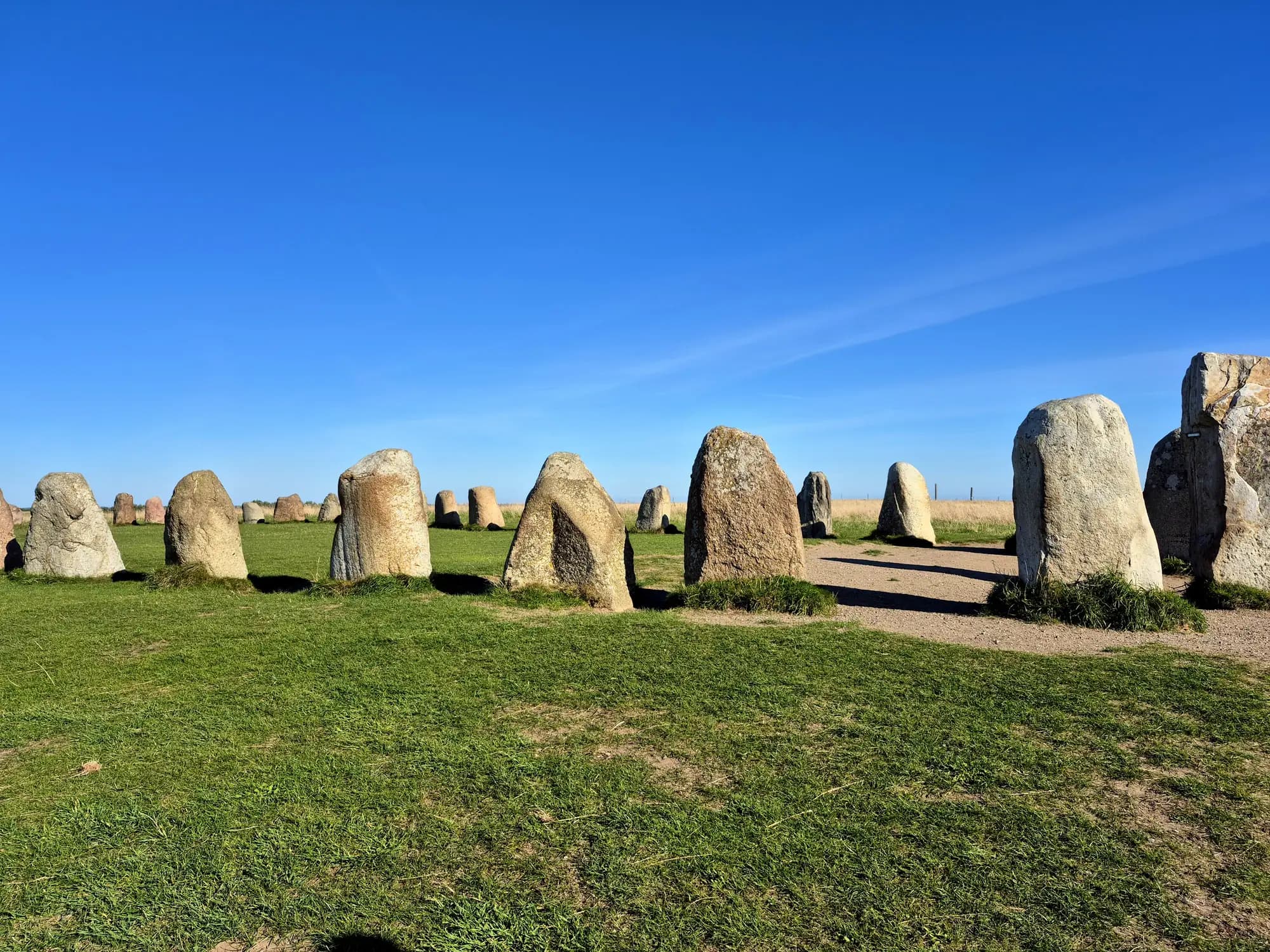
Fifty-nine standing stones in the shape of a ship, on the cliff above Kåseberga, walked at the quiet end of the day.
A ship of stone above the sea
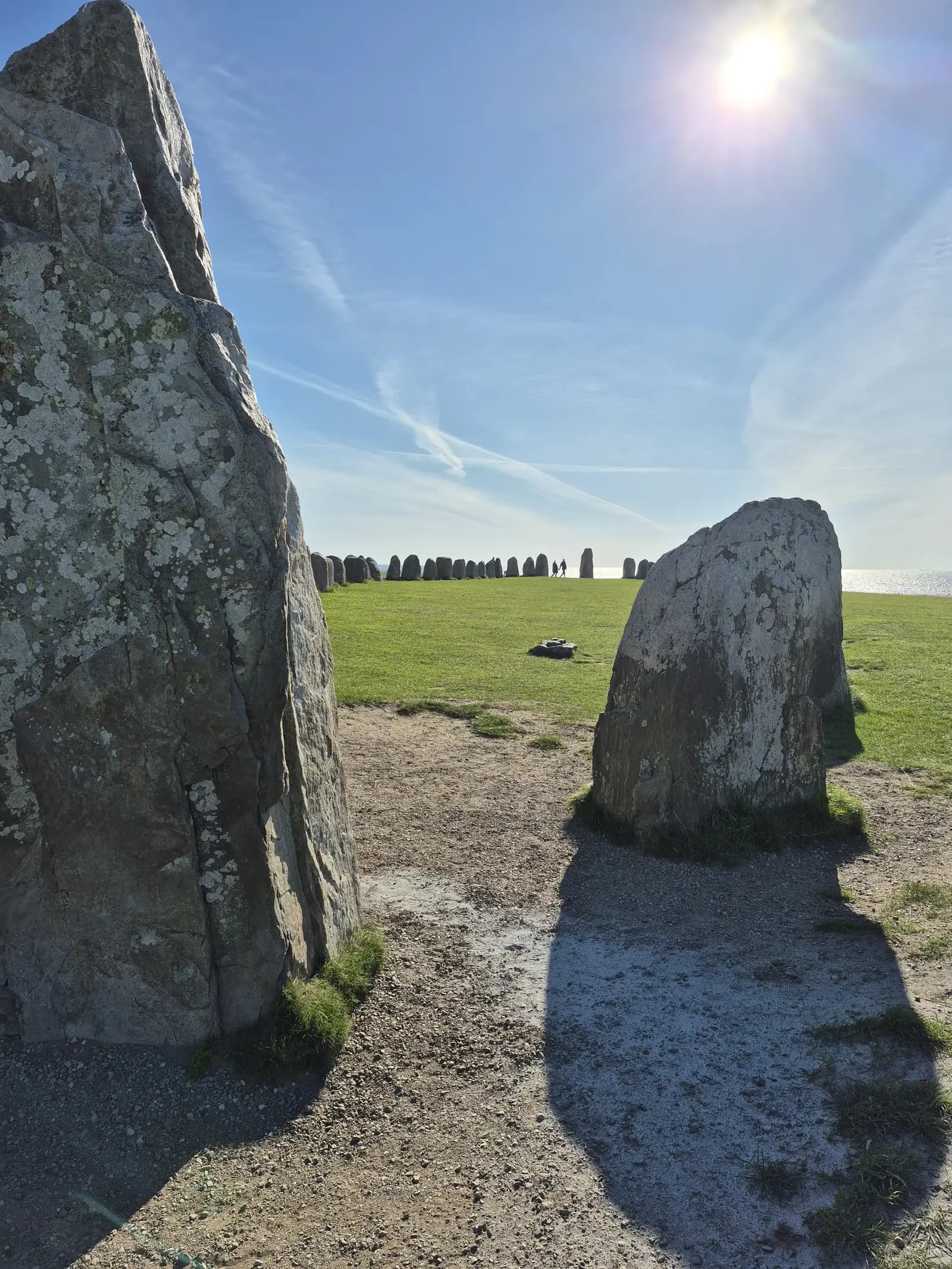
Ales stenar is a ship drawn on the ground in standing stones: fifty-nine boulders set in the outline of a hull about 67 metres long and 19 metres wide, on the open headland above Kåseberga on the south coast of Skåne. It is the largest ship setting in Sweden, and it stands 32 metres above the Baltic with nothing between it and the sea but grass.
It is about ten kilometres east of Ystad, in the corner of the province everyone calls Österlen. You leave the car by the harbour at Kåseberga and walk up: a gravel track, then a grass path along the cliff, ten to fifteen minutes and steep enough near the top to notice. The stones come into view all at once, which is the right way to meet them.
The site belongs to the state and is looked after by Statens fastighetsverk. It is open at every hour of every day of the year, with no gate and no ticket, which is exactly why the hour you arrive matters more than anything else. At midday in July the hill is busy. Early in the morning, or in the last hour of light, it is very nearly yours.
We plan the timing around the light and the season, the drive and the walk up, and a table at the harbour afterwards. If you would like the arguments about the stones explained on the hill itself, we can arrange a local guide to walk it with you.
Read the stones up close
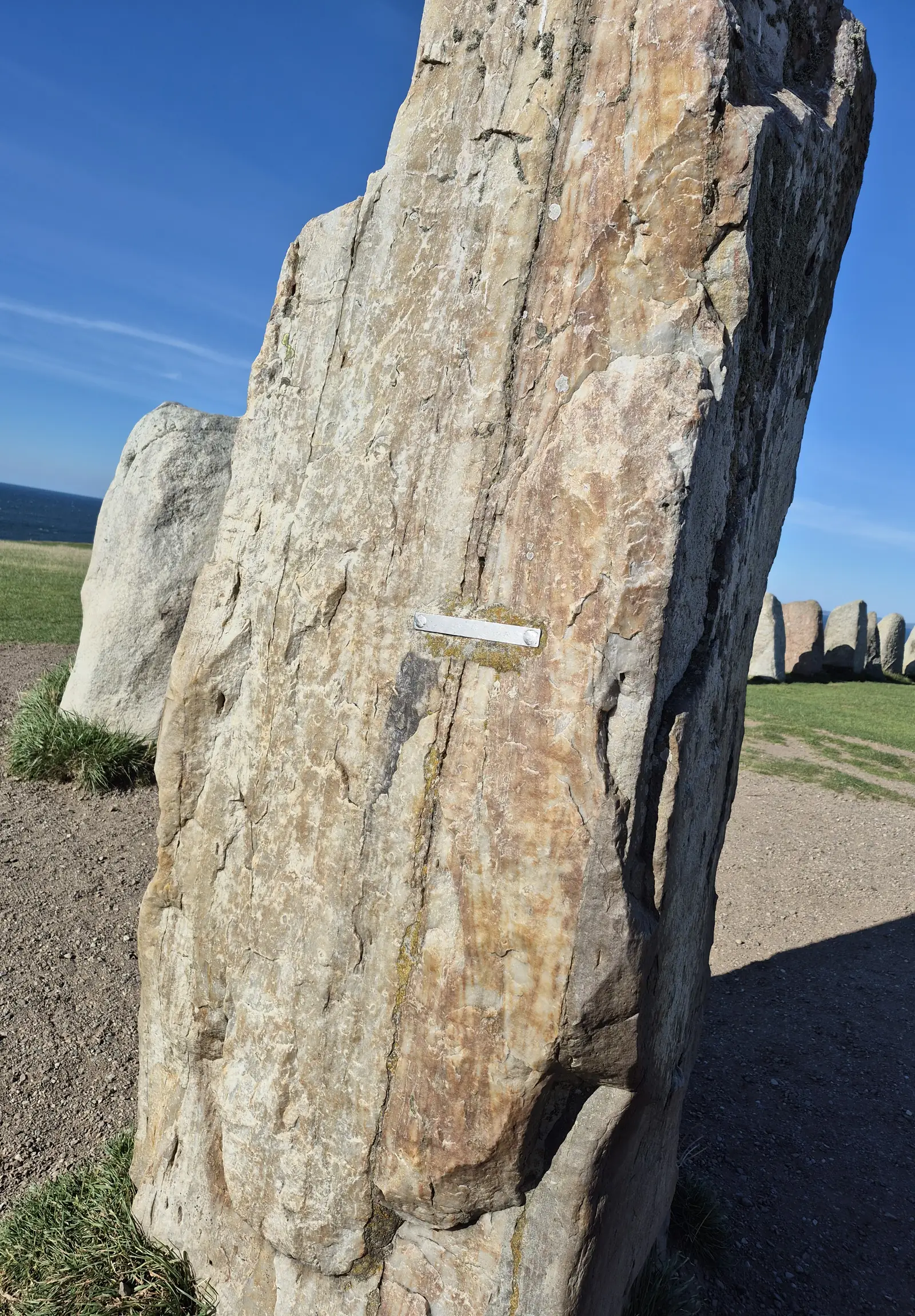
Close to, the stones are not what they seem from a distance. Most are granite and gneiss, boulders left behind by the ice and chosen, it seems, for being long and narrow, which boulders of that kind seldom are. A handful are sandstone. The heaviest weigh around five tonnes, and the stones at the two ends, the stem and the stern, stand taller than the rest, as a ship's would.
What nobody can tell you is exactly when, or exactly why. Charcoal from the site has been radiocarbon dated, and Statens fastighetsverk places the monument between about 600 and 1000: the Late Iron Age, so possibly Viking and possibly older. In 1989 excavators found a clay pot holding burnt human bones inside the setting, which supports the idea that it marks a grave. It may also have been a place of gathering, or both. It is sometimes called the Swedish Stonehenge, but Stonehenge is a stone circle thousands of years older; this is a ship, and a far younger one.
What you are looking at is also partly a restoration. Stones were reset in 1916, and again, more heavily and with machinery, in the late 1950s, with little record kept of what was moved. The outline is old; the exact place of every stone may not be. The name is old too, and nobody knows who Ale was. Local legend makes him a king buried here, which is a story rather than a finding.
For the longer history of the Viking age in Sweden, from Skåne to Lake Mälaren, our Vikings in Sweden guide has it.
The sun at either end
The ship lies roughly north-west to south-east, and that is a large part of its fame. On midsummer evening the sun sets close to the line of the ship, over its north-western end, and at midwinter it rises near the other. Some researchers think it was laid out as a calendar for exactly that reason; others think the alignment is the happy result of a ship laid along the coast. Midsummer evening is the busiest hour of the year on the hill, whichever is right.
For the stones themselves, we would choose an ordinary clear evening outside July, or the first hour after sunrise. The light comes in low off the sea, the shadows run long across the grass, and on the clearest days the Danish island of Bornholm sits on the horizon. The headland is open to every wind there is, so bring a warm layer even in summer.
Below the stones, cattle graze the slopes of the nature reserve, and when the wind is right, paragliders lift off the edge of the cliff and hang over the sea. Then it is back down to the harbour at Kåseberga, where fish is smoked that morning: herring and salmon, eaten at an outdoor table with the water in front of you. Allow two or three hours for all of it, and longer if the evening is good.
The path up is gravel and grass and steep in places, which makes it hard going with a pushchair or for anyone who finds hills difficult. Tell us beforehand, and we will say plainly whether it suits.
Before you ask
Ales stenar: common questions
Anything not answered here, ask us directly — we'd rather you did.
Where is Ales stenar?
On the headland above Kåseberga harbour, on the south coast of Skåne, about ten kilometres east of Ystad in Österlen. From the harbour it is a ten- to fifteen-minute walk up a gravel track and a grass path, steep near the top.
Is Ales stenar the Swedish Stonehenge?
It is often called that, but it is a different kind of monument. Stonehenge is a stone circle built thousands of years earlier; Ales stenar is a ship setting, 59 stones in the outline of a hull, dated to between about 600 and 1000.
How old is Ales stenar?
Charcoal from the site has been radiocarbon dated, and Statens fastighetsverk places it between about 600 and 1000: the Late Iron Age, so possibly Viking and possibly older. The stones were reset in 1916 and again in the late 1950s, so the outline is old but not every stone stands exactly where it first did.
Does it cost anything to visit, and when is it open?
Nothing, and always. There is no gate and no ticket, and the site is open at every hour of every day of the year. Midday in July is busy; early morning or the last hour of light is very nearly empty.
Can you see the midsummer sunset at Ales stenar?
Yes. On midsummer evening the sun sets close to the line of the ship, over its north-western end, and at midwinter it rises near the other. Whether that was intended is still argued over. Midsummer evening is also the busiest hour of the year on the hill.