Switzerland is the country people arrive with the most settled picture of, and almost always the same one. The Matterhorn against a clean sky. A red train threading a viaduct. A week of skiing in February, the chocolate, the watches, the sense of a place that has been thoroughly photographed and reliably runs on time. It is a picture that is not wrong, exactly. It is simply a picture of one season, seen from the inside of a resort, and it leaves out most of the country it is standing in.
Because the version of Switzerland that the postcard cuts out is the larger and the older one. It is the country of the summer high Alps rather than the winter piste, the months when the snow is off the passes and the valleys are green to the glacier line, when the high routes open and almost no one is on them. And it is the country of the valleys themselves, the long side-valleys that run up from the Rhône into the ice, each of which was a separate world for most of its history and several of which still feel like one.
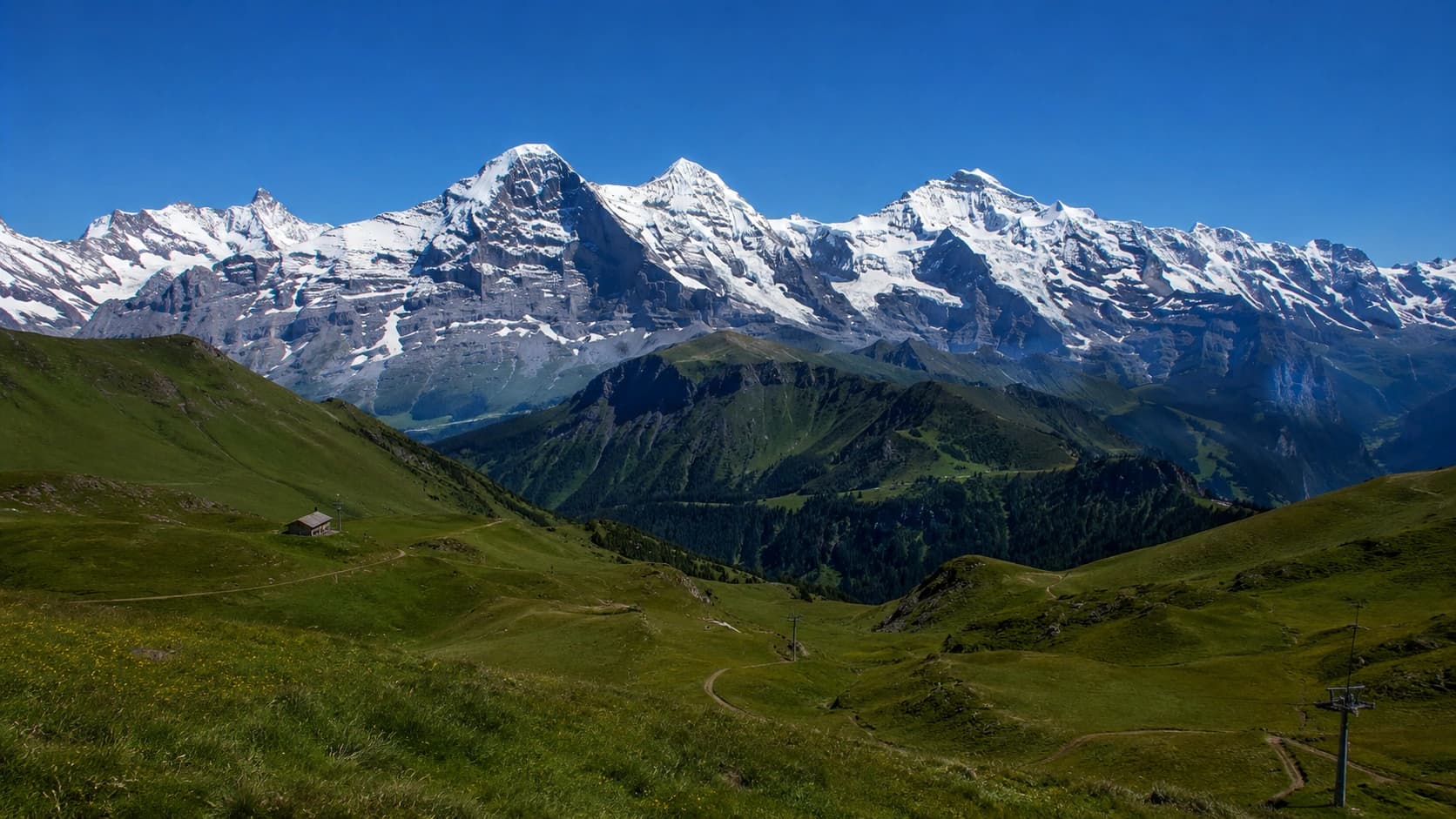
The clearest place to see all of this at once sits above the town of Martigny, where the Rhône turns north for Lake Geneva. A south-facing terrace at around fifteen hundred metres, looking straight across at the Grand Combin, four thousand three hundred metres of ice and rock, and backed by a valley that climbs twenty-five kilometres into a protected wilderness and the Italian border. The terrace is Verbier. The valley behind it is the Val de Bagnes. And between them they hold the Switzerland the ski week never quite reaches.
This is where this begins.
What the country actually is.
Verbier and the Val de Bagnes lie in the canton of Valais, Wallis in German, the canton being bilingual, French in the west and German in the east, which is the high heart of the Western Alps and, by some distance, the most vertical part of Switzerland. The canton holds more than forty peaks above four thousand metres, the greatest concentration anywhere in the Alps. The Matterhorn is here. So is the Dufourspitze, at four thousand six hundred and thirty-four metres the highest mountain in the country. And three of the largest glaciers in the Alps, among them the Aletsch, a UNESCO World Heritage Site, pour off these summits. It is the part of Switzerland that looks most like the idea of Switzerland, and it is also the part that almost no one travels through slowly.
The shape of the canton is its great peculiarity. The Rhône runs the length of it, west to east, from a glacier at one end to Lake Geneva at the other, in a single deep trench, and the floor of that trench is the driest and sunniest place in Switzerland. Vineyards climb its terraces; apricot orchards fill it; this is the country's largest wine canton, growing varieties grown almost nowhere else. So the defining experience of the Valais is the contrast held in one view: Mediterranean vegetation and ripening grapes on the valley floor, and an unbroken wall of ice four thousand metres above it. You can stand among vines in the morning and be on a glacier by the afternoon, and the whole of the canton's character lives in that distance.
The Val de Bagnes is one of the side-valleys that climbs out of that trench. It runs roughly twenty-five kilometres south from Martigny, traced by the Drance, past the resort terrace of Verbier and the older villages below it, up through Lourtier and Fionnay into the Haut Val de Bagnes, a protected high wilderness of game reserves and alpine pasture that ends, where the road finally stops, at the Mauvoisin dam, one of the highest arch dams in Europe, holding back a long turquoise reservoir beneath the peaks. Beyond it there is no road at all: only the pass, the Fenêtre de Durand, over the watershed into the Aosta Valley of Italy. The valley is, in other words, a cross-section of the entire Alpine idea, from a working wine country at the bottom to a glacier crossing at the top, in a single afternoon's drive.
“A glacier at one end of the canton and a lake at the other; vineyards on the valley floor and forty peaks above four thousand metres over them. Most people come for one week of one season and see almost none of it.
What the valley holds.
Verbier is known to the world as a winter resort, one of the great off-piste mountains, the freeride end of the sport, a village of under three thousand that swells past thirty thousand in February. That is real, and for those who ski seriously it is reason enough. But the more interesting case is the one almost no visitor makes, which is for the rest of the year. In summer the same terrain becomes one of the finest stretches of high walking in the Alps: this is a stage of the Haute Route, the classic high traverse from Chamonix beneath Mont Blanc to Zermatt beneath the Matterhorn, a route born of nineteenth-century Alpine exploration that passes directly through the Val de Bagnes. From here a person can walk for days between mountain huts with a four-thousand-metre skyline on every side, or simply take a cable car to a high col, look across to the Matterhorn and Mont Blanc at once, and walk down through pasture to dinner. The valley also carries its own culture lightly worn, the Verbier Festival brings world-class classical music to the mountain each summer, so that the choice here is never only between exertion and rest.
How it feels to be there.
The rhythm on the terrace is set by the light and the altitude. Mornings come sharp and clear, the Grand Combin catching the sun first while the valley below is still in shadow, and the early hours are the ones for the mountain, the lift up, the walk out along the balcony paths, the high col before the afternoon cloud builds. The middle of the day is for the long lunch on a terrace in the sun, which the Valais climate delivers more reliably than almost anywhere in the Alps. The late afternoons soften the rock to gold, and the evenings are quiet in the particular way of a mountain village out of season, the cowbells in the pasture, the air thinning and cooling, the peaks holding the last light long after the valley has let it go. In winter the same place is all energy and snow; in summer it is one of the calmest grand landscapes in Europe. The argument of the trip is for the second of those, the season the country itself keeps quiet about.
What we look for when we plan a stay here.
Switzerland rewards a trip that treats the resort as a base rather than the whole point, and that gives the valley behind it, and the seasons either side of the ski week, the days they deserve. The right stay pairs the comfort and the views of the terrace with real access to the high country above and behind it, and treats the Rhône valley below, the wine and the warmth and the old towns, as the counterpoint it is. The logistics of doing this at the right standard are entirely a matter of the chalet, the guiding, and the people on the ground who know which col will be clear on which morning.
What we look for here: a private chalet on the right part of the terrace, with the Combin in the window and the village within reach, fully staffed and run so that the mountain is the only thing that asks anything of you. Mountain guiding of real calibre, for the walking and the high routes in summer, the off-piste and the ski-touring in winter, by people who live in the valley. The means to move easily between the high terrace and the warm valley floor, the glacier and the vineyard. And a plan built around the season the trip is actually for, rather than the one the brochures assume.
Through our network we have access to chalet stays on the Verbier terrace, and to arrangements across the Val de Bagnes and the wider Valais, that sit within this standard, private, staffed, and matched to the season and the temperament of the trip. Each is assembled personally and handled end-to-end, from the arrival at the lake to the last walk above the glacier.
Who Switzerland is right for.
Not, particularly, those who want only the conventional winter week with everything arranged around the lift queue. The Switzerland that rewards the most attention is the active one and the out-of-season one, the country of the high walk, the long view, and the quiet valley rather than the crowded piste.
This is for travellers drawn to mountains: to walking and ski-touring, to high huts and longer routes, to a skyline of four-thousand-metre peaks reached on foot. For families with children old enough to be marked by it, a glacier up close, a cable car into the ice, a summit with two countries in view. For couples who want the calm and the light of the summer Alps over the noise of the winter ones. For the keen skier, for whom Verbier needs no introduction. And for the traveller who has understood that the most rewarding version of a famous country is rarely the one the postcard agreed to show.
A canton that runs from a vineyard to a glacier in a single valley; forty peaks above four thousand metres standing over country warm enough for apricots; a high route, two centuries old, that walks from Mont Blanc to the Matterhorn straight through the valley behind the resort. The week of skiing that most people come for is the smallest part of it, and the argument for going is the argument for staying longer, and arriving in the season the country quietly keeps for itself.
When to visit Switzerland
The Valais has two distinct high seasons and two quieter shoulders, and the choice between them is really the choice of which country you want. Winter, roughly December through March, is the ski season: deep snow, the off-piste and ski-touring for which Verbier is famous, the village at its busiest and brightest. Summer, roughly late June through September, is the season this guide makes the case for: the passes open, the high routes walkable, the pasture green, the valley-floor vineyards in full leaf, and the resort village far quieter than its winter self, July and August also bring the Verbier Festival. The shoulder months either side, late spring, when the valley floor is in blossom while the tops still hold snow, and the autumn, when the larches turn and the wine is harvested below, are the connoisseur's windows, with the clearest air and the fewest people. As a general rule, come in summer for the mountains and the calm, in winter for the snow, and in the shoulders for the light.
How to get to Switzerland
Geneva (GVA) is the gateway, and an unusually easy one: the Val de Bagnes lies roughly two hours away by road or rail along the shore of Lake Geneva and up the Rhône. The valley is reached via Martigny, on the main Rhône line, and then up to Le Châble at the foot of the mountain, from where a gondola climbs the last stretch to the terrace of Verbier; the village itself is reachable directly by road. Zurich is the alternative arrival for those combining the trip with the east of the country. Private jets route into Geneva and on to the regional fields, with the final leg by road or helicopter to the terrace. We coordinate the arrival, the transfers up the valley, and the timing of the whole route ourselves, including, where a trip runs the Haute Route or crosses into the Aosta Valley of Italy, the legs at either end.
Where to stay in Switzerland
A considered Valais trip works as a sequence of altitudes, and the best of them use more than one. The terrace of Verbier is the natural base, the views, the village, the access to the high country and the Haute Route, and the place to give the most days. The Haut Val de Bagnes, the protected upper valley to the Mauvoisin dam, is the wilderness counterpoint, reached on foot or by road from the resort. The Rhône valley below, the wine, the warmth, the old towns of Martigny and Sion, is the soft landing and the contrast. A long weekend can stay on the terrace alone; a longer trip walks a stage or two of the high route, or drops to the valley floor for the other Switzerland entirely.
We do not publish a property list. The chalets and stays we arrange across the terrace and the valley are matched once the brief is clear, the private staffed chalet on the right part of the mountain for the views and the seclusion, the right base for a walking trip or a ski week, the move down to the Rhône for the wine and the warmth. What we will say is that the right Switzerland trip is almost never the one that only sees the resort in the one week everyone else does. It is the one that follows the valley up behind it, and the season the country keeps for itself.