Italy is, for most of the world, a fixed circuit. Rome for the ruins, Florence for the Renaissance, the Amalfi Coast for the summer photograph, and Venice, almost always Venice, for a single crowded afternoon between the train and the cruise terminal, the route from the station to St Mark's and back, the gondola, the pigeons, the queue. It is one of the most visited sequences on earth, it is genuinely magnificent, and it has the curious effect of making one of the most varied countries in the world feel like a short and very busy list.
The north is where that list stops being adequate. Venice rewards a great deal more than the afternoon it is usually given, the lagoon it sits in is a hundred islands and a thousand years of history, and the city is a different place entirely once the day boats have gone and you have learned which way to walk. And then the land behind it rises, through the vineyards and the Palladian villas of the Veneto, into the Dolomites: a range of pale limestone peaks so singular that they are a UNESCO World Heritage Site in their own right, in a province where the first language is German, the food is closer to Vienna's than to Rome's, and Italy, in any sense the postcard would recognise, quietly runs out.
These two places, the lagoon and the mountains, are an hour or two apart and belong, in feel, to different countries. That is exactly why they make the case for the Italy beyond the obvious better than anywhere. One is the most famous city in the world experienced as almost no visitor experiences it. The other is an Italy most visitors do not know exists.
This is where this begins.
What the lagoon actually is.
Venice is not a city with some water in it. It is a lagoon, a shallow, protected expanse of the Adriatic, dotted with more than a hundred islands, on which a maritime republic built, over a thousand years, one of the great trading powers of the world. The Most Serene Republic ran the eastern Mediterranean for centuries, and the city is the physical record of that wealth: the palazzi along the Grand Canal are the counting-houses and residences of merchants who grew rich on the routes to Byzantium and beyond. The day-tripper sees the set. The traveller who stays sees the city, the quiet northern sestieri where Venetians actually live, the back canals with no one on them, the early mornings and late evenings when the light does what the painters spent centuries trying to hold, and the bàcari where the city eats standing up, a glass of wine and a few small plates at a time.
And beyond the city, the lagoon itself. Torcello, where the whole story began before Venice existed, holds a cathedral with Byzantine mosaics and almost no one looking at them. Burano is a village of fishermen's houses painted in defiant colours. The Veneto on the mainland behind is one of the richest cultural landscapes in Europe: the villas Palladio built for the Venetian aristocracy, themselves a UNESCO inscription and the template for a great deal of Western architecture since; the hills of Prosecco; Verona and Padua; the wine country running up towards the mountains. Venice is the door. The lagoon and the Veneto are the rooms behind it, and almost no one opens them.
What the mountains actually are.
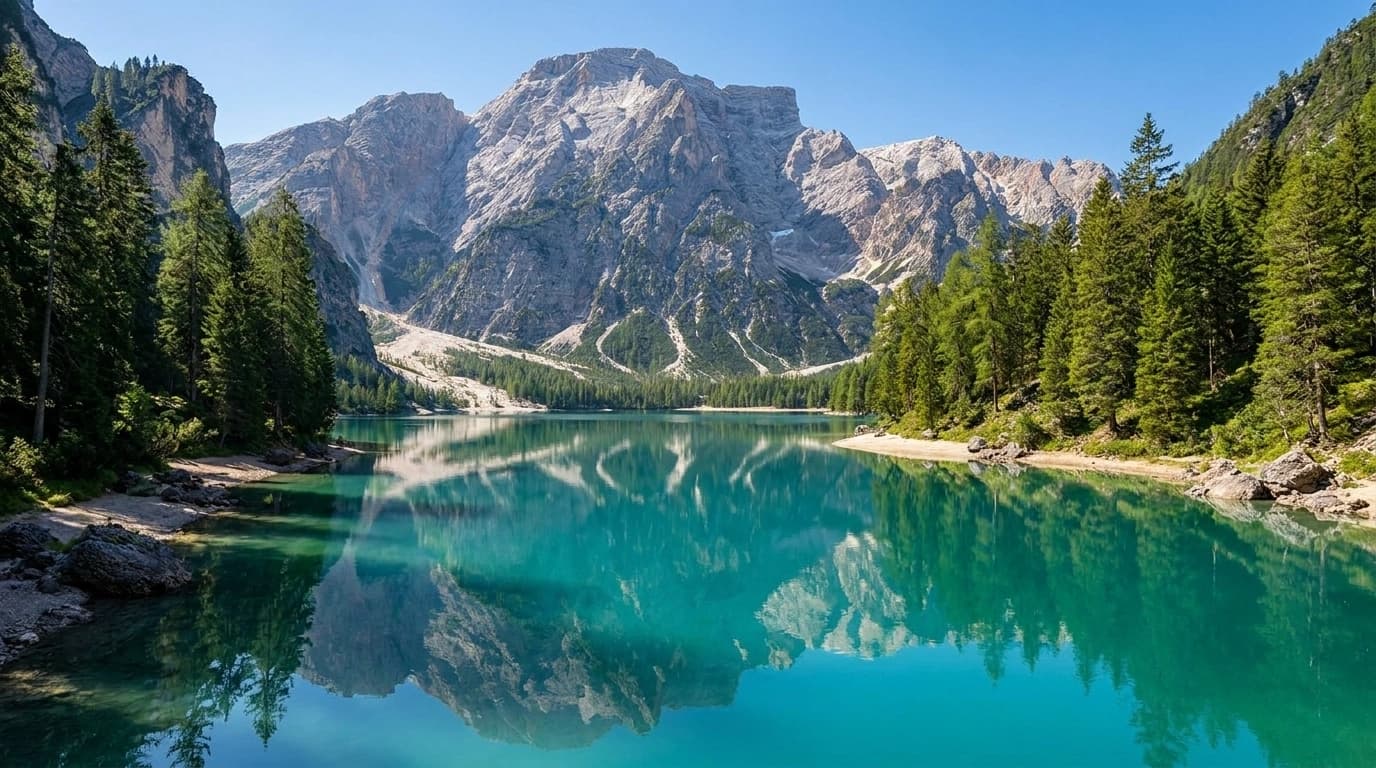
North of the vineyards, the land rises into the Dolomites, a range unlike any other in the Alps, of pale, sheer limestone towers that the old name calls the Pale Mountains, turning rose and gold at either end of the day in a phenomenon the locals have a word for. Eighteen peaks rise above three thousand metres; the whole range was inscribed by UNESCO in 2009 for the sheer drama of its geology. It is a landscape of high meadow and vertical rock, of ski circuits that link valley to valley in winter and of trails that cross the same country on foot in summer, and it has produced one of the most refined mountain cultures in Europe.
The surprise is the country it sits in. South Tyrol, Alto Adige, Südtirol, was part of Austria until the end of the First World War, and it has never stopped being, in most of its rhythms, Tyrolean. The majority first language is German. In the high valleys, an older language again survives: Ladin, a Romance tongue descended directly from the Latin of the Roman soldiers, spoken now by only a few tens of thousands of people in a handful of valleys, where the wood-carving tradition is centuries deep. The food is speck and dumplings and strudel as much as pasta; the architecture is alpine; the wine is among the best white wine in Italy. It is Italian by passport and, for a thousand years before that, something else, and the seam between the two is one of the most interesting things in the country.
“The most famous city in the world, experienced as almost no one experiences it. A mountain range so singular it is a World Heritage Site. An Italy where the first language is German. All within two hours of each other.
What the north carries.
The two halves share a long memory. Venice's was an empire of the sea; South Tyrol's was the southern frontier of the Habsburg world, a mountain march fought over for centuries. The seam between Italy and the German-speaking lands runs straight through these valleys, and it is written in the names, the languages, and the cooking. It is also written, more strangely, in the ice: in a glacier high in the Ötztal Alps, a five-thousand-year-old man emerged from the melting ice a generation ago, the oldest natural human mummy in Europe, and now lies in a museum in the regional capital, a reminder that people have been crossing these passes since before recorded history. The north of Italy is not the country's pretty edge. It is one of its deepest and most layered interiors.
How it feels to be there.
The two settings keep opposite rhythms, and the pleasure is in the contrast. Venice is for the slow unfolding, mornings on the water before the day boats, a vaporetto out across the lagoon, long lunches and the particular Venetian evening when the light goes amber off the canals and the city empties of everyone who is leaving on the last train. The Dolomites are for the air and the movement, the walk or the ski out of the valley into the high meadows, the hut lunch with the peaks overhead, the cold clear evenings and the wood-panelled warmth afterwards, the deep quiet of mountains at night. To begin in the lagoon and end in the mountains, or the reverse, is to travel between two worlds without leaving one country, and to understand that Italy is far larger than the circuit makes it.
What we look for when we plan a stay here.
Northern Italy rewards a trip that pairs the lagoon and the mountains rather than treating either as a stop on a longer dash, and that gives Venice the time it needs to become more than its set-piece. The drive or the train between the two is short and beautiful, and the contrast is the entire point.
What we look for here: in Venice, a base that puts the city's quieter, residential side within reach and a private boat that turns the lagoon from an obstacle into the experience, the back canals, the outer islands, the early mornings the day-trippers never see. In the mountains, a base in the heart of the Dolomites with the high country on the doorstep, for the walking and the skiing and the Ladin culture of the valleys. The Veneto in between, the Palladian villas, the Prosecco hills, for those who want the link made properly rather than driven through. And the whole thing arranged so the city and the mountains each get the days they deserve.
Through our network we have access to arrangements across Venice, the Veneto, and the Dolomites that sit within this standard. Each is arranged personally, matched to the season and the temperament of the trip, and handled end-to-end, the arrival, the private boat on the lagoon, the transfer up into the mountains, and the rhythm between them.
Who northern Italy is right for.
Not those who want Venice for an afternoon on the way to somewhere else. That version of the city is widely available, extremely crowded, and gives almost nothing of what the place actually is.
This is for travellers who have understood that the most famous places reward the longest stays, and who want the Italy beyond the circuit they have probably already done. For couples who want the romance of the lagoon and the clear air of the mountains in a single trip. For families who want a city on the water and then a summer of high meadows or a winter of snow. For the culturally curious, drawn to a Venice read slowly and an Italy that turns, an hour to the north, into somewhere that does not sound Italian at all. And for the traveller who has done Rome and Florence and wants to find out how much more of the country there is.
The Venetian Republic ran the sea for a thousand years and has been gone for two hundred, and the city it left is sinking slowly into the lagoon it was built on. The Dolomites were a coral reef on the floor of a tropical sea before they were mountains, and rose into the pale towers over a span of time that makes the republic look like an afternoon. The man in the ice walked these passes five thousand years ago. These timescales sit on top of each other across the top of Italy, and the argument for going is the argument for the country that the postcard, and the afternoon in Venice, leave entirely out.
When to visit northern Italy
The two halves of the trip have almost opposite calendars, which is part of what makes the pairing work across the year. Venice and the Veneto are at their best in the shoulder seasons, roughly April to June and September to October, when the weather is kind, the light is at its finest, and the worst of the summer crowds and heat have not arrived or have eased; high summer is hot, busy, and prone to the smell of the canals at low water, while winter is atmospheric, quiet, and cold, with the chance of the acqua alta that floods St Mark's. The Dolomites run two seasons: the summer hiking season from roughly late June through September, when the high meadows are in flower and the trails and huts are open; and the winter ski season from roughly December through March, when the linked circuits are running. The ideal pairing depends on the trip, a late-spring lagoon with a summer mountain, or an autumn Veneto with the first snow above, and the planning is largely a matter of matching the two calendars to the kind of trip you want.
How to get to northern Italy
Venice Marco Polo (VCE) is the natural gateway for the lagoon, with direct connections from across Europe and a growing number of long-haul routes, and the romance of arriving in the city by boat directly from the airport rather than overland. For the Dolomites, the most convenient gateways are Venice, Verona (VRN), and Innsbruck (INN) just over the Austrian border, with the mountains reached by a scenic road transfer of two to three hours up into the valleys; the regional capital, Bolzano, has a small airport and a fast rail link. The two halves of the trip are linked by a short and beautiful drive or train up from the plain into the mountains. Private jets route into Venice, Verona, and Innsbruck, with helicopter transfers available into the Dolomite valleys. We coordinate the arrival, the private boat in the lagoon, the transfer to the mountains, and the timing of the whole route ourselves.
Where to stay in northern Italy
A considered northern-Italy trip works around its two contrasting bases. Venice is the first, and the right base is one that places you within the living city and gives access to a private boat and the lagoon, rather than on the crowded route between the station and the square. The Veneto, between the two, is for the villas, the wine, and the gentle link from the plain to the mountains. And the Dolomites are the counterpoint, a base in the heart of the range, in one of the Ladin or Tyrolean valleys, with the high country on the doorstep for walking or skiing and the alpine culture all around. A week pairs the lagoon and the mountains; a longer trip gives the Veneto its own days in between.
We do not publish a property list. The places we arrange across the north are matched once the brief is clear, the Venetian base on the quieter side of the city with the boat to read the lagoon, the mountain base in the heart of the Dolomites for the air and the culture. What we will say is that the right Italian trip is almost never the one that gives Venice an afternoon and the north a miss. It is the one that reads the lagoon slowly and then climbs into the mountains behind it.