The Scottish Highlands arrive for most visitors as a route. There is a road, and a set of stops along it that have been photographed so many times they have become a kind of itinerary in themselves: a castle on a loch, a glen with a famous name, a distillery with a tour, and, almost always, a pause on the shore of Loch Ness, camera pointed at the water, in case. It is a real journey, and a beautiful one, and a great many people drive it every summer and come away genuinely moved by the scale of the place. What almost none of them do is stop driving.
Because the part of the Highlands that rewards stopping does not sit on the road. It sits to the east of it, in a block of mountains that is the closest thing Britain has to the Arctic, wrapped in the last great fragments of a forest that once covered the whole of the Highlands, and it is, at this particular moment in its history, the one stretch of the country that is being actively brought back to life.
The Cairngorms are the largest national park in the United Kingdom, and the high ground at their centre is unlike anything else in the country: a plateau above the tree line that holds a genuine subarctic climate, where the weather, the plants, and the wildlife belong to latitudes far further north. Around its flanks lie the Caledonian pinewoods, Rothiemurchus, Abernethy, Glen Feshie, the surviving remnants of the ancient forest of Scots pine that has stood here since the ice withdrew, and that now exists across only a small fraction of the ground it once held. Through the country to the north runs the Great Glen, a single straight geological fault that splits the Highlands corner to corner and holds, in its trench, the largest body of fresh water in Britain. And across much of it, on the great estates that a century of too many deer left stripped bare, the forest is beginning, deliberately and at last, to grow back.
This is where this begins.
What the mountains actually are.
The Cairngorm massif is the largest area of high mountain ground in the British Isles, and the only part of the country that can reasonably be called Arctic. Five of Scotland's six highest peaks stand here; Ben Macdui, the second-highest mountain in Britain after Ben Nevis, rises to a little over one thousand three hundred metres. But the height is not really the point, the plateau is. Above roughly the thousand-metre line the Cairngorms flatten into a vast, open tableland of frost-shattered granite, sub-zero for much of the year, scoured by some of the highest winds ever recorded in Britain, and holding in its north-facing corries the longest-lasting snow in the country. The plants that grow up there, dwarf willow, alpine flowers, deep cushions of moss, are the same species found in Lapland and Svalbard. The birds are ptarmigan, dotterel, and snow bunting. It is, in every sense that matters, a piece of the Arctic that the rest of Britain happens to be attached to.
The park around it, declared in 2003, and the largest in the United Kingdom, protects not just the plateau but the whole graded landscape that falls away from it: the high tundra, then the montane scrub, then the pine forest, then the strath with its river and its fields. That full sequence, intact and connected, is rarer in Britain than any single rare species, and it is the reason the Cairngorms hold the concentration of wildlife they do.
What the forest remembers.
After the last ice age, a forest of Scots pine, birch, and juniper spread across most of the Highlands. It is called the Caledonian forest, and the Romans knew it by name. Over the centuries that followed it was felled, burned, and, most lastingly, eaten: grazed flat by sheep and by the enormous numbers of red deer kept on the sporting estates, so that for generations no young tree could survive its first summer. What remains of the original forest today stands on only a small fraction of its former ground, and the greatest surviving fragments are here, in the Cairngorms, the old pinewoods of Rothiemurchus, Abernethy, and Glen Feshie, where Scots pines three and four hundred years old, the granny pines, stand widely spaced over heather and blaeberry with the mountains behind them.
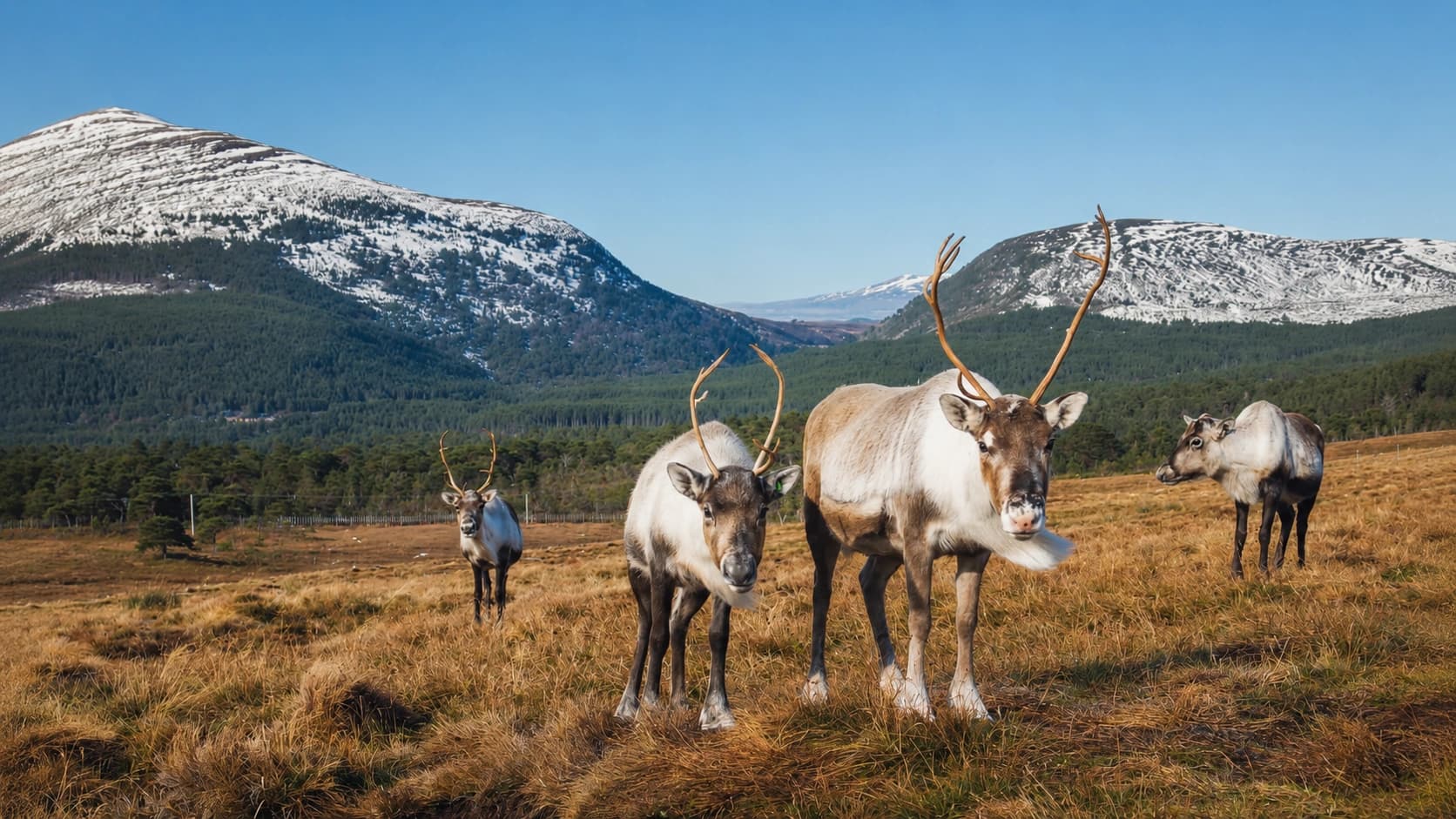
What the forest holds is the rarest wildlife in Britain. The capercaillie, a turkey-sized grouse of the old pinewoods, survives in the country now almost only here, and even here only just. The Scottish crossbill, which feeds on the pine cones, is the single bird species found nowhere on earth but Scotland. The osprey, lost to Britain for most of the twentieth century, returned to nest at Loch Garten in these forests in the 1950s and was watched back from the brink by more or less the entire country. Golden eagles ride the ridges. Pine martens and red squirrels move through the canopy, this is one of the last strongholds where the red squirrel has not been displaced, and the Scottish wildcat, the only native cat left in Britain and among its most endangered animals, holds on at the forest's edges. And on the open slopes of Cairn Gorm itself ranges the only herd of reindeer in the country, brought here from Swedish Lapland in 1952 and left free on exactly the kind of ground they were built for.
“The only Arctic in Britain. The last great stand of a forest the Romans named. The single bird species found nowhere else on earth. And a country, very slowly, putting all of it back.
What is being put back.
The most interesting thing happening in the Highlands right now is not a place you can photograph in an afternoon. It is a change in the way the land is being held. For more than a century the great Highland estates were managed for one thing above all, red deer, kept in numbers far beyond what the ground could carry, for the stalking, and the price of those numbers was the forest, which could not regenerate under the pressure of so many mouths. Over the last few decades, on a growing number of these estates, that calculation has been reversed: deer numbers brought down hard, and the land simply left to do what it had been waiting to do. The result, in places, has been astonishing. Hillsides that were bare grass and heather for as long as anyone could remember are filling, on their own, with young pine, birch, willow, and aspen, the forest returning without a single tree being planted, from seed that was in the ground the whole time.
Glen Feshie, on the western edge of the Cairngorms, has become the most closely watched example of this in Britain, a glen where the regeneration is now visible by the year, and where the woodland is climbing back up towards a tree line the country had nearly forgotten it was meant to have. It is part of a larger effort: a partnership of neighbouring landholders working to a two-hundred-year plan to restore and reconnect the habitats across a great block of the central Highlands. Two hundred years is the honest timescale of a forest, and stating it plainly is the point. This is not landscaping. It is the slow, deliberate undoing of a century of damage, and it is happening now, on ground you can walk through, in the company of the people doing it.
What the glen holds.
North of the mountains, the land is cut clean in two. The Great Glen is a single geological fault, a straight diagonal slash running the full width of the Highlands, from Inverness on the east coast to Fort William on the west, along which the two halves of the country slid past each other in the deep geological past and have been grinding slowly ever since. The trench it left holds a chain of long, deep lochs, joined since 1822 by the Caledonian Canal, the engineer Thomas Telford's improbable staircase of locks that lets a boat cross Scotland coast to coast through the middle of the mountains.
The largest of those lochs is Loch Ness, and it is far stranger than its reputation. It is not especially wide, and from the road it can look almost ordinary, but it runs more than thirty kilometres long, over two hundred metres deep, and holds more fresh water than every lake in England and Wales combined. Its water is stained near-black with peat, so that visibility falls to nothing a few metres down; this, more than anything, is the real source of the folklore. The monster is a twentieth-century story, the modern legend dates only to 1933, and its most famous photograph was admitted, decades later, to be a hoax, and the queue of cars on the shore is the price the loch pays for it. The loch itself, seen properly from the water at the right hour, with Urquhart Castle on its bank and the glen walls falling straight into the dark, needs no monster at all.
At the glen's eastern end sits Inverness, the capital of the Highlands, where the River Ness runs out into the Moray Firth, home to the most northerly resident population of bottlenose dolphins in the world. And a few miles east of the town lies Culloden, the moor where, in 1746, the last pitched battle on British soil was fought and the Jacobite cause ended in under an hour. The battlefield is kept as it was, open and unadorned, the clan graves marked in the heather. Any week in these Highlands that takes the castles and the whisky and skips Culloden has, like a Cape week that skips the apartheid past, not quite understood the country it is standing in.
How it feels to be there.
The central Highlands move at the pace of the forest and the river, which is to say slowly, and they reward those who let them. Mornings belong to the pinewoods, walking out under the granny pines with a stalker or a forester who can show you the regeneration happening at your feet, the tracks in the soft ground, the sign of the capercaillie, or to the Spey, the fastest of Scotland's great rivers and one of its finest for salmon, where a day with a ghillie is a day spent reading water. The middle of the day opens out: up onto the plateau for those who want the high ground and the Arctic light, or along the glen and the loch by boat. Afternoons soften into the long northern evenings, which in June barely end at all. And the evenings themselves, very often, end with a dram, because this is also Speyside, the valley of the River Spey, which holds the greatest concentration of malt whisky distilleries anywhere in the world, roughly half of Scotland's total within an hour's drive of one another.
The food has caught up with the land. The Spey salmon and the hill venison, the venison a direct product of the deer management that is bringing the forest back, which gives eating it a certain rightness here, anchor a regional table that the better estates and the restaurants of Speyside and Deeside now take seriously. And the whisky is not an add-on but a genuine expression of the place: the water, the peat, the barley, and the cool damp air of the glen are the reasons the spirit tastes the way it does, and tasting it where it is made, in the valley it is named for, is a different thing entirely from drinking it anywhere else.
What we look for when we plan a stay here.
The central Highlands reward a base set inside the landscape rather than beside it, a house in the pinewoods, a lodge on the river, an estate on the loch, from which the forest, the hill, and the water are stepped into rather than driven to. The difference between a trip that works here and one that does not is, as ever, the people: the stalker who knows where the deer and the forest stand in the long argument between them, the ghillie who knows the river, the guide who can read the regeneration as a story rather than a view.
What we look for here: properties that sit within the regenerating estates and the old pinewoods, the ones where staying is itself a way of being inside the restoration rather than looking at it across a fence, or on the shore of the loch and the glen, with private access to the river, the hill, and the forest. The right guiding: a forester or stalker who can walk you through what is actually happening to this land, a ghillie for the Spey, the access to the working distilleries that a public tour does not give. And the timing set to the season, because the central Highlands in October, the deer roaring on the hill, the birches gold, the river full, are a wholly different country from the same ground under June's midnight light.
Through our network we have access to estates and lodges across the Cairngorms, Speyside, and the Great Glen that sit within this standard. Each is arranged personally, matched to the group and the season, and handled from the Inverness arrival onward.
Who the central Highlands are right for.
Not those who want the Highlands as a drive, the castle, the loch, the photograph, and on by lunchtime. That version exists, is genuinely beautiful, and is exactly what the main road is for.
This is for travellers who have understood that the most interesting thing a landscape can be doing is changing for the better, and who would rather walk through a forest coming back than past one that is merely there. For families with children old enough to grasp what they are seeing, a glen filling with trees, a reindeer herd on an Arctic hill, the last of a vanished forest, and to remember it. For couples who have done the famous Highland drive and want the country it passes through without stopping. For those who care about wild places not as scenery but as living systems, and who find a particular satisfaction in seeing one put right. And for anyone who takes whisky, or salmon, or mountains seriously enough to want them at their source.
The pines in these forests can be older than the country around them. The rock beneath the glen has been grinding along its fault for hundreds of millions of years. The canal that joins the lochs opened in 1822; the national park was declared in 2003; the plan to restore the forest is written in units of two hundred years, which means almost no one alive to begin it will see it finished. None of these timescales contradict each other. They simply exist on top of each other, across a landscape older than all of them that is, for once, being handed forward in better condition than it was received. The argument for going is the argument for seeing a wild place at the rare moment it is winning.
When to visit the Cairngorms and the Great Glen
The central Highlands have four genuine seasons, and each is a different trip. Late spring, May and June, is arguably the finest: the ospreys back on the nest, the capercaillie at their dawn display, the birches in new leaf, and the light stretching towards the midsummer nights when, this far north, it scarcely gets dark at all. High summer, July and August, is the warmest and busiest, with the long days and the full calendar, though it is also midge season in the damp and the still air, a genuinely Highland fact of life that the right planning works around. Autumn, from late September into October, is the other peak and for many the best of all: the red deer rut, when the stags roar across the hill; the forests and birches turning; the salmon running the Spey; and the whisky and the fireside coming into their own. Winter brings snow to the plateau and skiing at Cairn Gorm and Glenshee, the reindeer in their element, the fewest visitors of the year, and, at this latitude, on a clear cold night, a real chance of the aurora. Booking lead times for the better estates run four to six months in the high seasons, considerably more for the autumn sporting weeks.
How to get to the Cairngorms and the Great Glen
Inverness (INV) is the gateway airport, the capital of the Highlands, at the head of the Great Glen, with direct connections from London, Amsterdam, and a growing number of other European hubs, and only thirty to forty minutes from the northern Cairngorms and Loch Ness alike. Edinburgh (EDI) and Glasgow (GLA) are the larger international gateways, with the broadest long-haul connections; from either, the central Highlands are about two and a half to three hours north by road, or by the Highland Main Line railway, which climbs up through Perth and the Drumochter pass to Aviemore and Inverness and is one of the more scenic train journeys in Britain. The Caledonian Sleeper from London Euston is the other way in, and the best, boarding in the city at night and waking among the mountains, with stops at Aviemore and Inverness, a journey worth treating as part of the trip rather than the means to it. Private jets route most easily into Inverness. We coordinate the arrival, the transfers, and the routing between the Cairngorms, Speyside, and the glen ourselves.
Where to stay in the Cairngorms and the Great Glen
The region works around three settings, and the best weeks use two of them. The Cairngorms and Speyside side, the country around Aviemore, Kingussie, and Glen Feshie, is the heart of the forest, the river, the regeneration, and the whisky, and the natural base for the pinewoods and the high ground. The Great Glen and Loch Ness, Inverness, the loch, the canal, and the country around Culloden and the Moray Firth, is the base for the water and the history, and the easiest arrival. Royal Deeside, on the park's eastern side around Ballater and Braemar, is the third: the Dee valley, the country the royal family chose for itself at Balmoral, with the Highland games at Braemar each September. A week that combines the forest side with either the glen or Deeside sees the central Highlands whole.
We do not publish a property list. The estates and lodges we arrange across the central Highlands are matched once the brief is clear, the pinewood house for the forest and the river, the lochside base for the glen and its history, the Deeside estate for the eastern park. What we will say is that the right place here is rarely the grandest. It is almost always the one set deepest inside the land that is being given back to itself.