Malta arrives, for a great many people, as a budget proposition. A short cheap flight, reliable sun, a beach, English spoken everywhere, a package that asks very little and costs about the same. It is one of the most underestimated places in Europe, and the underestimation is almost structural, the island has been so accessible and so affordable for so long that the wider world has filed it under value rather than wonder, and a great many visitors never look past the resort strip and the lido.
Which is a remarkable thing to have happened to one of the most historically dense places on the face of the earth. Malta is a small archipelago in the exact middle of the Mediterranean, and that position, astride the narrows between Europe and Africa, between the eastern and western halves of the sea, has made it, for seven thousand years, a place worth fighting for. Phoenicians, Carthaginians, Romans, Byzantines, Arabs, Normans, the Knights of St John, Napoleon, and the British each took their turn, and each left a layer. The result is a few small islands carrying more history per square mile than almost anywhere on the continent.
And the headline is genuinely astonishing: on these islands stand the oldest free-standing stone buildings in the world. The megalithic temples of Malta and Gozo were raised by a vanished people more than five and a half thousand years ago, older than the pyramids of Egypt, older than Stonehenge, among the very first monumental structures humanity ever built. The visitor who comes for the beach and leaves having seen only the beach has stood on the doorstep of all of this and never knocked.
This is where this begins.
What the island actually holds.
Begin with the temples, because nothing else on earth is quite like them. Scattered across Malta and the smaller island of Gozo, the megalithic complexes were built between roughly 3600 and 2500 BC by a Neolithic culture that flourished, raised some of the largest stone structures of its age, and then mysteriously vanished, leaving behind temples aligned to the solstices, carved with spirals, and, beneath the surface, an extraordinary underground necropolis cut into the living rock across three levels, the only prehistoric subterranean temple in the world. These are not ruins to glance at on the way to lunch. They are, with Stonehenge and the pyramids, among the founding monuments of human civilisation, and Malta has more of them than anywhere.
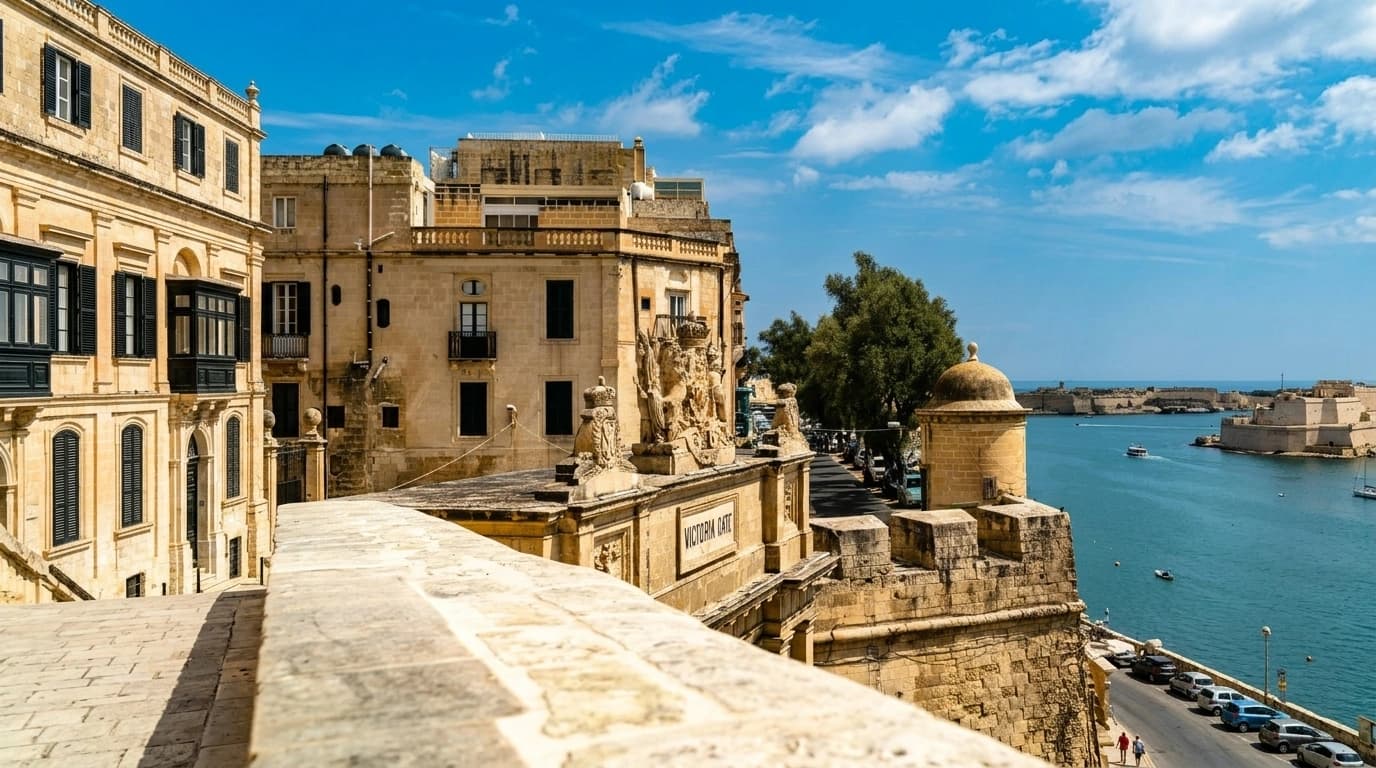
Then the Knights. In 1530 the Knights of St John, the crusading order, expelled from Rhodes, were given Malta, and in 1565 they held it, against enormous odds, through one of the most famous sieges in European history, turning back the Ottoman fleet at the high-water mark of its advance into the western Mediterranean. In the aftermath they built Valletta: a fortress-city raised from nothing on a rocky peninsula between two great harbours, a planned baroque capital of golden limestone, named for the Grand Master who had led the defence, and today a UNESCO World Heritage Site. Within it, in the Knights' own co-cathedral, hangs the work that alone would justify the journey: the largest and only signed painting by Caravaggio, who fled to Malta as a fugitive, was made a Knight, and painted here before fleeing again, a vast, dark, devastating canvas that is one of the supreme achievements of European art, hanging in the room it was painted for.
And around the famous sites, the island itself. Mdina, the old capital, the Silent City, is a walled hilltop town of palaces and narrow shaded lanes, almost without traffic, where the Maltese nobility still keep their houses; the quiet villages of the island's centre hold the baroque parish churches and the honey-stone palazzi of an inland Malta the coast never shows. The Maltese language, spoken nowhere else, is a Semitic tongue written in Latin letters, a direct survival of the island's Arab centuries, and the only language of its kind in the European Union. And Gozo, the greener, slower sister island, holds the oldest temple of all and a rural Malta that the modern island has largely left behind.
“The oldest free-standing buildings on earth. The siege that turned back an empire. A Caravaggio in the room it was painted for. A rock the whole sea has fought over for seven thousand years.
What the island carries.
Every conqueror left a layer, and the island wears all of them at once. The Semitic language is the Arab centuries; the baroque churches and the auberges of Valletta are the Knights; the red telephone boxes, the side of the road they drive on, and the English everyone speaks are the British, who held Malta as a naval fortress for a century and a half and whose island endured one of the most concentrated bombardments of the Second World War, for which the entire population was collectively decorated, a distinction still carried on the national flag. To walk a single street in Valletta is to pass through all of it: a Phoenician foundation, a medieval wall, a baroque palace, a British letterbox, a Maltese conversation. Few places of comparable size carry so much, so openly.
How it feels to be there.
The pleasure of Malta done properly is the pleasure of staying inland, in the honey-stone heart of the island, and letting the depth come to you rather than chasing the coast. Mornings are for the great sites before the day's heat and the day's crowds, the temples, Valletta, Mdina at first light when the Silent City lives up to its name. The middle of the day, in the Mediterranean way, slows to nothing in the shade of a walled garden or a courtyard. Late afternoons return to the sea, the island's coast is rock and clear water and sea caves rather than long sand, and it is at its best from a boat, slipping into a cove or crossing to the blue lagoon between the islands. Evenings are long and warm, on a terrace above the honey stone, over the genuinely good Maltese table, the island's own bread, its rabbit, its fish, its wine. The package island never finds this. It is a few streets and a short boat ride away, and it is a different country.
What we look for when we plan a stay here.
Malta rewards a stay that treats the island as a place of extraordinary depth rather than a beach with sun attached, based inland or in the historic heart, with the great sites reached early and the coast taken from the water. The island is small enough to know well in a few days, and the difference between a memorable stay and a forgettable one is entirely in whether the history is allowed in.
What we look for here: a base in the historic, honey-stone interior, a restored Maltese house away from the resort strip, with the privacy and calm of a private home. Real access to the great sites, properly timed and properly guided: the temples and the underground necropolis, Valletta and the Caravaggio, Mdina at the right hour. The coast experienced from a private boat, the coves, the caves, the crossing to Gozo and the lagoon, rather than from a crowded beach. And the genuine Maltese table and the quiet villages, rather than the international strip.
Through our network we have access to arrangements across Malta and Gozo that sit within this standard, including restored historic houses in the island's quiet centre. Each is arranged personally, matched to the season and the trip, and handled end-to-end, the arrival, the private guiding, the boat, and the rhythm of the island.
Who Malta is right for.
Not those who want a sun-and-sand package and nothing of the country behind it. That Malta is widely available and very cheap, and there is no need to improve on it if the lido is all the island is being asked to be.
This is for travellers who have understood that the most rewarding places are rarely the ones with the biggest reputation, and who are drawn to genuine, layered history. For the culturally serious, for whom the oldest buildings on earth, a Caravaggio in situ, and a baroque fortress-capital are reason enough to cross a continent. For couples who want warmth, the sea, and somewhere with a soul rather than a strip. For families with children old enough to be marked by standing inside a temple older than the pyramids. And for the seasoned Mediterranean traveller who has done the famous coasts and wants the small, dense island the whole sea once fought over.
A vanished people raised the temples five and a half thousand years ago and left no name. The Knights held the island against an empire and built a city out of the victory. Caravaggio painted his masterpiece here while running from a death sentence. The island endured a war that earned it a medal still on its flag. These timescales sit on top of each other across a few small islands in the middle of the sea, and the argument for going is the argument for the place the cheap flight delivers you to and almost no one ever actually sees.
When to visit Malta
Malta has one of the sunniest, mildest climates in Europe, and a long season. The shoulder months, roughly April to June and September to October, are the finest: warm, sunny, and comfortable, with the sea warm enough to swim and the great sites bearable in a way the high-summer heat does not allow. High summer, July and August, is hot, dry, and busy, with the island at its most crowded and the midday sun fierce, best spent on the water and in the shade, with the sites taken early. Winter, roughly November to March, is mild, green, and very quiet, with the occasional storm; it is an excellent time for the history and the towns, if too cool for much swimming, and the light on the honey stone is at its softest. The island's festas, the village feast days, with their fireworks and processions, run through the summer and are worth catching. As a general rule, spring and autumn give the best balance of weather, sea, and the chance to see the great sites in something like peace.
How to get to Malta
Malta International (MLA), a short drive from anywhere on so small an island, is exceptionally well connected across Europe and the Mediterranean, with direct flights from a great many cities and easy onward links from the major hubs. The island is tiny, nowhere is more than a short drive from anywhere else, and the historic interior, Valletta, and the coast are all within easy reach of one another. Gozo is reached by a short ferry or, more quickly, by helicopter or fast launch. Private jets route into Malta International. We coordinate the arrival, the transfers, the private guiding and boat, and the timing of the whole trip ourselves.
Where to stay in Malta
A considered Malta stay works from the historic, honey-stone interior rather than the resort coast. The island's quiet centre, the old villages and towns between the capital and the silent old city, is the natural base, a restored Maltese house within easy reach of everything, away from the strip. Valletta itself, the fortress-capital, is the cultural heart and the place of the Caravaggio and the Knights. The coast is for the boat days, the coves, the caves, the lagoon. And Gozo, the slower sister island, is the onward option for those who want the rural Malta and the oldest temple of all. A few days takes in the great sites and the sea; a longer stay adds Gozo and the deeper corners.
We do not publish a property list. The places we arrange across the islands are matched once the brief is clear, the restored house in the quiet interior, the right access to the temples and the Caravaggio, the private boat for the coast, the onward leg to Gozo. What we will say is that the right Malta stay is almost never the one on the resort strip. It is the one in the honey-stone heart of the island, from which seven thousand years of history are an easy morning away.