Japan arrives for most visitors in a familiar order. Tokyo first, because that is where the plane lands and where the city of the twenty-first century is at its most complete. Then the Shinkansen to Kyoto, for the temples and the gardens and the particular kind of distilled Japaneseness that has been constructed and maintained there across twelve centuries. Perhaps an evening in Osaka for the food, a night in a ryokan in Hakone for the view of Fuji, a quick detour to Nara for the deer. Ten days. Two hundred photographs. A flight home. An excellent trip, and a genuinely Japanese one.
What the standard route does not include is the body of water between Osaka and the southern island of Kyushu, a sheltered inland sea the size of Belgium, containing more than three thousand islands, and hiding, among the small fishing communities along its coasts, one of the most sustained and unusual cultural projects of the late twentieth century.
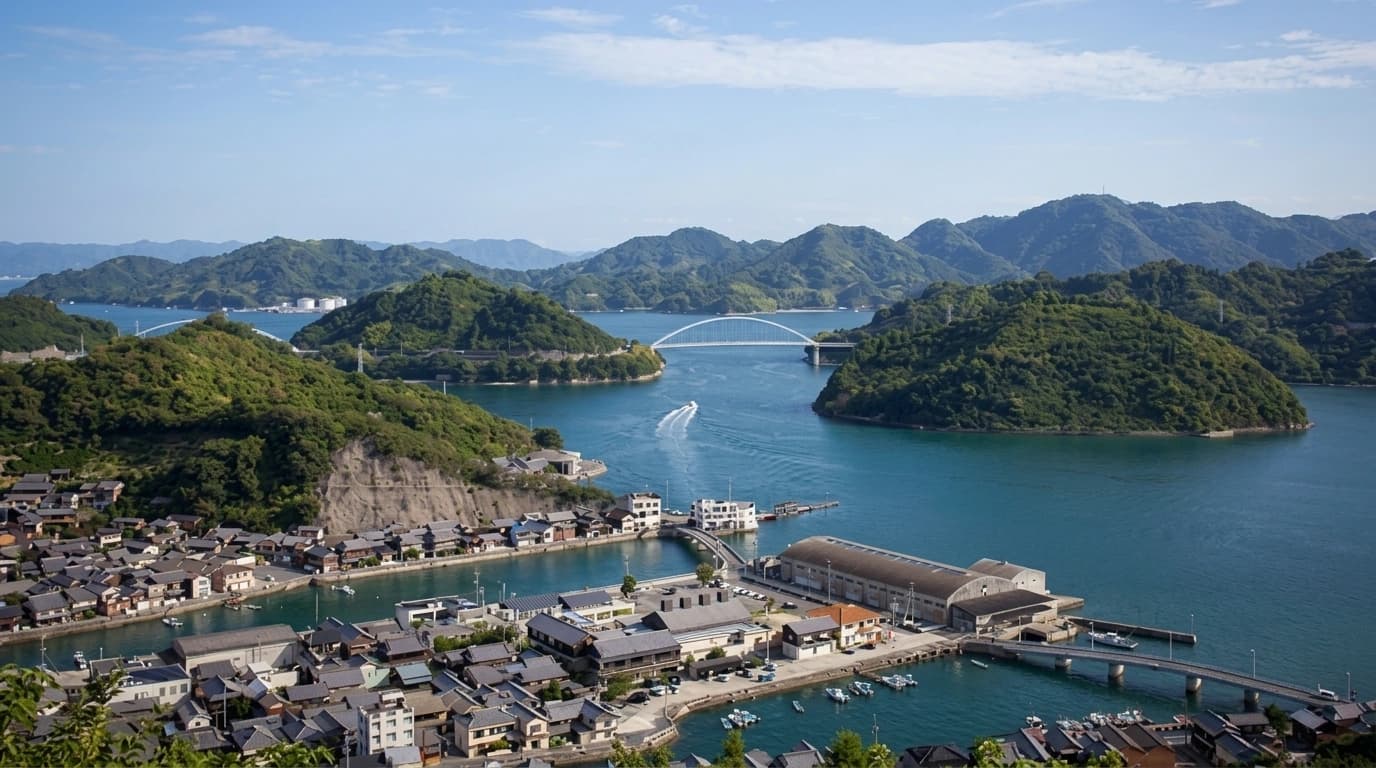
The Seto Inland Sea, the Setouchi, was the main artery of Japanese civilisation for more than a thousand years before the roads were built. The trading ships that carried rice from the south and silk from the west, the warships of the Genji and the Heike clans, the imperial envoys and the Buddhist missionaries all moved through these waters. It is, by some margin, the most historically dense body of water in Japan. And it has, in the last forty years, quietly become something else: a region where some of the country's most serious artists, architects, and cultural foundations have built an archipelago-wide landscape that the Japanese themselves describe as a museum, but which is something considerably more unusual than that.
This is where this begins.
What the inland sea actually is.
The Seto Inland Sea is the stretch of water enclosed on three sides by the main Japanese islands of Honshu, Shikoku, and Kyushu. It runs for roughly four hundred and fifty kilometres east to west, varies between fifteen and fifty kilometres wide, and covers an area of approximately twenty-three thousand square kilometres. The three thousand islands within it, of which several hundred are inhabited, range from mountainous territories with their own towns and traditions down to tiny rocks with a single shrine and a pine tree. The water is sheltered, calm in a way the Pacific side of Japan is not, and warm enough through most of the year to keep the climate around it notably milder than the rest of the country. This is why the old civilisation concentrated along these shores: the sea was navigable year-round, and the land was reliably fertile.
The islands carry an extraordinary density of specific local cultures. Shōdoshima, the second-largest island in the sea, has been producing soy sauce and olive oil for several centuries; its olive groves, planted in 1908, were the first in Japan and remain among the oldest continuously worked. Okunoshima, off the Hiroshima coast, is best known now for its population of wild rabbits but carries a darker history as the site of Japan's wartime poison gas production. Itsukushima, more widely known as Miyajima, holds the famous floating torii gate of the Itsukushima Shrine, one of the most photographed religious sites in Japan, UNESCO-listed since 1996. Naoshima, until the late 1980s an unremarkable island of about three thousand people, declining like much of rural Japan, is the centre of what has become the region's most extraordinary recent story.
In 1987 the Japanese publishing magnate Soichiro Fukutake began buying land on Naoshima with the intention of creating what he described as a project to restore rural Japan through contemporary art. He commissioned the architect Tadao Ando to design a first museum, which opened in 1992. Over the following three decades the project expanded, first across Naoshima and then to the neighbouring islands of Teshima and Inujima, into what is now a permanently installed archipelago-wide art landscape. Chichu Art Museum, buried into a hillside on Naoshima, holds five paintings by Monet in a naturally lit chamber designed specifically for them. Teshima Art Museum, by the architect Ryue Nishizawa, is a single concrete dome with two oval openings to the sky and a water installation by the artist Rei Naito that responds to weather and season. Lee Ufan Museum, also on Naoshima, is a single-artist space designed by Ando. Yayoi Kusama's yellow pumpkin stands at the end of a pier on Naoshima, in what has become one of the most photographed contemporary artworks in the world. The Art House Project, in Naoshima's old village of Honmura, is a program in which abandoned traditional houses have been converted into permanent installation works by Japanese artists. The island hosts, every three years, the Setouchi Triennale, a major contemporary art festival spread across a dozen islands, drawing international visitors who stay for weeks. Between festivals, the work remains.
“A Monet, a Turrell, a Kusama, and a Tadao Ando museum, all of them permanently installed on a small rural island in the inland sea, as part of a forty-year project to rebuild the villages through art.
What Kyoto keeps.
The other half of a Setouchi trip is Kyoto, which sits a two-hour train journey away and is the cultural anchor the islands are not quite trying to be. Kyoto was the imperial capital of Japan for more than a thousand years, from 794 until the court's move to Tokyo in 1868, and it escaped the firebombing that destroyed most of the rest of the country's major cities during the Second World War. What remains, therefore, is one of the most intact traditional cities in East Asia: more than two thousand Buddhist temples and Shinto shrines, seventeen UNESCO World Heritage sites within the city alone, entire neighbourhoods of wooden machiya townhouses that have been continuously occupied for three or four hundred years, and a set of traditional craft industries, the tea ceremony, ikebana, kyō-yuzen silk dyeing, kyō-shikki lacquerware, Nishijin weaving, that have been refined, generation over generation, in the same workshops in the same streets for the better part of a millennium.
Kyoto is a city that has been photographed exhaustively, and almost none of the photographs capture what it is actually like to be there. The city rewards patience and quiet in a way that a weekend visit cannot really provide. Mornings in a temple garden, in the first hour after opening, before the coach parties arrive. An afternoon spent watching a Nishijin weaver work a piece of silk that will take her eight months to finish. An evening in one of the older ryōtei restaurants in Gion, where kaiseki dinners are served across ten or fifteen small courses over two and a half hours, each course using ingredients chosen for a specific day in the year and presented on a specific piece of pottery fired for that kind of food. This is the city at the pace it requires. Anything faster produces the photographs and misses the place.
The neighbourhoods matter. Gion and Pontocho hold the older geisha and maiko districts, which still function as working entertainment quarters rather than historical recreations. Higashiyama runs up the eastern hills through a succession of temples, shrines, and preserved streetscapes that are among the most photographed in Japan, and are worth photographing. Arashiyama, to the west, holds the famous bamboo grove and a string of small temples and gardens that reward a full day. And the Philosopher's Path, Tetsugaku no Michi, is a stone walkway along a canal in the northeastern part of the city, lined with cherry trees, named for the philosopher Nishida Kitarō who walked it daily in the early twentieth century, and quiet enough for the walk he recommended to still be possible.
How it feels to be there.
The two halves of a Setouchi trip run on entirely different rhythms, and that contrast is much of the point. Kyoto is cultural density, every block is a working tradition, every meal is a four-hundred-year-old recipe, every garden is a conscious composition. The pace is contemplative, but the content is rich, and a week in the city can genuinely fill itself. The islands, by contrast, are closer to what the Japanese call ma, the cultivated emptiness between things, the silence that gives the notes meaning. Days on Naoshima or Teshima move at the pace of the ferries between the islands, which run on schedules that have not changed much in decades. Mornings begin with a walk to the harbour, a short boat to the next island, an hour in a concrete chamber with a single Monet and no one else in the room, a coffee on a pier. Lunch is whatever the island produces, olive oil pasta on Shōdoshima, lemon sorbet on Ikuchijima, rice cooked over charcoal on Teshima. Afternoons are for the more walking, or for returning to the base. Evenings are quiet, dinner in a small guesthouse, a hot spring on the hill, the lights of a neighbouring island visible across a stretch of calm water.
The climate of the inland sea is genuinely different from the rest of Japan. The sheltered geography produces mild winters and comfortable summers without the typhoon exposure of the Pacific coast. Spring, when the cherry blossoms run across the islands from late March into April, and autumn, when the maples turn in October and November, are the two classic seasons. Both are very good. The early summer weeks of May and June, before the rainy season, are also quietly wonderful and less visited. The Setouchi Triennale, in the years it runs, pulls crowds that the rest of the time the islands entirely do not see.
Food in the inland sea is its own quiet pleasure. The waters produce some of the best small-fleet seafood in Japan, sea bream, conger eel, oysters in astonishing quantities, octopus from Akashi. Lemons, olives, salt, soy sauce, and the particular kind of udon made in Sanuki on Shikoku all come from the region. Meals are simpler than Kyoto's kaiseki tradition and considerably cheaper, but the ingredients are as serious as the country produces.
What we look for when we plan a stay here.
Japan rewards a structure that moves without rushing. The right week is usually built around two bases: a stay of four or five nights in Kyoto, and a stay of three or four on the inland sea. A short Shinkansen connection between them makes the transition essentially seamless. The trick is to give both enough time, Kyoto less than four nights and the city only shows the surface; the Setouchi less than three and the rhythm of the ferries and the islands does not quite start.
What we look for here: a stay in Kyoto that places the group in one of the older machiya neighbourhoods, in a restored traditional townhouse or a quiet, long-established ryokan, rather than in the international hotels near the station. Staff who understand the city's cultural layers and can open the right doors: private tea ceremonies, workshops with textile or pottery masters who do not take public bookings, evening dinners in ryōtei that take reservations only through introduction. For the Setouchi, a property on one of the quieter islands, a private villa on Naoshima's south coast, a renovated farmhouse on Shōdoshima, a small inn on Teshima, that gives direct access to the art sites without the day-trip crowds, and that takes the inland sea's own food culture seriously. And the right private arrangements for the inter-island boats, which in the right hands turn from a tourist logistics problem into one of the great quiet pleasures of the trip.
Through our network we have access to stays in Kyoto and on the inland sea islands that sit within this standard. Each is arranged personally, matched to the group and the season, and handled end-to-end from the Kansai airport onward.
Who the Setouchi is right for.
Not first-time visitors to Japan, in most cases. The Tokyo-Kyoto-Mount Fuji axis is the right introduction to the country, and there is a real argument for doing it first. The Setouchi is the trip that comes after. It is for travellers who have already seen enough of Japan to know what they do and do not want from it, and who are ready for the version of the country that sits quietly to one side of the standard circuit.
This is for travellers who have understood that Japan's most interesting cultural projects are almost never the ones the tourist board is currently advertising. For families with older children, the Setouchi works especially well for teenagers and older, who are ready to engage with contemporary art and traditional culture on their own terms. For couples who have done the first Japan trip and want the slower, quieter, considerably more unusual second one. For those interested in architecture, because the region has become, in the past four decades, the most concentrated open-air collection of major Tadao Ando buildings anywhere in the world. For those interested in contemporary art, because the projects here are unlike anything being attempted elsewhere. For those who have learned that the most substantial cultural experiences rarely come from the most obvious itineraries, and who are prepared to give the inland sea the several days it needs to reveal itself.
The trading ships stopped moving through these waters a long time ago. The villages shrank. The islands began to empty. And then, very quietly, over forty years, something else began to happen, a small group of people with a very long view decided that the region was worth saving through the most unusual means they could imagine, and proceeded to do it, without hurry, one island at a time. It is still happening. The argument for going now is that the project is still in its most interesting phase, and that the islands it is being built on have not yet been discovered in the way that almost everything else of this quality, in a country this organised, tends eventually to be.
When to visit the Setouchi and Kyoto
The classic windows are two. Late March into early April catches the cherry blossoms, exact dates shift each year by a week or so, but the Setouchi typically peaks several days earlier than Kyoto thanks to the milder coastal climate. Mid-October through late November is the autumn, the maples in Kyoto are the more famous spectacle, while the Setouchi has its own slower colour change across the wooded islands. Both classic seasons are heavily booked: the best machiya stays in Kyoto's central districts are typically taken six to nine months in advance for the cherry weeks. The quieter alternatives are May and June before the rainy season opens, and the second half of September into early October before the autumn crowds arrive. The Setouchi Triennale runs every three years across the islands, the next edition is scheduled for 2028, and changes the rhythm of the islands considerably while it runs.
How to get to the Setouchi and Kyoto
Kansai International (KIX) in Osaka is the principal gateway and serves both Kyoto and the Setouchi most efficiently, wide-body flights from Europe, North America, and the rest of Asia route in directly. Tokyo Haneda (HND) and Narita (NRT) are alternatives, with a three-hour Shinkansen onward to Kyoto if the entry is from Tokyo. From Kyoto, the route into the Setouchi has not changed much in years: Shinkansen south to Okayama (forty minutes), then a thirty-minute connection by train and ferry to Naoshima, or by road to the small ports at Uno and Takamatsu for access to the other islands. Private jets route most easily into Kansai or, for the western end of the inland sea, into Hiroshima. We coordinate the ferries, the inter-island private boats, and the ground transfers between Kyoto and the Setouchi ourselves.
Where to stay in the Setouchi and Kyoto
The trip works around two bases. In Kyoto, the most rewarding stays sit within the older machiya neighbourhoods, close to the temples and gardens for the early-morning visits that matter, and set back from the international hotel quarter near the station. In the Setouchi, the choice is between basing on the principal art island of Naoshima itself (closest to the museums, busiest in season) or on one of the surrounding islands, Teshima for proximity with considerably more quiet, Shōdoshima for a larger landscape and the olive groves, or one of the smaller islands for the deepest seclusion. Each suits a different temperament. The combination is usually right: a few nights in each, with the inter-island routing arranged in advance.
We do not publish a property list. The Kyoto and Setouchi stays we arrange are matched once the brief is clear, with attention to the precise neighbourhood in Kyoto, the precise island in the Setouchi, and the season that determines both. What we will say is that the right structure on this trip is rarely the one the public itineraries suggest.