Austria tends to arrive for the international visitor in the order the tourist board would prefer. Vienna first, for the coffee houses and the palaces and the idea of a lost imperial capital that spent the twentieth century learning to be a smaller, more interesting version of itself. Then Salzburg, for Mozart and the Altstadt and the film set everyone has seen. Then, depending on the season, a few days in the Arlberg or on the Wörthersee, and a flight home with a sense that the country has been adequately covered.
The country has not been adequately covered.
An hour east of Salzburg, the road climbs into a landscape that the Habsburgs spent six centuries treating as their personal property, and that has, partly as a consequence, remained one of the most intact and genuinely preserved regions in Europe. The Salzkammergut, a lake district of roughly seventy-six lakes pressed between the northern Limestone Alps and the Dachstein massif. A country within the country, held for most of its history by the imperial family and the salt monopoly that paid for their empire, and still, to a surprising degree, living on its own terms.
This is where this begins.
What the region actually is.
The Salzkammergut takes its name from salt, Salz, and from the imperial chamber, Kammergut, that administered it. From the late Middle Ages until the mid-nineteenth century the region was held directly by the Habsburg crown rather than by any province, because the salt pulled from its hills was for centuries the single most valuable commodity the empire produced. White gold. The monopoly on it paid for armies, for palaces, for the marriages that extended Habsburg reach across half of Europe. And because the region belonged to the crown, development of it was tightly controlled, no industrial expansion, no railway lines where the emperor did not want them, no villages growing beyond the size the imperial administration considered appropriate. What was preserved by accident of ownership has remained preserved ever since.
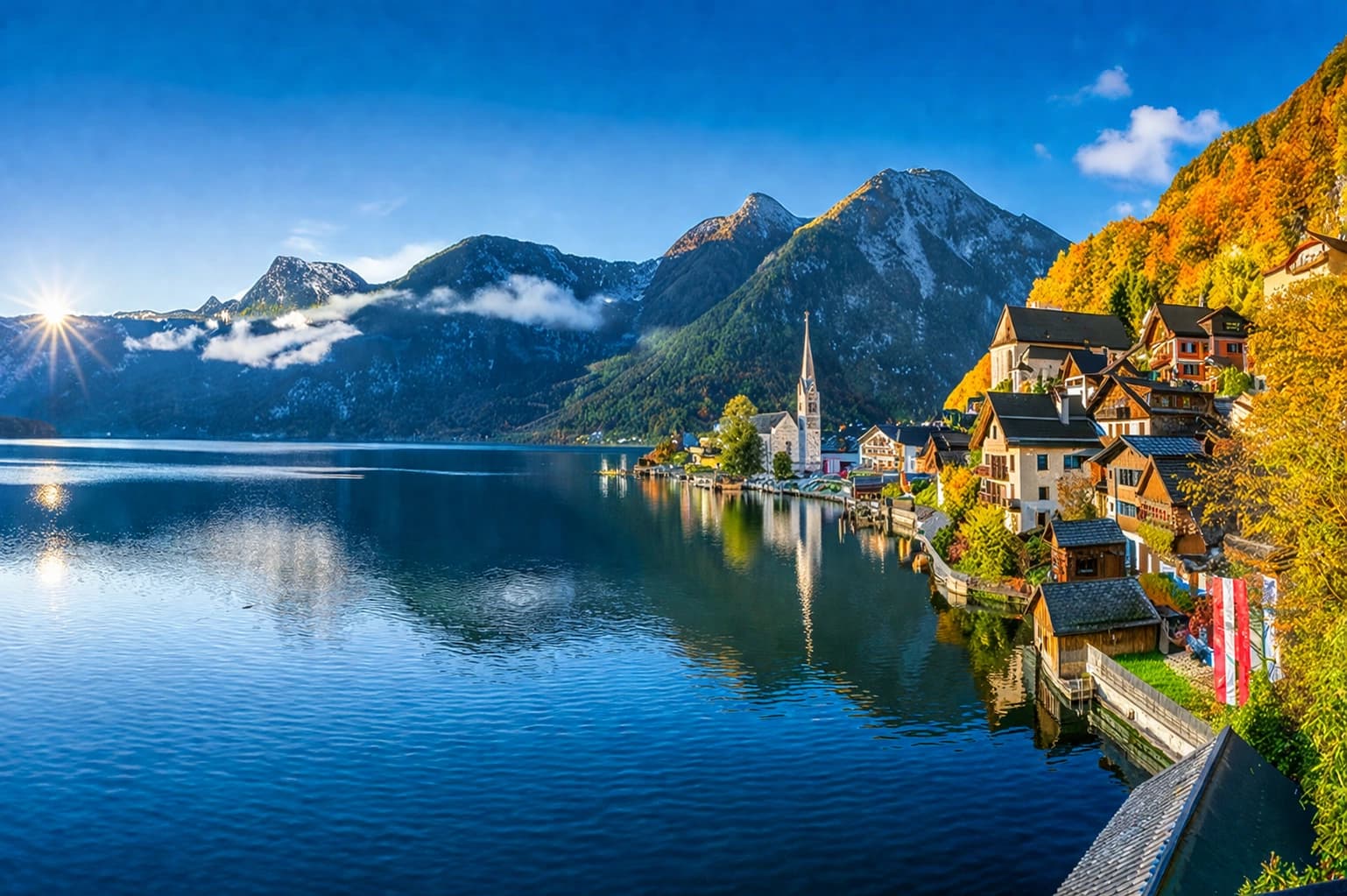
At Hallstatt, the salt has been mined continuously for more than seven thousand years. This is not a metaphor. The oldest working salt mine in the world sits above the village, and archaeologists have pulled artefacts from its galleries that predate the pyramids. The Iron Age civilisation that spread across central Europe from roughly 800 to 450 BC takes its name from this village: the Hallstatt culture, the proto-Celtic society whose graves, tools, and trade goods have defined the archaeology of early European prehistory. The village of Hallstatt itself, clinging to a strip of shoreline so narrow that the houses are stacked on top of one another between the lake and a vertical cliff, has been continuously inhabited for longer than almost any settlement on the continent.
Further north, around the Wolfgangsee and the Mondsee and the Attersee, the lakes open out into broader valleys. The water is the defining feature, fed by Alpine snowmelt and filtered through limestone, it reaches a clarity that is difficult to describe and genuinely warms in summer, the shallower basins reaching temperatures in which an afternoon swim is not only possible but comfortable. The lakes were glacier-carved in the same process that shaped the Alps themselves, and from certain angles they resemble the Norwegian fjords more than any other Austrian landscape.
“Salt mines older than the pyramids. Lakes held by one family for six centuries. A village continuously inhabited for seven thousand years.
What the summer tradition kept.
The Habsburgs did not just administer the region. They also, from the mid-nineteenth century onward, spent their summers in it, and the effects of that choice are still readable in the landscape. In 1853 the young Emperor Franz Joseph became engaged to his cousin Elisabeth, Sisi, on holiday in the spa town of Bad Ischl, a wooded valley town at the centre of the region. From that year until 1914, every summer of his reign was spent there. The court came with him. The aristocracy of the empire followed the court. The composers and writers and painters followed the aristocracy, because the patrons who funded them were now in the mountains rather than the city. Within a generation, the Salzkammergut had become the summer address of the entire Austro-Hungarian intellectual establishment. Brahms came. Mahler composed here, in a small wooden hut he had built on the shore of the Attersee because he could only work in silence. Klimt painted the lakes, more than fifty canvases of a landscape he never published the locations of, because he considered them private.
The villas those families built, the Sommerfrische houses, the summer refreshment houses, still line the lakes. Painted in the warm yellows and ochres the Habsburg era preferred. Wide verandas, turreted corner rooms, gardens that descend to private boathouses on the water. Many are still held by the same families they were built for, passed down across five or six generations. This is not a museum. It is a living continuity of a summer tradition that has been essentially unbroken since the Congress of Vienna.
What it produces is a region that feels quietly confident in itself in a way most lake districts do not. The Salzkammergut does not need to perform. It has been the summer address of the cultured class of central Europe for nearly two centuries, and it behaves accordingly.
How it feels to be there.
Days here have a specific Austrian shape that is not quite Bavarian and not quite Italian and not quite anything else. Mornings begin with coffee on a terrace that faces a lake still holding the mist from the night before. The bread, the butter, the honey, and the cured ham on the breakfast table have all come from within fifteen kilometres. By ten the mist has lifted and the surface of the lake is the shade of green that Klimt spent thirty years trying to mix. The water is warm enough by midday to swim in from May until late September.
Afternoons are for the mountains that rise directly from the lakeshore. A cable car runs to the Krippenstein plateau above the Dachstein ice caves, and from the ridge you look down onto four or five lakes at once, with the Alps stretching south toward Italy. Lower down, the walking tracks move through meadows that have been grazed on the same rotation for eight hundred years, past small wooden hay barns that have stood in the same corners of the same fields for generations. The pace is slow. The cows still wear bells. The bells are not a tourist flourish.
Evenings belong to the Gasthäuser. The village inns that have been serving the same five dishes in the same dining rooms for a hundred years, the Forelle from the lake, the Wiener schnitzel done correctly, the Tafelspitz that was the Emperor's preferred dinner, the Kaiserschmarrn that was named after him. A glass of the local Riesling, and a pace of conversation that has never been in any particular hurry. The cities of central Europe are close, Salzburg in an hour, Munich in two, Vienna in three, and feel, for the duration of the week, entirely irrelevant.
What we look for when we plan a stay here.
The Salzkammergut rewards a property that inherits the region's tradition rather than imitating it. The Sommerfrische architecture here is specific, a particular scale, a particular palette, a particular way of sitting between the lake and the forest that took several decades of trial and error in the nineteenth century to get right. What works is a house that belongs to that lineage: a villa that has been held and maintained across generations, or a recent estate that has read the vernacular with intelligence rather than pastiche.
What we look for here: direct lake frontage, because the organising fact of the region is water and the houses without their own shore feel perpetually on the wrong side of something. A private boathouse, because much of the best of a Salzkammergut week happens from a wooden boat at low speed. Enough land behind the house to give real privacy, which in a region this densely beautiful is rarer than it sounds. Interiors that read as Austrian, warm wood, loden fabrics, hunting prints, tile stoves that still work, rather than international. And the right staffing: people from the region rather than the hospitality circuit, who know the lakes and the hill paths and the kitchen traditions and who hold themselves with the quiet confidence the region itself has.
Through our network we have access to estates on the principal lakes that sit within that standard. Each is arranged personally, matched to the season and the group, and prepared with the kind of attention the Habsburg families themselves would have recognised.
Who the Salzkammergut is right for.
Not those who came to Austria for the Alpine scale of the western provinces. The mountains here are real but not vast. The skiing, where it exists, is good but not serious in the Tyrol sense. If the point of the trip is altitude and verticality, the Arlberg and the Silvretta are an easy drive west, and the Salzkammergut will feel subtler than it needs to.
This is for travellers who have understood that the most cultivated landscapes in Europe are rarely the most dramatic ones. For families who want a week that moves between water and forest without ever being far from either, swimming in the morning, a small boat in the afternoon, a mountain path before dinner, and that gives children the kind of unstructured, outdoor summer that central European children have been having here for a century and a half. For couples who have done Vienna and Salzburg and want the Austria that the Austrians themselves go to when they want to stop being in a city. For those who have learned that the most restorative holidays are the ones that have already been tested by several generations of discerning people, and who are content to join a tradition rather than invent one.
The salt has been coming out of these hills for seven thousand years. The families have been coming to these lakes for six. Both are still here, still themselves, still unhurried. The only question is whether you come quietly enough to notice.
When to visit the Salzkammergut
The region has been a summer destination for nearly two centuries and the calendar reflects that. The high season runs from June through early September, with the lakes warming from late May and reaching their best swimming temperatures in July and August. The water in the smaller and shallower lakes, the Mondsee, parts of the Wolfgangsee, warms noticeably faster than in the deeper alpine lakes such as the Attersee and the Traunsee. The Salzburg Festival, the most significant classical music event in Europe, runs from late July through the end of August each year; the festival is in Salzburg itself, but the surrounding lake country fills accordingly, and the better lakeside estates within an hour of the city are typically booked nine to twelve months ahead for these weeks. Early September is perhaps the most rewarding moment, the summer warmth still present, the festival crowds gone, and the Almabtrieb cattle drives from the high pastures taking place across the region in mid to late September. Autumn through October brings the larch and beech forests to colour, with the air clear and the villages at their quietest. Winter is a different country here, the region is more about cross-country skiing and lakeside walking than about serious downhill, with the Christmas markets in Bad Ischl, Hallstatt, and the smaller villages running through Advent. May and early June are the inter-seasonal weeks: the meadows in flower, the lakes still cool, the villages essentially without other visitors.
How to get to the Salzkammergut
Salzburg (SZG) is the principal gateway, about an hour by road east to the centre of the lake district, with direct flights from across Europe and seasonal connections from further afield. Munich (MUC) is the larger long-haul alternative, two hours by road east, useful particularly for North American and Asian arrivals and worth the longer transfer for the broader flight network. Vienna (VIE) is the third option, three hours by road or train west, useful only when the trip is combining the imperial city with the lakes. The OBB rail service from Salzburg into the Salzkammergut is well-developed, Bad Ischl and the Wolfgangsee are reachable directly, and the regional connections from there are frequent. Private jets route most easily into Salzburg, with substantial business jet capacity. We coordinate the airport arrival, the transfer to the estate, and any onward routing, to the Bavarian Chiemgau across the German border, or south into the Tyrol, ourselves.
Where to stay in the Salzkammergut
The region's seventy-six lakes are not interchangeable, and the right choice shapes the trip considerably. The Wolfgangsee, closest to Salzburg, is the most accessible and the most traditionally aristocratic, the village of St Wolfgang on the northern shore, St Gilgen at the western end with the Mozart family connections, and the long-established Sommerfrische villas along the wooded slopes. The Mondsee, just to the north, is the warmer and more domestic-feeling lake, broader, gentler, with the baroque abbey at its northern end and easy access to Salzburg. The Attersee, the largest of the principal lakes, is the more open landscape, the lake Mahler chose for his summer compositions and the one Klimt painted obsessively, with the most genuinely private estates along its shores. The Traunsee, further east toward Gmunden, is the dramatic option, the Traunstein mountain rising directly from the water, the lake's medieval island castle, the salt-trade history of the lakeside towns. The Hallstättersee at the southern end of the region is the most photographed and, in recent years, the most heavily visited of the lakes; the village is better experienced from the lake at dawn or in early winter than from the village square at midday. A trip of a week or more often uses two lakes, one as the base, the other as the day excursion.
We do not publish a property list. The estates we arrange across the Salzkammergut are matched once the brief is clear, a Wolfgangsee villa within reach of the Salzburg Festival, an Attersee house for the quietest week of the year, a Traunsee property for the dramatic landscape, sometimes a combination across two lakes. What we will say is that the right house in the Salzkammergut is the one held by the same family long enough to know what each season asks of it. The continuity is the region's defining quality, and the right stay belongs to it.