The United States arrives for most international travellers as a set of competing images that are all, in their way, correct, and none of which quite add up to the country itself. The Manhattan skyline. The California coast. The Grand Canyon. The beach clubs of Miami. The ski resorts of the Rockies. The Napa wine country. The New England autumn. Each of these is a real and considerable place, and any of them, taken individually, would make for a legitimate week. What they have in common is that they are all recognisably the America that the twentieth century invented and the twenty-first is still exporting.
There is an older America, and it does not advertise itself in any of these ways.
A two-hour flight from Dallas, or four hours from Los Angeles, or a day's drive from Denver, sits a stretch of high desert plateau that has been continuously inhabited for longer than almost any part of the continent and that was integrated into the United States only in 1912, making New Mexico one of the most recent states in the union, despite being one of the oldest places in it. The altitude is above two thousand metres. The air is thin, dry, and specifically clear in a way that sea-level coasts cannot produce. The light has been the subject of serious study by painters, physicists, and observatory astronomers for more than a century. And the country this light falls on is a cultural landscape of a density the United States is not generally thought to possess: eight Pueblo nations still living in the same villages they were living in five centuries before Columbus, a Spanish colonial tradition nearly as old as the one in Mexico, and a concentration of twentieth-century American art, science, and literature that in almost any other country would already be a national park on its own.
This is where this begins.
What the plateau actually is.
The northern New Mexico plateau, running roughly from Santa Fe north through Española and Abiquiu to Taos, and on into the Sangre de Cristo mountains that form the southern tip of the Rockies, sits between two thousand and two thousand five hundred metres of elevation. This is genuinely high country. The effect on the landscape is specific: the temperature drops several degrees every few hundred metres, so the valleys are warm and the surrounding mountains carry snow well into summer. The vegetation changes in vertical bands that are visible in a single view, desert at the base, juniper and piñon above, ponderosa pine higher, aspen and fir at the passes, tundra at the summits. The Sangre de Cristos themselves reach just over four thousand metres at the summit of Wheeler Peak, which is the highest point in New Mexico and genuinely substantial.
What the altitude combines with is a peculiar geology. The plateau sits on a series of ancient volcanic fields, some of them active within the last several thousand years. The Jemez caldera, a short drive west of Santa Fe, is one of the largest volcanic craters in the continental United States, and its eruption roughly one and a quarter million years ago laid down ash deposits that shaped the entire surrounding landscape. The soft volcanic tuff that resulted is the material the Pueblo peoples carved their cliff dwellings from at Bandelier, a thousand years ago. It is also the stone used in many of the traditional adobes and the building vocabulary of the region. Further west, the land drops into canyons cut by the Rio Grande and the Rio Chama, narrow, serpentine river valleys with hot springs along their banks and, in places, petroglyphs carved by the people who lived there long before the pueblos took their present form.
The Pueblo peoples have been here the longest. Their ancestors, the ancestral Puebloans the older literature calls the Anasazi, built the cliff cities at Mesa Verde and Chaco Canyon between roughly 900 and 1300 AD. Chaco, in the high desert of northwestern New Mexico, was one of the most sophisticated urban centres in pre-Columbian North America, great houses of up to five stories containing hundreds of rooms, built with the kind of astronomical alignment and structural engineering that Europeans would not match until several centuries later. The civilisation declined and dispersed around 1300. The people who were its descendants settled in the villages along the Rio Grande that remain today.
Taos Pueblo, an hour's drive north of Santa Fe, is the most extraordinary of them. A multi-story adobe complex built around a central plaza, it has been continuously inhabited for more than a thousand years. The people who live there now are descendants of the people who built it. No electricity or running water is permitted in the main village, by decision of the community; the houses are maintained each year by re-plastering with mud in the traditional method. It is a UNESCO World Heritage Site. It is also a living town. The church on the plaza holds mass on Sundays. The ceremonial dances, some of which have been performed in the same plaza for perhaps nine centuries, still take place on their calendar, some public, most not.
“A continuously inhabited town older than most European nations. A Spanish colonial capital older than Plymouth. An American state less than one hundred and fifteen years old. The layers do not compete; they simply exist on top of each other.
What the Spanish left.
The Spanish arrived in the valley in 1598, and Santa Fe was formally founded in 1610, making it older than Boston, older than New York, older than any other state capital in the United States. The Palace of the Governors on the Santa Fe plaza is the oldest continuously occupied public building in the country, built by the Spanish colonial government four hundred and fifteen years ago and still in civic use today. The architecture that the Spanish developed, adapting the pueblo building traditions they found, thick adobe walls, flat roofs with wooden vigas projecting through the exterior, rounded corners, shaded courtyards, became the regional vernacular. A municipal code in Santa Fe still requires new buildings in the historic centre to be built in this tradition. The result is one of the few American cities that has a coherent historical architectural identity, and one of the few anywhere in the world that has done so without freezing itself into a museum.
The food tradition of the region is the other great inheritance. New Mexican cuisine is not Mexican cuisine; it is a distinct tradition developed in the valley over four centuries, built on the chile varieties grown in the specific microclimates of Hatch, Chimayo, and Espanola. The red and green chile that anchors almost every serious meal in the state is native to this region, and the Hatch pepper harvest each August is the region's closest thing to a civic festival. The dishes, green chile stew, carne adovada, sopapillas, posole, stacked enchiladas with fried eggs on top, belong to the valley and essentially nowhere else. A New Mexican restaurant in Santa Fe will ask, as a matter of course, 'Red or green?' The correct answer, for the undecided, is 'Christmas', which means both.
The Spanish colonial trace remains visible across the whole valley. The village of Chimayo, above Santa Fe, holds a small nineteenth-century adobe church, the Santuario, whose dirt floor has been considered sacred for two hundred years. It is one of the most visited pilgrimage sites in the United States. The village also holds the Ortega and Trujillo families, who have been weaving on looms in the same houses for eight generations, and whose blankets and rugs are among the most serious textile art being produced anywhere in the country.
What the artists found.
In the early twentieth century, the artists arrived. D.H. Lawrence spent several formative periods in Taos in the 1920s. Mabel Dodge Luhan, the Manhattan salon host, moved to Taos in 1917 and turned her adobe house into one of the quiet centres of early-twentieth-century American culture; the list of people who stayed with her there reads like the index of a mid-century American Studies textbook. Ansel Adams photographed the valley extensively in the 1930s. The Taos Society of Artists, founded in 1915, produced a generation of painters who made the high desert light their subject.
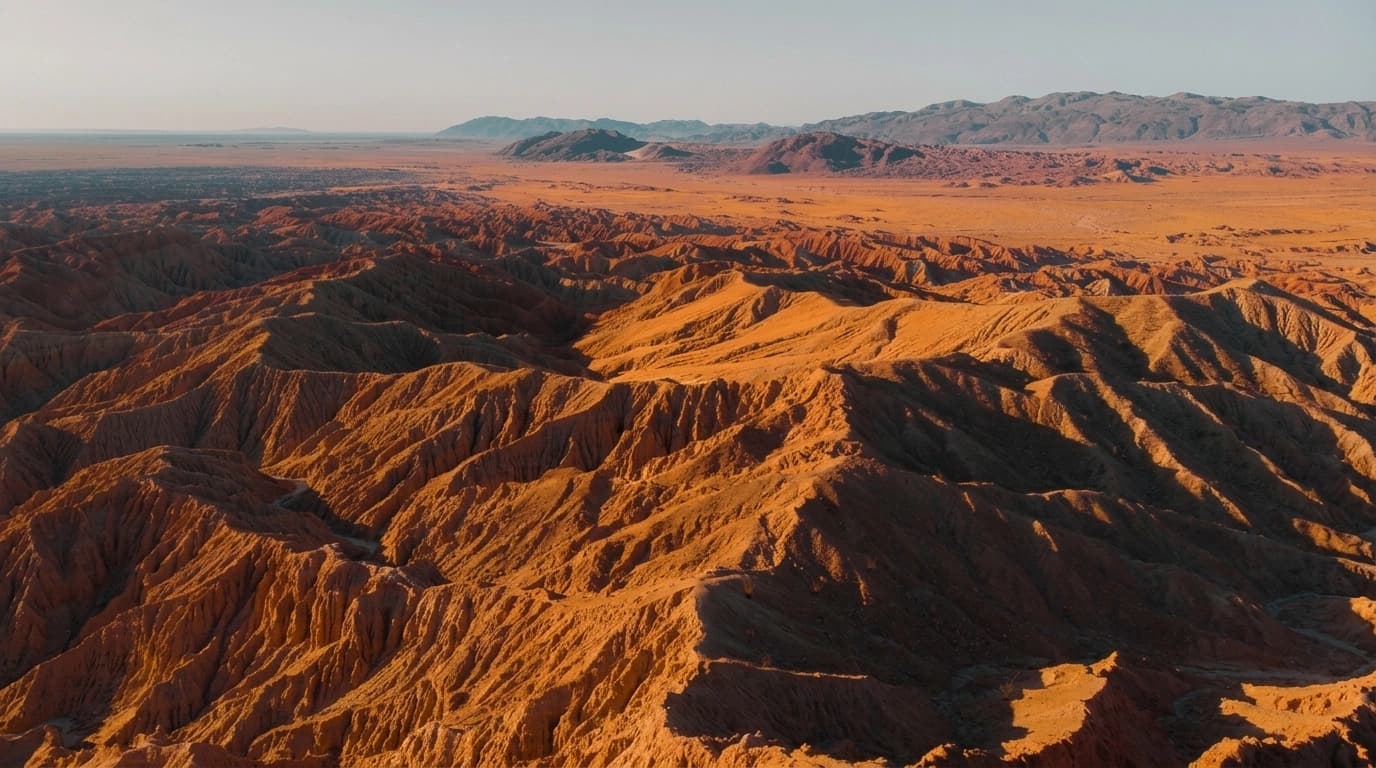
And Georgia O'Keeffe. She arrived first in 1929, returned every summer for two decades, and moved to the village of Abiquiu, northwest of Santa Fe, in 1949. She lived there for most of the next forty years, producing a body of work that is almost entirely built from a single stretch of landscape, the Pedernal mesa, the red cliffs of Ghost Ranch, the bones she collected on her walks, the adobe shapes of her own house. Her two houses are now preserved as museums, visited by small groups on reservation. The landscapes she painted are still there, essentially unchanged. Driving through the country north of Abiquiu, a traveller with her paintings in mind will find the shapes of them appearing in the windscreen in real time.
The tradition she helped establish has continued. Santa Fe has the third-largest art market in the United States, after New York and Los Angeles. Its annual Indian Market, held each August on the Santa Fe plaza, is the largest and most important exhibition and sale of Native American art in the world. The galleries along Canyon Road, a single mile-long street of more than a hundred working galleries, hold one of the densest concentrations of working artists anywhere on the continent.
How it feels to be there.
The right seasons are the shoulder months, late April through June, and then September and October. Summers in the valley are warm but not extreme; the altitude holds the heat down, and afternoon storms arrive most days in July and August, clearing by evening. Autumns are crystalline, with the cottonwoods along the rivers turning gold in the first weeks of October and the aspens on the mountains a week or two later. Winters are cold but bright, with reliable snow on the mountains for skiing and clear cold days in the valley that suit the landscape well. The light through the year is remarkable. There is a reason so many artists, photographers, and astronomers live here.
Days in the valley arrange themselves around distances that are shorter than they look. Santa Fe is an hour's drive from Taos, fifteen minutes from Chimayo, thirty from Abiquiu. A week-long stay can take in the cliff dwellings at Bandelier, the O'Keeffe houses, the weaving villages, the Taos Pueblo, and the observatories at the top of Sandia in the same week without ever feeling rushed. Meals in the valley are a quiet pleasure, the New Mexican traditions in the older restaurants, the serious contemporary cooking in the newer ones, the small farm-to-table places in the villages that have grown up around the valley's agricultural economy. Evenings belong to the sunsets, which across the high desert are of a kind and duration that most lowland places simply cannot produce, and to the stars that follow them; the dark-sky areas north of Santa Fe are among the best in the continental United States.
The Sangre de Cristos, in winter, carry the southernmost reliable skiing in the American West. The slopes at Taos Ski Valley are serious and genuinely uncrowded. Further north, the desert gives way to the San Luis Valley of southern Colorado, and then the Sangre de Cristos proper, which are among the most dramatic and most lightly-developed mountains in the lower forty-eight states. A private trip that combines the high desert with the southern Colorado mountains is, for those who want it, a genuinely exceptional combination of landscape.
What we look for when we plan a stay here.
The high desert rewards a property that reads its landscape correctly. The adobe architectural tradition, thick walls, deep-set windows, courtyards, flat roofs, wooden ceilings with exposed beams, was developed across five centuries specifically for this climate, and the properties that work here are the ones that have extended this tradition rather than imposing an international luxury vocabulary on it. What works is a genuinely old adobe estate, restored with intelligence; or a newer house that has been built in the regional tradition by architects who understand it.
What we look for here: a position that gives real privacy, the valley rewards it, with a view of the Sangre de Cristos or the Jemez across open land. Outdoor spaces that handle the high desert climate across the seasons: courtyards for the spring, sheltered terraces for the summer storms, fireplaces outdoors for the cool autumn evenings. Interiors warm in the regional way, with the specific textiles, ceramics, and art that the valley produces. A kitchen that takes the regional food seriously, and the right staff to arrange the private access that makes this region fully itself: a morning with a weaver in Chimayo, a small-group tour of the O'Keeffe houses when they are otherwise closed, a private viewing at one of the major galleries before it opens, a guide who knows both the Pueblo villages and the protocols for visiting them.
Through our network we have access to estates in the Santa Fe hills, north toward Abiquiu, and up into the Taos valley that sit within this standard. Each is arranged personally, matched to the group and the season, and handled from the Albuquerque or Santa Fe arrival onward.
Who the high desert is right for.
Not those who want the United States as they already imagine it. The country has plenty of places that deliver exactly what the international images promise, and the east and west coasts will do that job efficiently. This is not that trip.
This is for travellers who have understood that the most interesting parts of most large countries are the ones that the country itself is not currently using to market itself. For families with older children who will genuinely engage with the layering of cultures here, the Pueblo villages, the Spanish colonial churches, the O'Keeffe landscape, the weaving families, the observatories at the ridgeline, and who have had their fill of the more obvious American destinations. For couples who have been to New York and California enough times and want the America that those coasts do not explain. For those interested in art, because this small corner of New Mexico has produced and continues to produce some of the most serious American work of the last century. For those who have learned that the most rewarding landscapes in the Americas are almost never the ones at sea level, and that a high plateau in the southwest, inhabited continuously for a thousand years and only recently a state, has considerably more to offer than most people have been told.
Taos Pueblo has been there for a thousand years, and the community that lives there plans to be there for another. The Spanish founded Santa Fe when the English were still establishing Jamestown. The state joined the country in 1912, which makes it younger than the Empire State Building. None of these timescales contradict each other. They simply exist, on top of each other, across a landscape that is older than all of them and will outlast them all. The argument for going is the argument for seeing any country's older self before its younger one entirely covers it.
When to visit Santa Fe and Taos
The high desert has four genuinely distinct seasons, and each rewards a different kind of trip. Late April through June is the dry, warm shoulder, wildflowers in the valleys, the rivers full from the snowmelt, and the longest stretch of reliably clear weather before the summer monsoon arrives. July and August bring afternoon thunderstorms that clear by evening, and also the densest cultural calendar of the year, the Santa Fe Opera season runs from late June through August, the Santa Fe Indian Market falls on the weekend after the third Thursday of August and is one of the most important cultural events in the American West, and the Spanish Market in late July is a smaller but serious gathering of colonial-tradition craft. Indian Market weekend in particular is essentially fully booked across the region eight to twelve months ahead. September and October are perhaps the most reliably good months of all, crystalline light, the cottonwoods turning gold along the rivers in early October and the aspens on the mountains a week or two later. The Fiestas de Santa Fe, the city's oldest civic celebration, falls in early September. Winters are cold but bright; the ski season at Taos Ski Valley runs from late November through early April. Booking lead times for the better houses run four to six months in the warm seasons, considerably more for Indian Market and the Christmas-New Year holiday.
How to get to Santa Fe and Taos
Albuquerque International (ABQ) is the principal commercial gateway, an hour's drive south of Santa Fe and the airport with the broadest direct connections, most major US hubs, with seasonal direct international service from Mexico. Denver International (DEN) is a useful alternative, particularly for international arrivals via European or Asian connections, with the drive south to Santa Fe about six to seven hours through the southern Colorado country that the article describes, done as a road journey rather than a transfer, this is one of the more rewarding ways into the region. Santa Fe Regional (SAF) is the smaller airport just outside the city itself, with limited but useful regional connections from Dallas, Phoenix, and Denver, well suited to private aviation, which routes here directly with substantial business jet capacity. Taos Regional (TSM) handles smaller aircraft for those going directly to the Taos valley. The drive between Santa Fe and Taos is about an hour and a quarter on the High Road or an hour and a half on the more scenic Low Road through the Rio Grande Gorge. We coordinate the airport arrival, the transfers, and any inter-region routing across northern New Mexico and into southern Colorado ourselves.
Where to stay in Santa Fe and Taos
The plateau works around three principal bases, and the right choice depends on what shape the trip is meant to take. Santa Fe itself is the cultural and culinary centre, the historic plaza, the Palace of the Governors, the galleries on Canyon Road, the opera, the markets, and the densest concentration of restaurants, museums, and working artists. A property in the Santa Fe hills above the city gives access to all of this within twenty or thirty minutes while offering real privacy and the open views the valley rewards. The Abiquiu country, an hour north-west, is the O'Keeffe landscape itself, Ghost Ranch, the red rock cliffs, the wider quieter country, and the working farm and weaving villages along the way. Taos, an hour north, is the third base, the Pueblo, the older Spanish town, the Sangre de Cristo foothills, and the entry point for the ski mountain and the longer expeditions into southern Colorado. A trip of a week or more usually combines two of these settings. Some of the most considered itineraries use all three, with the routing between them treated as part of the trip rather than against it.
We do not publish a property list. The estates we arrange across northern New Mexico are matched once the brief is clear, a Santa Fe-hills house for the cultural week, an Abiquiu place for the landscape, a Taos-valley base for the older country and the mountains beyond. What we will say is that the right house on this plateau is rarely the one with the most modernist intervention. It is almost always the one where the adobe is still doing the work the climate built it to do.