The United Arab Emirates is the country international visitors arrive at with the most pre-formed a picture of, and the most inaccurate one. The skyline of Dubai photographed against the Gulf at blue hour. The Burj Khalifa. The indoor ski slope, the seven-star hotel, the island shaped like a palm tree. The mall that contains an aquarium, or the aquarium that contains a mall, it is never quite clear which way around. Everyone arrives with a shorthand for this country, and in most cases the shorthand is not wrong. It is simply a description of something that did not exist forty years ago.
The United Arab Emirates as a country is, in federal terms, fifty-four years old. It was established in 1971 by the union of seven emirates along the southern shore of the Arabian Gulf, most of which had until then been British protectorates known collectively as the Trucial States. Before that, and for the three or four thousand years before that, this coast and the interior behind it were something else entirely. They were Bedouin country. Pearl-diving ports. Falaj-irrigated oases in the dry hills of the east. And behind them all, extending south across nearly seven hundred thousand square kilometres of Saudi Arabia, Oman, Yemen, and the Emirates themselves, the largest continuous sand desert on earth.
This older country did not disappear when the oil economy arrived. It was overlaid. And across the last fifteen years, the UAE has been quietly and very deliberately recovering it, through museums, cultural institutions, ecological restoration programs, and a set of private arrangements that allow serious travellers access to the Arabia the glass towers were built on.
This is where this begins.
What the country actually is.
The United Arab Emirates occupies the southeastern corner of the Arabian peninsula, between Qatar to the northwest, Saudi Arabia to the south and west, and Oman to the east. The country is small, about eighty-three thousand square kilometres, roughly the size of Austria, but it contains a surprising range of landscapes within that area. The Gulf coast to the north is shallow, sandy, and studded with mangrove lagoons and islands. The Hajar Mountains rise along the eastern border with Oman, reaching two thousand metres in places, with wadi-cut valleys that carry seasonal water and some of the oldest falaj irrigation channels in Arabia. And the entire southern half of the country is desert, specifically the northern edge of the Rub' al Khali, the Empty Quarter, which extends continuously south into Saudi Arabia and Oman and covers an area larger than France, with some of the highest sand dunes in the world.
The Emirati population itself is small. There are roughly ten million people in the country, but fewer than one and a half million are Emirati citizens. The remaining eighty-five per cent are foreign workers from across South Asia, the Arab world, Europe, and the Philippines. The Emirati culture itself, the Khaleeji Arabic dialect, the family structures, the poetry traditions, the falconry, the camel husbandry, continues in a smaller and more specific cultural space than the international version of the country would suggest. Much of it is not immediately visible to a casual visitor. Some of it, particularly the desert traditions, requires leaving the cities to find.
The coast itself has the longer history. The city of Abu Dhabi sits on an island that was occupied by the Bani Yas tribe from at least the late eighteenth century, after a hunting party following a gazelle discovered fresh water on the island and settled there, the name Abu Dhabi translates approximately as father of the gazelle. The Al Nahyan family, which has ruled Abu Dhabi continuously since then, are direct descendants of that settlement. Further inland, at Al Ain on the Omani border, archaeological sites have documented continuous human occupation dating back more than five thousand years, one of the oldest permanent settlements in the Arabian Peninsula, built around the water of the Jebel Hafeet aquifer and still, today, an oasis of date palms and working farms. Al Ain is a UNESCO World Heritage Site, and it is almost entirely absent from the international conversation about the UAE.
“A country fifty-four years old, built on a coast five thousand years old, facing a desert older than both. Most people only see the top layer.
What the desert holds.
The Rub' al Khali is one of the most legendary deserts on earth, and for good reason. Its dunes reach heights of up to two hundred and fifty metres, significantly higher than the dunes of the Sahara, and they move, shaped by the wind, in parallel ridges that can extend for hundreds of kilometres. Temperatures in the summer exceed fifty degrees Celsius. Rainfall, in most years, is essentially zero. No permanent human population has ever existed within the desert itself, though the Bedouin tribes, particularly the Al Murrah and the Bani Yas, have moved through it for several thousand years, following seasonal waters and grazing, with routes memorised across generations.
The first westerner to cross it and report on the crossing was the British explorer Bertram Thomas in 1930, who made the traverse with Bedouin guides and published the account as Arabia Felix. Wilfred Thesiger, who followed him twice in the 1940s, produced the book that made the desert part of the western literary imagination, Arabian Sands, published in 1959, a piece of travel writing whose quality has not been matched in the English language on the subject. Thesiger described a desert that by his own account was already passing as he wrote about it. The Bedouin way of life he documented did transform with the oil economy that arrived in the decades after. But much of what he described, the skill with camels, the navigation by stars and dune shapes, the deep knowledge of water, the falconry, the oral poetry, did not disappear. It moved. And in recent decades the royal families of the Gulf have been working, privately and in some cases publicly, to preserve what they can of it.
The Liwa oasis is the northern gateway. A long crescent of date-palm villages curving along the edge of the Empty Quarter in the western Emirates, Liwa is the ancestral heartland of the Bani Yas, the original home of the ruling families of both Abu Dhabi and Dubai. The date farms here produce some of the most prized varieties in the Gulf. The villages are genuine, not reconstructed. And from Liwa, the dune country begins to rise in earnest. The largest accessible dunes, Moreeb Dune among them, rising more than three hundred metres from its base, are here, and a drive out from Liwa into the dune country places the traveller in a landscape that is essentially unchanged from the one Thesiger crossed.
A night in a private camp on the edge of the Empty Quarter is one of the more remarkable experiences the region offers. The camps themselves are not what most visitors expect. The better ones, small, properly staffed, and located well away from the day-trip operations that work closer to the cities, provide a version of Bedouin hospitality that is quite specifically what it has been for a long time: unhurried, precise, attentive in a formal and slightly old-world way, and built around coffee, conversation, and the stars. Falconry displays with practising falconers. Camel introductions with handlers whose families have worked the animals for generations. A kitchen built around the regional cuisine. And the silence of the desert, which in the Empty Quarter is more profound than in almost any other desert in the world, because the surrounding land extends for hundreds of kilometres in every direction and genuinely nothing else is there.
What Abu Dhabi is becoming.
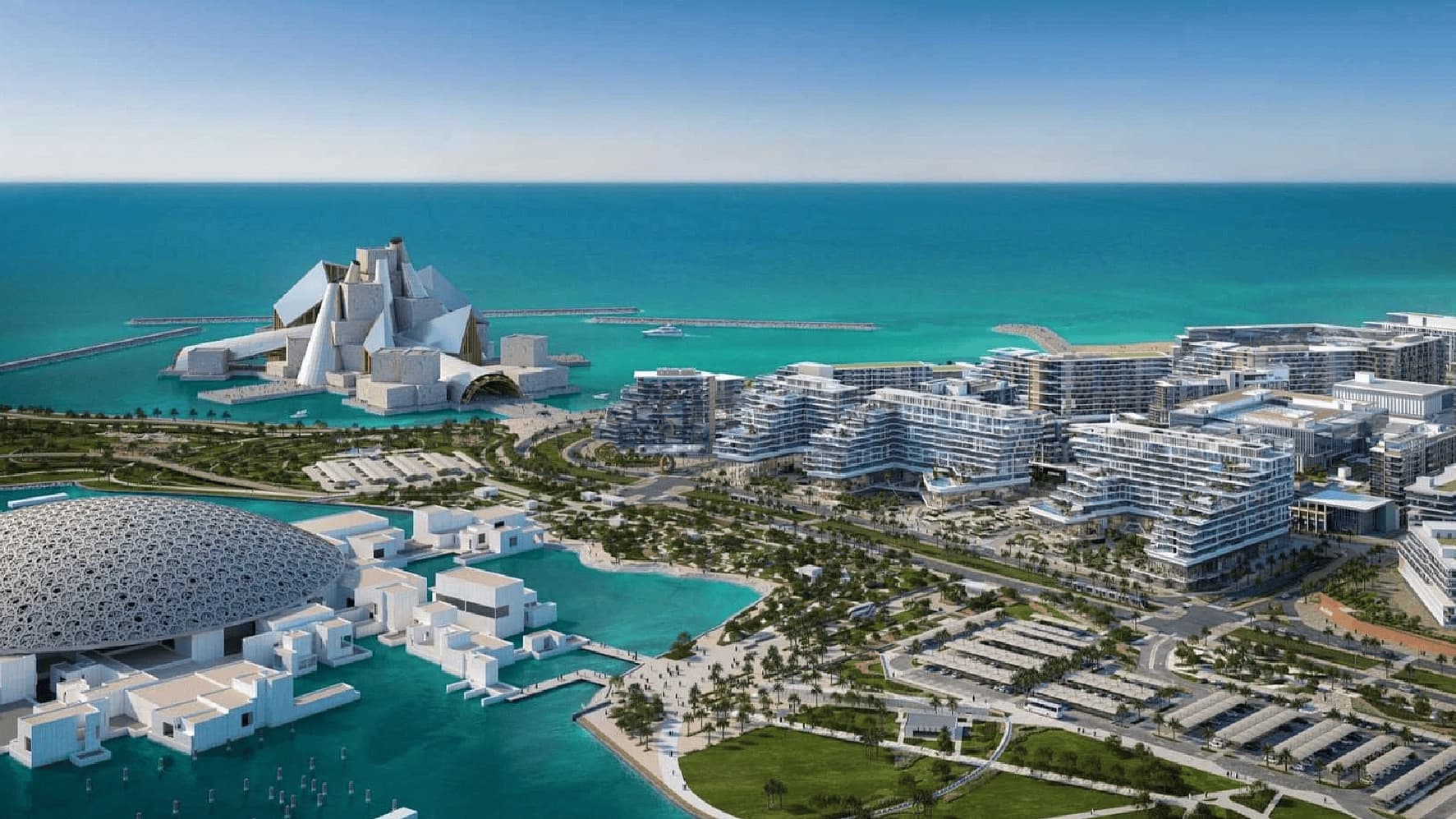
The cultural project on Saadiyat Island is one of the more ambitious of its kind anywhere in the world, and it is worth understanding before approaching the country. Abu Dhabi began, about fifteen years ago, a program of building one of the world's major cultural districts on an island a short causeway from the main city. The first institution to open was the Louvre Abu Dhabi, in 2017, a Jean Nouvel-designed museum under a latticed silver dome that scatters what he called a rain of light across the galleries beneath it. The collection is built on a thirty-year partnership with the Louvre in Paris, and it displays human cultural production from the Neolithic period through the present, organised thematically rather than geographically, in a way no other major museum quite does. The Zayed National Museum, designed by Norman Foster, is scheduled to open in 2026 and will cover the history of the Emirates and the leadership of the country's founder. The Guggenheim Abu Dhabi, designed by Frank Gehry, will follow. The Natural History Museum Abu Dhabi is also in progress. When the project is complete, the island will hold one of the densest concentrations of major museum architecture in the world.
This is a deliberate cultural project, the country is, by explicit policy, building itself a cultural heritage that is visible to the world, and it is doing so at a scale and pace that almost no other country is currently attempting. Whatever one's view of the underlying geopolitics, the result is one of the most interesting museum landscapes being created anywhere at the moment, and the first institutions are already operational and worth a day or two of proper attention.
Back on the mainland, Abu Dhabi itself is a quieter and more cultural city than Dubai, and it rewards slightly more attention than it usually gets. The Grand Mosque, the Sheikh Zayed Grand Mosque, completed in 2007, is the largest mosque in the UAE and one of the most architecturally significant modern religious buildings anywhere. The Qasr Al Hosn, the original fort that was Abu Dhabi's first permanent building, has been restored and opened as a museum that explains the pre-oil history of the city. The Corniche runs for eight kilometres along the waterfront. And the Abu Dhabi Falcon Hospital, the largest falcon hospital in the world, treating more than eleven thousand birds a year, offers tours by arrangement that are one of the more specific windows into the culture anywhere in the region.
How it feels to be there.
The right season is narrow. November through March is the window for the desert interior and the coast alike, temperatures in the low twenties in the day, cool at night, humidity manageable, the light at its most useful. April and October are shoulder months, warmer but still workable. The summer, May through September, is essentially not on the table for anyone not committed to the indoor life, temperatures in Dubai and Abu Dhabi routinely exceed forty-five degrees, and in the Empty Quarter considerably more than that.
Days arrange themselves differently between the city and the desert. In Abu Dhabi, mornings belong to the cultural district, the Louvre is at its best in the first hour after opening. Middays are for the indoors: the restaurants, the galleries, the mosque in the cooler hour before the afternoon heat. Evenings are long and warm, and dinner happens late outdoors when the weather allows. In the desert, the rhythm inverts. Early mornings at dawn for the dunes, before the heat arrives, when the light and the silence are both at their most remarkable. Middays for shade. Late afternoons for the camels, the falcons, a drive further into the dune country. Evenings for the camp, dinner under the stars, which in the Empty Quarter, far from any city lights, are as visible as they are anywhere on earth.
The food culture of the Emirates is older than many visitors realise, and it deserves better than the hotel buffet treatment it usually gets. Traditional Emirati cuisine, machbous, harees, luqaimat, khameer, the slow-cooked coastal fish dishes, the fresh date varieties from the Liwa oasis, the Arabic coffee rituals, is a genuinely distinct regional cuisine that has been absorbing influences from Persia, India, East Africa, and the Levant for centuries, and it is best experienced either in the few specifically Emirati restaurants that have opened in recent years, or in private dining arrangements with local families, which can be arranged.
What we look for when we plan a stay here.
The UAE rewards a structure that visits two entirely different countries in the same week. A few nights in Abu Dhabi for the cultural district, the Grand Mosque, and the historical material, ideally in a property that places the group on the cultural district itself rather than in the generic hotel quarter. A night or two in one of the coastal properties on Sir Bani Yas or the other western islands, for the wildlife reserves the government has established over the past two decades, the Arabian oryx, once functionally extinct in the wild, has been re-established on these islands at scale. And three or four nights in the desert interior, in a private camp on the edge of the Empty Quarter at Liwa, with properly arranged access to the Bedouin traditions that remain there. The combination describes a country that no single half of it does.
What we look for here: in Abu Dhabi, a property on or near Saadiyat Island with real quality of service, not merely scale, the country has an abundance of five-star hotels, and the ones worth staying in are the ones that understand cultural and service traditions rather than simply size and polish. In the desert, a camp that is genuinely private and genuinely Emirati, staffed by people who know the traditions rather than by the imported hospitality crews that operate the larger tourist operations. A guide who is himself Emirati, who can open private doors, the working falconers, the camel breeders, the date farmers, that are not available through ordinary arrangements. And the right vehicles, the right desert drivers, the right quiet arrangements that allow a group to experience the interior in the way it deserves.
Through our network we have access to stays on the coast and in the interior that sit within this standard, and to the Emirati families and cultural institutions that can make the trip something considerably more than the default. Each is arranged personally, matched to the group and the season, and handled from the Abu Dhabi or Dubai arrival onward.
Who the UAE is right for.
Not those who want the Gulf as a luxury shopping destination with a beach. That version is widely available, efficiently delivered, and will not be what this piece has been about.
This is for travellers who have understood that the most interesting countries are often the ones actively constructing their own cultural identity in real time, and that the UAE is one of those countries right now, an experiment in building a modern state on top of a Bedouin desert culture, and a country that is consciously examining its own history in the process. For families with older children who will genuinely find it remarkable, the Louvre, the falcons, the camels, the dunes, the wildlife reserves. For couples who have been to Dubai on a stopover and want to find out what the rest of the country actually contains. For those interested in architecture, because the combination of traditional vernacular, Islamic classical, and contemporary signature-architect work here is quite unusual. For those interested in literature and exploration, because the Empty Quarter still carries the weight of its own literature and remains one of the great desert landscapes of the world. For those who have learned that the most interesting countries rarely advertise the older versions of themselves prominently, and that seeing them requires going a short distance beyond the skyline.
The country is fifty-four years old. The coast is five thousand. The desert is older than anyone has firmly established. The version of the United Arab Emirates that is currently being built is one that tries to make space for all of these at once, and that is a rarer and more interesting project than most of the international conversation about the country acknowledges. The argument for going is the argument for witnessing a country in the act of deciding what it wants to be, in a landscape old enough to survive any answer it arrives at.
When to visit Abu Dhabi and the Empty Quarter
The window is November through March, and within it the months distinguish themselves clearly. November and early December are quietly perfect, the heat has lifted, the humidity has dropped, the desert nights are cool without being cold. The Abu Dhabi Grand Prix at the end of the Formula 1 season fills the city for a particular weekend that is best either embraced or avoided rather than encountered by accident. The Christmas and New Year fortnight is the regional peak, Emirati families and Gulf neighbours travel into the desert and the islands, and the better camps and properties are typically booked four to six months ahead. January and February are the most reliably consistent months for the interior, with the desert at its coolest and the long horizons at their sharpest. March warms steadily; by the end of the month the daytime heat is beginning to climb again. April through October is essentially out of season for the desert, daytime temperatures from May through September run beyond forty-five degrees, and the Empty Quarter itself becomes uninhabitable in any practical sense. Ramadan, which moves through the calendar by roughly eleven days each year, changes the rhythm of the trip considerably: daytime food and drink are restrained, the evenings take on an entirely different character with iftar gatherings extending late, and arranging a trip around or into Ramadan is a deliberate choice rather than an oversight.
How to get to Abu Dhabi and the Empty Quarter
Abu Dhabi International (AUH) is the closest gateway for both the cultural district and the desert interior, with direct flights from across Europe, the Indian subcontinent, and much of Asia, and growing North American connections. Dubai International (DXB) is the larger hub and the obvious choice when itineraries include the city itself, with the drive south to Abu Dhabi about ninety minutes and to Liwa about three hours by road. Al Maktoum / Dubai World Central (DWC) is the principal field for private aviation in the region, with substantial business jet capacity. From Abu Dhabi, the cultural district on Saadiyat Island is about twenty minutes from the airport; Al Ain, on the Omani border, is about ninety minutes east; Liwa and the edge of the Empty Quarter are about two hours south-west by road. The drive into the deeper dune country from Liwa is a different proposition, four-wheel-drive only, with a regional driver who knows the routes, and the final stretch into a private camp is normally arranged through the camp's own logistics. We coordinate the airport arrival, the transfers between the city and the islands, and the desert routing ourselves.
Where to stay in Abu Dhabi and the Empty Quarter
The trip works around three quite different settings. The cultural district on Saadiyat Island, just off the Abu Dhabi mainland, is the base for the museum work and the city itself, Louvre Abu Dhabi, the forthcoming Guggenheim and Zayed National Museum, the Grand Mosque a short drive away. Sir Bani Yas Island and the other western islands, a couple of hours west along the coast, are the wildlife proposition, the Arabian Wildlife Park reserves there have re-established Arabian oryx, gazelle, and several other regional species at scale. Liwa, at the northern edge of the Empty Quarter, is the third setting, the date-palm villages of the Bani Yas heartland, and the properly arranged desert camps that sit beyond them, set well into the dune country and reachable only by four-wheel-drive. The most considered UAE trip uses all three; a week is essentially the minimum for the country to make sense in that form.
We do not publish a property list. The stays we arrange across the UAE are matched once the brief is clear, a Saadiyat base for the city, a single private island for the wildlife and the silence, a Liwa-edge camp for the desert, sometimes all three with the routing between them handled in the right rhythm. What we will say is that the right Emirates trip is the one that treats the country as three landscapes rather than one. And that the desert, in this country, is always the part that stays with you.