Germany, for most international visitors, arrives as a sequence of cities. Berlin for the history and the weight of the twentieth century. Munich for the beer halls and a particular kind of civic confidence. Hamburg for the harbour, Cologne for the cathedral, Frankfurt for the transfer. All of these cities are genuinely worth the time given to them, and none of them are wrong. But they are not, collectively, what the country is.
The Germany that Germans themselves retreat to sits an hour beyond the cities, and keeps to itself.
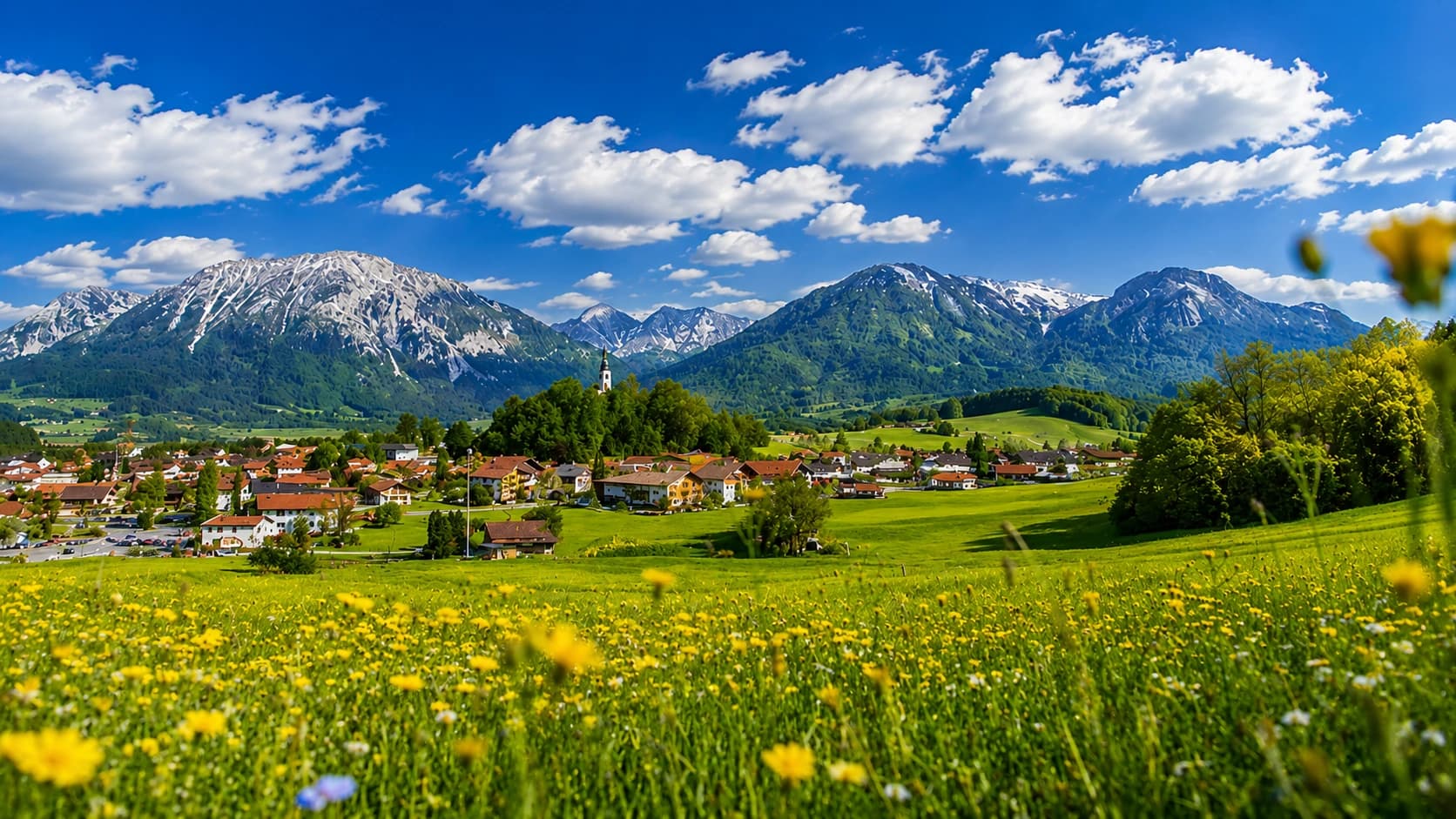
Southeast of Munich, the autobahn rises gently through fields and villages, and somewhere around the seventieth kilometre the Alps appear on the horizon. Not gradually, suddenly, as a wall of grey rock and green forest that was not there a moment before and is now the defining feature of the landscape. The Chiemgau is the region at the foot of those peaks. A short strip of country pressed between a vast pre-Alpine lake and the Austrian border, and holding more concentrated beauty per square kilometre than almost any other part of Western Europe.
This is where this begins.
What the region actually is.
The Chiemgau takes its name from the Chiemsee, a lake of roughly eighty square kilometres, the largest in Bavaria, often described locally as the Bavarian Sea. It was formed by the same glacier that shaped most of the pre-Alpine plain, and what the glacier left behind is the kind of scenery that has attracted painters for three centuries and overrun them for none of it. On the Fraueninsel, the smaller of the lake's two principal islands, a Benedictine convent has been operating continuously since around 782 AD, more than a thousand years before Bavaria itself was a kingdom. The nuns still bake the marzipan they have been baking for generations. The herbs they grow are sold at the Friday market in a wooden stall that has been there as long as anyone can remember.
The Herreninsel, the larger island, holds a different story. In 1878 Ludwig II of Bavaria, the king who built Neuschwanstein and Linderhof and very nearly ruined himself and his kingdom doing it, began construction of a third palace on the island, intended as a copy of Versailles. He completed the core rooms. He slept in them for nine nights before he died, under circumstances that Bavarian historians are still arguing about. The palace remains as he left it, its gilded hall of mirrors longer than the one at Versailles, much of its east wing never built. It sits on an island in the middle of a lake, below the Alps, surrounded by forest, in the wealthiest state of the wealthiest country in Europe, and it is, by any measure, one of the strangest monuments a nineteenth-century monarch ever attempted.
Further east, against the Austrian border, the land rises sharply into the Berchtesgadener Land. The Königssee, a fjord-like glacial lake pressed between vertical limestone walls, is cleaner than most water people have ever been asked to swim in, so clean that only electric boats are permitted on it, and has been that way for more than a century. The Watzmann rises directly from the shore to two and a half thousand metres, in a silhouette that every schoolchild in southern Germany can draw from memory. The salt mines beneath the hills have been worked continuously since 1517, which makes them, by a clear margin, the oldest working salt mine in the world.
“A Benedictine convent that has been baking marzipan in the middle of a lake since the eighth century. A king's palace that was never finished. A salt mine older than most European nations.
What the culture kept.
Bavaria has a particular relationship to its own past that is not easy to find elsewhere in Germany. Parts of the country had their historical fabric comprehensively destroyed in the twentieth century, by the war, by the partition, by the rapid modernisation that followed reunification. The Chiemgau largely did not. The war passed over it without erasing it. The postwar decades rebuilt rather than replaced. What remains is a landscape in which the architectural vernacular, whitewashed farmhouses with carved wooden balconies, painted religious frescoes on the southern walls, wide overhanging roofs, is not a preservation programme. It is simply what the houses look like, because it is what they have always looked like.
Lederhosen and dirndl are worn on Sundays and at weddings and at the beer gardens on summer evenings, not as costume, but because they are the correct thing to wear. The village brass bands still play in the bandstand in the square. The Maibaum, the maypole, is still raised in May in the villages that have always raised one, and still stolen by the rival village the night before in the ritual that has been repeated for several centuries.
The food is its own subject. Bavarian cuisine has been unfashionable internationally for a generation and is, in its actual context, quietly extraordinary. The bread alone, the dark, dense, sourdough rye that is the basis of the region's breakfasts, is reason enough to come. The Weisswurst at eleven in the morning with sweet mustard and a wheat beer is a regional rule rather than a suggestion. The venison from the forests, the trout from the streams, the cheeses from the high-altitude dairies that spend the summer grazing on Alpine pasture, all of it belongs to a food culture that has never had to perform for anyone.
How it feels to be there.
The days here organise themselves around altitude and weather. In summer, the mornings begin cool, the Alps at this latitude do not really warm up until mid-morning, with mist sitting in the valleys until the sun burns it off. By eleven the air is warm enough to swim, and the Chiemsee and the smaller surrounding lakes are genuinely warm water, unlike most pre-Alpine bodies at this elevation; the shallow basins heat quickly and hold it. Afternoons are for the hills, a cable car, a ridge walk, a summit hut where the food is better than it has any right to be and the coffee is served in porcelain that has been there for fifty years. Evenings are slow. The Biergartens in the villages fill gradually from seven. Conversations run late. Nobody is in a particular hurry to be anywhere else.
Winter is a different country. The snow arrives reliably from late November, and the whole region reorients around it, cross-country tracks through the forest, downhill skiing in a network of small, serious resorts without the Austrian scale or the Swiss prices, sleigh rides through valleys that look exactly as they did in the engravings of the nineteenth century. Christmas here is the real version of the thing the rest of the world has copied. The markets in the villages, the candlelight on the snow, the choirs in the churches that have been standing for eight hundred years.
Both seasons share the same pace. The Chiemgau does not rush. It assumes you will be here for a while.
What we look for when we plan a stay here.
Bavaria rewards a property that has read the vernacular correctly. The traditional architecture here is not picturesque by accident, the carved balconies, the wide roofs, the southern frescoes all answer a specific climate and a specific way of living inside it. What works is a property that has extended the vernacular intelligently rather than abandoning it. An estate that feels Bavarian without being a theme park of itself. Interiors that are warm in the regional way, wood panelling, tile stoves, heavy textiles, rather than cold in the international one.
What we look for here: a position that places the Alps on one horizon and the lake on the other, because the geography of the Chiemgau is the entire reason to come. Land enough for privacy without distance from the villages, which are where the week's best hours will happen. A kitchen that takes the regional produce seriously, the lake fish, the game, the cheeses from the high pastures. And the right staffing: people who know the region and its rhythms, and who understand that in this corner of Germany the most valuable service is the kind that does not intrude.
Through our network we have access to estates in the Chiemgau and the Berchtesgadener Land that sit within that standard. Each is arranged personally, matched to the season the group wants to be inside, and handled quietly from beginning to end.
Who the Chiemgau is right for.
Not those who want Germany as a sequence of cities and monuments. The region has plenty of history, the palace on the lake, the convent older than the nation, the salt mines and the churches and the Baroque pilgrimage sites scattered through the hills, but it does not deliver any of it on a tourist schedule. You come upon things in the Chiemgau. It does not come upon you.
This is for travellers who have understood that the most genuine version of a European country is almost never its capital. For families who want a week that moves between lake and mountain without ever having to go far, swimming in the morning, a cable car in the afternoon, a beer garden in the evening, the kind of outdoor week that small children remember for decades. For couples who have done Berlin and Munich and want the Bavaria behind them. For those who have learned that the quietest regions in Western Europe are often the ones that have the most to offer, and who are prepared to drive an hour out of Munich to find out why.
The Chiemsee has been here since the last ice age. The convent has been baking for twelve hundred years. The salt has been pulled from the hills since before Bavaria was an idea. None of it is in a hurry. Neither, if you choose correctly, are you.
When to visit the Chiemgau
The region has two genuinely distinct seasons and two narrower shoulder windows, and each has a different character. Summer runs from June through early September, with the lakes warm enough to swim from mid-June onward and the Alpine huts and cable cars in full operation. July and August are the busiest weeks of the warm season, particularly the German school holidays in early August; the better estates are typically booked four to six months ahead for this period. The first weeks of September are perhaps the most rewarding moment of the year, the summer warmth still present, the crowds easing, and the Almabtrieb, the ceremonial autumn cattle drive when the herds are brought down from the high pastures wearing flower crowns, takes place across the region in mid to late September. Late September brings Oktoberfest in Munich, which fills the regional roads and hotels considerably even at this distance; planning around or into it is a deliberate choice rather than an oversight. Autumn from October through November is quieter, with the colours in the forests at their best in the first weeks. Winter runs from late November through early April, with reliable snow at altitude, Christmas markets in every village through Advent, and a different rhythm entirely; January and February are the most consistent months for the snow. May is the inter-seasonal month, with the lakes still cool and the high mountain passes occasionally still closed, but the meadows in flower and the villages at their quietest of the year.
How to get to the Chiemgau
Munich (MUC) is the principal gateway, about an hour by road south-east to the Chiemsee and slightly further to the Berchtesgadener Land. Munich has direct flights from across Europe, the Middle East, North America, and a growing list of Asian hubs, and is the most efficient arrival for almost any Chiemgau itinerary. Salzburg (SZG), on the Austrian side of the border, is the smaller alternative, particularly efficient for the Berchtesgaden end of the region, which is only thirty minutes from the airport by road, and useful for travellers combining the Chiemgau with the Salzkammergut. The Deutsche Bahn ICE service from Munich to Prien am Chiemsee is just under an hour and a useful option for those who prefer not to drive. Private jets route most easily into Munich, with Salzburg as the smaller alternative; the regional field at Memmingen handles some business traffic. We coordinate the airport arrival, the transfer to the estate, and any onward routing, between the lake region, the Berchtesgaden valleys, and the Salzkammergut across the border, ourselves.
Where to stay in the Chiemgau
The region has two principal halves, and the most considered trips use both. The Chiemsee proper, the lake itself and the country immediately around it, is the more open landscape, with the pre-Alpine plain rising into the foothills, the two islands at the centre of the lake, and a string of historic villages along the shore: Prien on the western side, Übersee and Chieming on the east, the smaller communities of Bernau and Grassau in the gentler hills above. The Berchtesgadener Land, an hour south-east against the Austrian border, is the dramatic half, the Königssee pressed between vertical limestone walls, the Watzmann rising from the shore, the salt mines and the high pastures, the Berchtesgaden village itself in the valley below. The two halves offer different propositions: the Chiemsee for the lake-and-pre-Alpine landscape and the closer access to the Bavarian villages, the Berchtesgaden for the steeper Alpine drama and the deeper sense of remoteness. A property in either is within easy reach of the other for a day, and a longer stay often moves between them. The Salzkammergut across the Austrian border is the natural extension for those wanting a fuller version of this country.
We do not publish a property list. The estates we arrange in the Chiemgau and the Berchtesgadener Land are matched once the brief is clear, a lakeside house for the summer half of the year, a higher property for the winter, sometimes both. What we will say is that the right house in Bavaria is one where the Alps are part of the architecture rather than the view from it. And one where the lake, in the morning, is the part of the day that decides what the rest of it does.