There is a version of Sri Lanka that most people know about without quite knowing Sri Lanka. A tropical island. Good beaches. Relatively affordable. The kind of place that appears on lists of destinations to visit before they change. That version is not wrong, it is simply incomplete in a way that matters.
Sri Lanka is not a beach destination with interesting things nearby. It is one of the most compressed and varied countries on earth, ancient civilisations, cloud forest, leopards, colonial ramparts, whale-watching waters, tea estates so high they disappear into mist, all of it contained within an island smaller than Ireland. To travel here properly is to understand that the coast is only the beginning.
What the south knows.
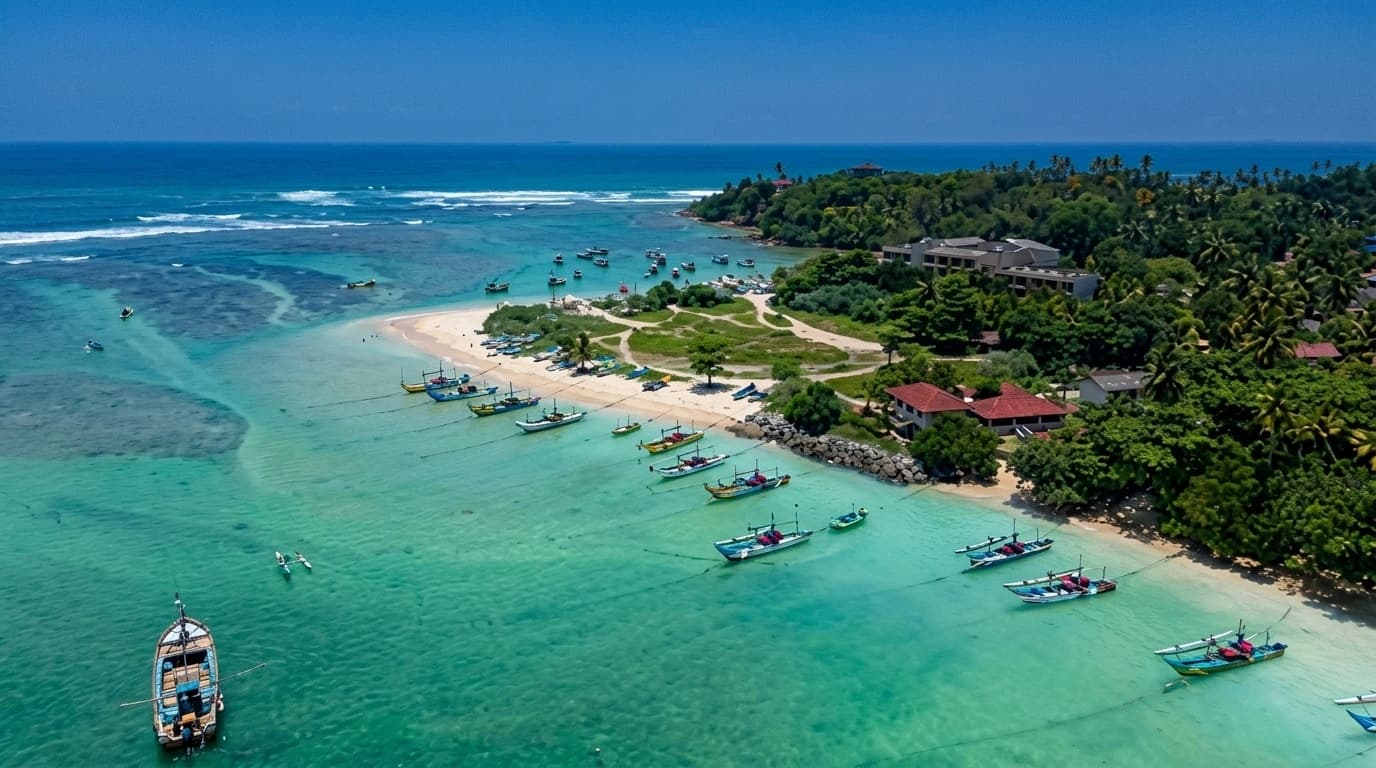
The south coast is where the island reveals itself most generously. Between Dickwella and the fishing towns to the west, the Indian Ocean arrives without ceremony, wide, warm, and serious in a way that the waters further east are not. The beaches here are not manicured. The jungle presses toward the shore. Stilt fishermen balance above the breaks at dawn, as they have for generations, in a posture that looks both ancient and improbable.
Galle Fort is an hour's drive along the coast. This is a UNESCO World Heritage Site, but the designation undersells it, Galle Fort is a living town, not a museum. Dutch and British colonial architecture lines streets where families have lived for centuries. The ramparts walk in a loop around the headland, and from the lighthouse at the southern point you can watch children flying kites above the water while the fishing boats return below. It is the kind of place that asks nothing of you except time.
“To travel here properly is to understand that the coast is only the beginning.
What the interior holds.
An hour or two from the south coast, the island changes entirely. Yala National Park sits at the southeast corner, dry forest, ancient rock outcrops, and the highest density of wild leopards anywhere on earth. These are not guaranteed sightings, and that is precisely the point. The possibility of one, moving through the early morning light between the trees, is a different kind of encounter to anything a resort itinerary can arrange.
Udawalawe is different again, open grassland and the Sri Lanka Elephant Transit Home, where orphaned elephants are rehabilitated before release. Bundala is the birdwatcher's reserve, a wetland system on the coast that draws species from across the region. These three parks are within range of a single base, which is rare anywhere in the world.
Further north and higher, the tea country begins. The estates at Handunugoda produce Virgin White Tea, one of the rarest varieties in the world, picked by hand before sunrise to avoid oxidation. A helicopter from the coast reaches the upcountry in under an hour, landing among plantations that fold into the hills in every direction. It is a journey that takes you from Indian Ocean light to cool mountain air in the time it takes to finish a cup of what you are about to learn about.
What we look for when we plan a stay here.
Sri Lanka does not reward a hotel that sits you in one place and sends you on day trips. It rewards a base, private, comfortable, positioned correctly on the south coast, from which the rest of the island opens up in whatever direction the group wants to move.
What we look for here: direct beachfront access, because the ocean is the rhythm the days organise themselves around. Enough space for a group to move independently without performing togetherness. Staff who know the island, not scripted hospitality, but genuine local knowledge that opens doors a guidebook cannot. And the right level of arrangement: everything available, nothing imposed.
Through our network we have access to a property on the south coast that sits within that standard. It accommodates groups of varying sizes, is staffed entirely around each visit, and operates on the understanding that the experience is yours to design. Everything else is arranged from there.
Who Sri Lanka is right for.
Not those who want to be looked after in one beautiful place and return home. Sri Lanka gives that back to you willingly, the beach, the pool, the food, the water, but it saves its best for those who are willing to move through it with intention.
This is for families who want a trip that means something to children old enough to remember it, leopards in Yala, elephants at Udawalawe, the ramparts at Galle, releasing turtle hatchlings into the Indian Ocean at dusk. For couples who have done the Maldives and want something with more substance behind the beauty. For those who understand that the most interesting places are rarely the most obvious ones, and who are prepared to be genuinely surprised by a country that has been quietly extraordinary for a very long time.
The Pearl of the Indian Ocean is not a marketing phrase. It is a description of density, the way this island holds an improbable amount of the world's most interesting things within its shores. The question is only how deep you want to go.
When to visit Sri Lanka
Sri Lanka has two monsoon systems that affect different parts of the island at different times of year, and understanding this is the single most useful piece of planning for the country. The southwest monsoon (Yala) brings rain to the south and west coasts and the hill country from roughly May through September. The northeast monsoon (Maha) brings rain to the east coast, the north, and the cultural triangle from roughly October through January. The practical result is that the south coast, the tea country, and Yala have their high season from December through March, dry, warm, and reliably good, while the east coast at Trincomalee and Arugam Bay is at its best from May through September, the same months the south is wet. The two-monsoon system means there is almost always a part of the island that is in its season; it also means a poorly timed multi-region trip can be considerably affected. April is the inter-monsoonal month and often the warmest. The Christmas and New Year fortnight is the peak on the south coast, with the better private estates typically booked four to six months ahead.
How to get to Sri Lanka
Bandaranaike International (CMB), about thirty kilometres north of Colombo, is the principal gateway, with direct flights from across Asia, the Middle East, and a limited number of European hubs; most European routes connect via Dubai, Doha, or Singapore. From the airport, the south coast is the longest road transfer, about three to four hours to Galle and a further hour to the Dickwella stretch, depending on traffic through Colombo. The Southern Expressway has reduced this considerably from what it once was, but the timing still matters. Helicopter transfers from Colombo airport directly to the south coast, the tea country, or the national parks are available and frequently used for serious itineraries, Colombo to the south coast takes about forty minutes by helicopter, Colombo to the tea country a similar time, and the inter-region hops avoid the longer road journeys entirely. The smaller domestic airfield at Mattala (HRI) in the deep south serves Hambantota and is occasionally useful. Private jets route most easily into Colombo. We coordinate the international arrival, the airport transfer, and any helicopter routing between regions ourselves.
Where to stay in Sri Lanka
The country is best understood as four or five regions, each offering a different proposition. The south coast, Galle to Dickwella, with Weligama, Mirissa, and Tangalle along the way, is the principal beach base and the orientation point the article describes; this is where most luxury private estates sit. The tea country in the central hills around Hatton, Nuwara Eliya, Ella, and Kandy is the second region, with cool air, plantation walks, and some of the most considered colonial-era estate restorations on the island. The national parks of the south, Yala, Udawalawe, Bundala, are within driving distance of the coast and don't require a separate base, though a tented camp on the edge of the parks adds a different texture for the wildlife portion. The Cultural Triangle in the north-central part of the country, Sigiriya, Polonnaruwa, Anuradhapura, Dambulla, holds the ancient capitals and rock-fortress sites; this is its own region and its own week if done properly, with the dry zone climate operating on a different calendar to the south. The east coast and the north are the third and fourth options, opened more fully in recent years and offering proper alternatives during the southwest monsoon when the south coast is wet.
We do not publish a property list. The arrangements we put together in Sri Lanka are matched once the brief is clear, a south-coast base for the beach and the southern parks, a hill-country addition for the tea estates, a Cultural Triangle leg for the older country, or a combination across all of them with the timing built around the monsoon. What we will say is that the right Sri Lanka trip is the one that uses the island's compactness, it is small enough that the variety becomes part of the rhythm, rather than a series of separate trips.