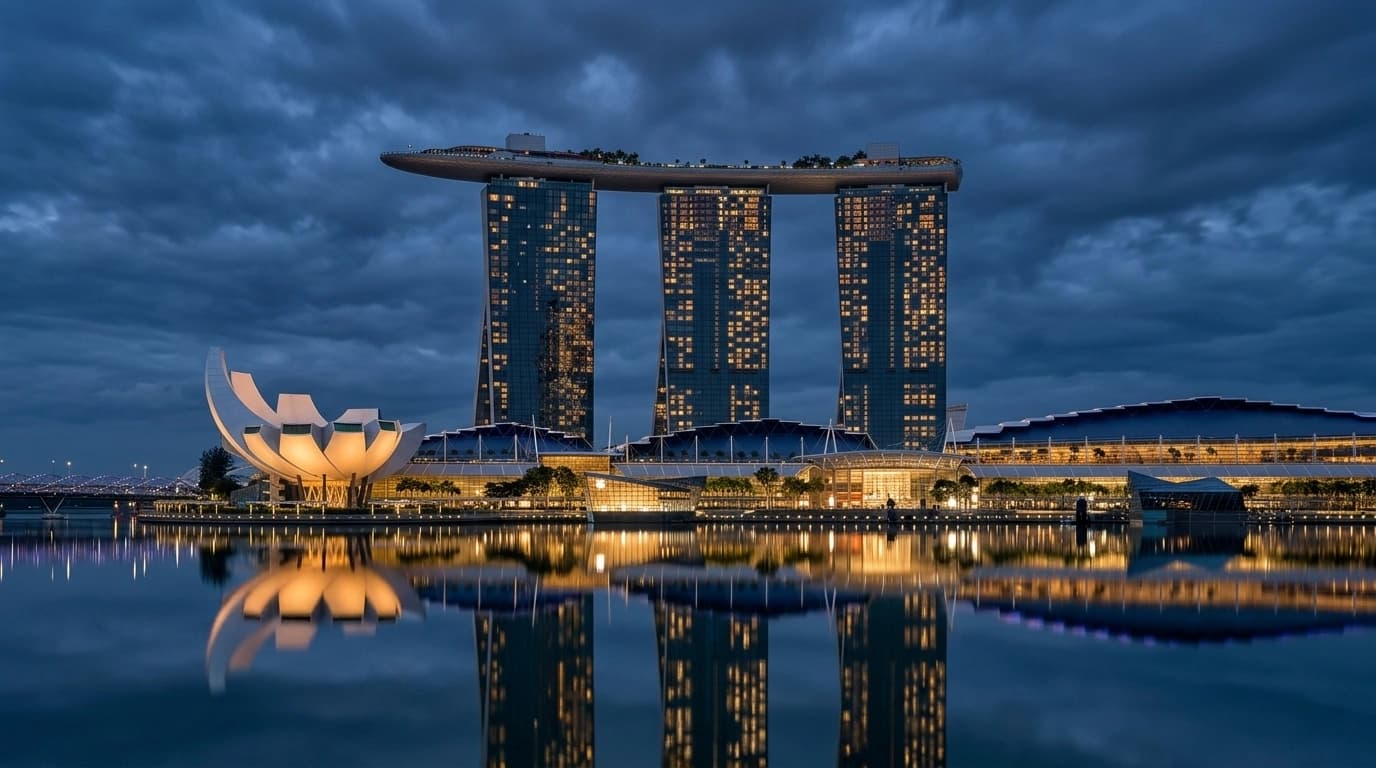
Singapore arrives for most international travellers as a transit point. Two nights in a business hotel, a meal on the top of a building, a photograph of the light show over Marina Bay, and then an onward flight, to Bali, to Thailand, to Australia. The city is efficient, clean, and improbably green; the airport functions at a standard that every other major hub has spent twenty years trying to imitate; the food is cheap and excellent in the way that nothing else at this latitude manages to be. Everyone leaves having enjoyed themselves, and almost nobody leaves having actually been there.
This is a specific kind of misunderstanding. Singapore is a small country, seven hundred and twenty-eight square kilometres, smaller than New York City, but it is a country, not a layover, and the way it rewards proper attention is entirely different from the way the guidebook describes. What the city does not have is a landscape to escape to. What it does have is a density of several of the world's great civilisations compressed into an island where the buses are punctual, the street food is Michelin-starred, and an hour in the wrong neighbourhood becomes an hour in a different century.
And beyond the city, across a short stretch of water that most Singapore visitors never cross, there is a set of islands that the locals themselves treat as the point of the place.
This is where this begins.
What the city actually is.
Singapore was founded, in its modern form, in 1819, which by the standards of most cities is recent, and by the standards of the neighbourhood almost brand new. Stamford Raffles arrived on behalf of the British East India Company looking for a free port that would break the Dutch monopoly on the Malacca Strait, and he found, on the south coast of the Malay peninsula, a sparsely populated island at the confluence of the three principal maritime trade routes of Southeast Asia. What he negotiated from the local sultan, what he built over the next decade, and what has continued essentially uninterrupted for more than two hundred years is one of the most successful urban experiments in modern history. By 1867 Singapore had become a crown colony. By 1965 it was a sovereign nation, expelled from the Malaysian federation against its will and facing what most outside observers considered impossible economic conditions. By the early 2000s it had the highest per capita GDP in Asia outside Japan. This trajectory, from equatorial swamp to one of the world's wealthiest nations in less than two centuries, is the city's organising fact, and the evidence of it is visible from almost every angle.
What the rapid modernisation did not erase, partly by design, is the historical fabric of the older neighbourhoods. The Peranakan shophouses of Joo Chiat and Katong, with their painted facades and their pastel tiles, remain largely intact, terraces of two- and three-storey buildings, each one a family residence above a ground-floor business, built by the descendants of Chinese traders who had settled in Malacca in the fifteenth century and whose hybrid Chinese-Malay culture became one of the defining sub-cultures of the region. Tiong Bahru, the first public housing estate built by the British in the 1930s, has been preserved in its original art deco vocabulary and is now one of the most quietly fashionable neighbourhoods in the city. Chinatown, Little India, and Kampong Glam each retain their own architectural coherence and their own communities, none of them in quotation marks, none of them arranged for visitors.
The food is its own subject, and it is not an exaggeration to say it may be the single strongest argument for the city. Hawker centres, covered markets of a hundred or more small stalls, each one specialising in a single dish, are a Singaporean institution dating to the mid-twentieth century, when the city's government formalised and housed the street vendors who had been feeding the population for generations. The tradition has produced what is almost certainly the densest concentration of serious cooking per square kilometre anywhere in the world. Two hawker stalls, one selling soya sauce chicken rice, one selling noodles, were awarded Michelin stars in 2016, the first street food anywhere to be so designated. A bowl of the city's best laksa, char kway teow, or chicken rice costs less than a cup of coffee in London, and is cooked by a family that has been perfecting the same single dish for three or four generations.
“A city too often reduced to the airport and a photograph. Treat it as a country, and it gives back considerably more than the layover admits.
What the islands offer.
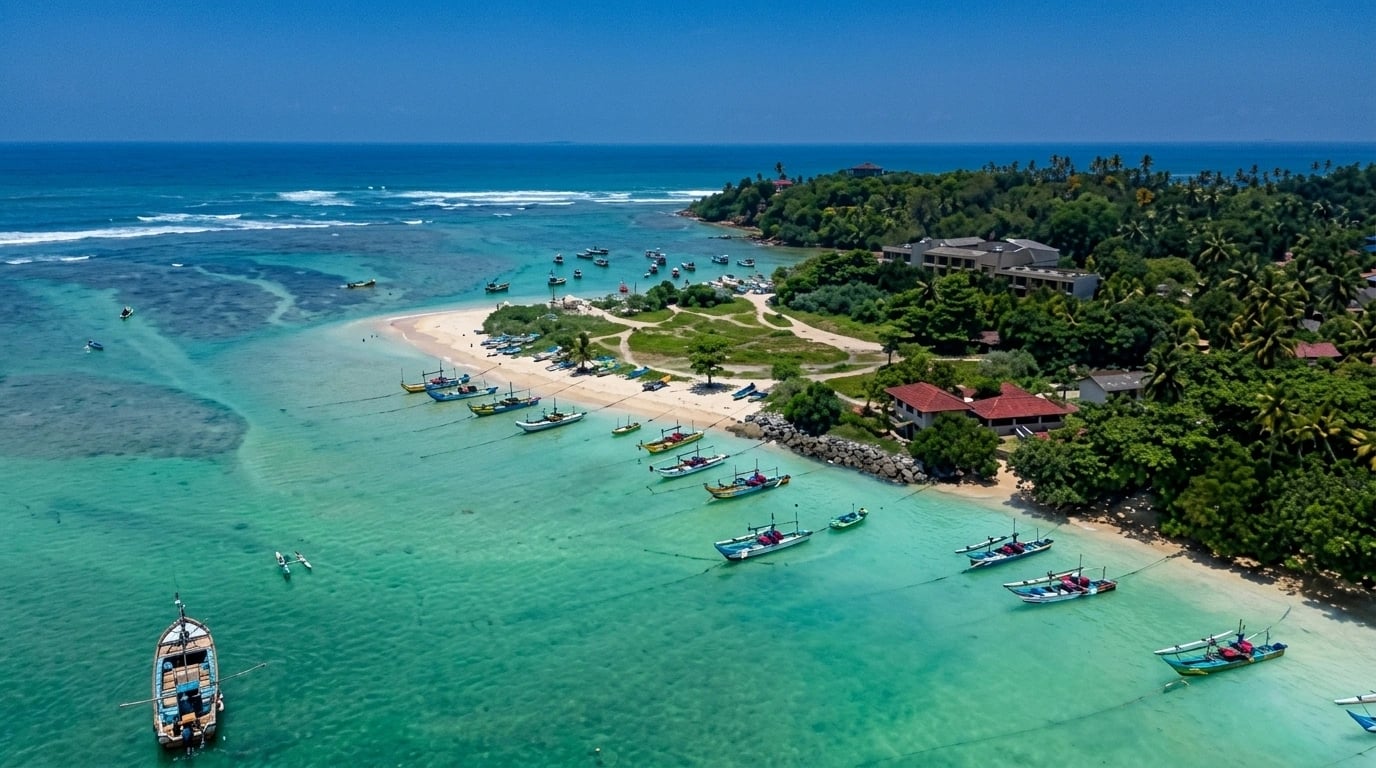
A forty-minute ferry from the HarbourFront terminal crosses the Singapore Strait to a chain of islands that very few international travellers know exist. The Riau archipelago is Indonesian territory, a remainder of the old Riau-Lingga Sultanate, whose lineage once ruled both sides of the Malacca Strait, and it consists of several thousand islands of varying sizes, stretching south from Singapore in an arc that eventually reaches Sumatra. The two principal islands closest to Singapore, Batam and Bintan, have their own characters: Batam is industrial and heavily urbanised, a specific kind of cross-border economic zone; Bintan, twice the size, is the one to cross for.
Bintan is where Singaporean families go for the weekend. The island is developed in specific corners, the northern coast has a cluster of resorts around the Lagoi area, and otherwise almost entirely empty. The beaches are long, the water is warm, and the pace is precisely the opposite of the city's: rural, slow, Indonesian. A proper crossing, for a few nights, makes the Singapore portion of the trip function entirely differently. The city becomes the primary base, the islands the weekend, and the two things together describe an experience of the region that nobody doing the layover version of Singapore ever has.
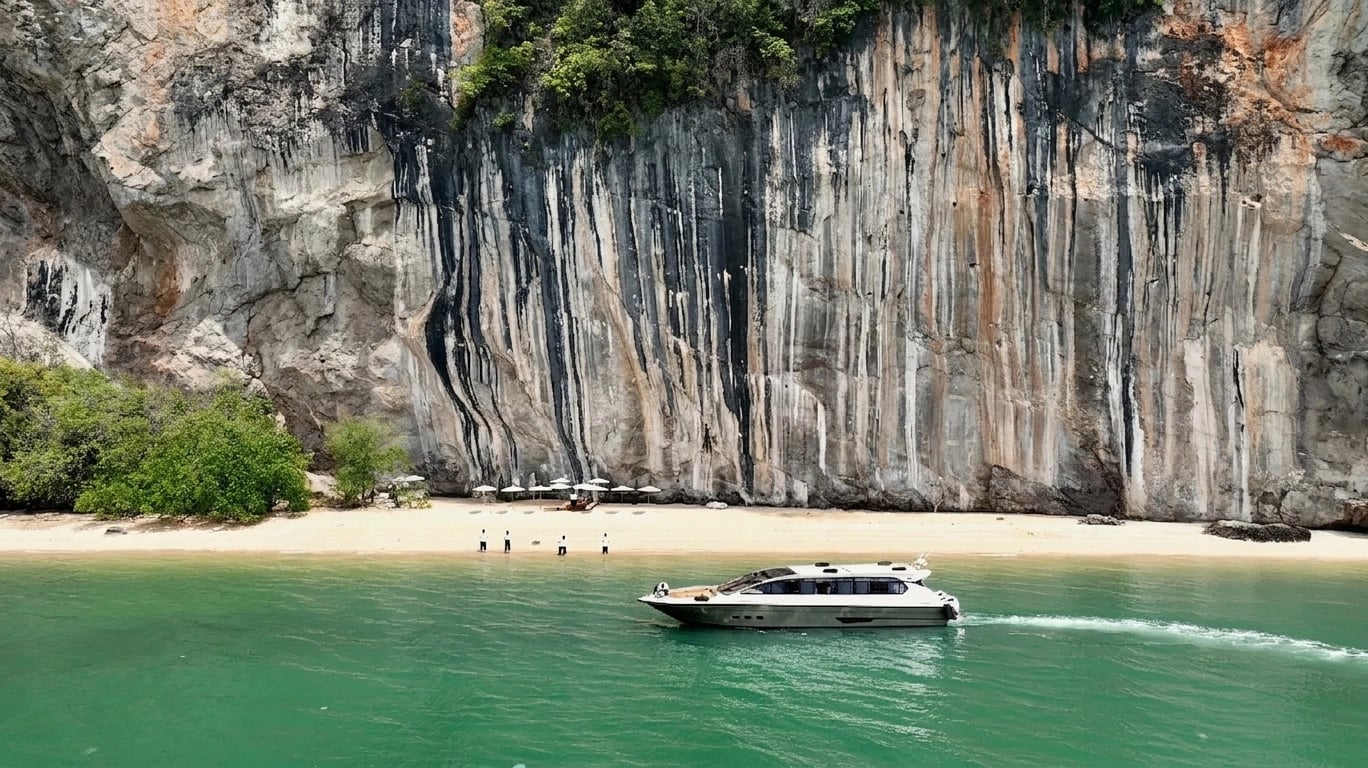
Further afield, the Anambas and Natuna groups, still in Indonesian Riau, are among the least visited archipelagos in Southeast Asia. Reachable only by a charter from Batam or a small commercial flight, they are what the Andamans used to be before the word got around. These are not everyone's trip, and they require several days' commitment. But for those who want to see what the waters of this region looked like before the resorts arrived, they remain, for the moment, entirely available.
How it feels to be there.
Singapore sits almost exactly on the equator, and the climate reflects it. The temperature hovers between twenty-six and thirty-two degrees year-round, the humidity stays high, and the weather moves in short, dramatic afternoon storms rather than seasonal cycles. What this means for the rhythm of a visit is that mornings and evenings are the right times to be outside, and middays are for the interior, the galleries, the museums, the long lunches in shophouse restaurants with the fans turning. The Botanic Gardens, a UNESCO World Heritage Site and one of the three great tropical botanical gardens of the world, are at their best at seven in the morning, when the monkeys are still in the canopy and the joggers are not yet out in numbers.
The evenings are the city's own. Rooftop bars at the top of buildings that look across the skyline; long dinners in the Peranakan neighbourhoods where the tables spill into the street; the hawker centres that do their busiest trade from nine at night onward, with families at the plastic tables eating the same dishes their grandparents ate in the same buildings. The public spaces are safe in a way that most cities have not been for a long time. Walking home from dinner at midnight through Tiong Bahru is precisely as comfortable as it would be at noon.
The islands, by contrast, run on entirely different rhythms. The pace on Bintan is closer to the pace of a quiet Indian Ocean island than to anything in the city, long mornings on the beach, afternoons moving between pool and sea, dinners at tables set up on the sand. The contrast between the two halves of a trip is the entire point.
What we look for when we plan a stay here.
Singapore rewards a property that takes the city seriously on its own terms. A generic international hotel is a missed opportunity in a place that has this much specific character to draw on. The best stays combine two things: a genuine position within the historical fabric, a restored shophouse, a private residence in one of the older neighbourhoods, a suite in one of the colonial-era hotels that have been maintained rather than rebranded, and a level of service that is unobtrusive in the specifically Singaporean register. Service here is precise, quiet, and entirely without performance. It is one of the city's defining qualities, and the right property understands this.
What we look for here: a base that places the group within the older neighbourhoods rather than the skyline. A kitchen, a concierge, and a team who understand the hawker culture, the restaurant scene, and the private doors that open to the right introductions, the Peranakan family homes that accept guests by appointment, the private art collections in the old houses, the small dinners in the dissident spaces of the city that do not advertise. And for the island component, an arrangement on Bintan that operates at the level the city has set, not a mass resort, but a private villa on a quiet stretch of the northern coast.
Through our network we have access to stays in the city and on the islands that sit within this standard. Each is arranged personally, matched to the group and the week, and handled from the airport onward.
Who Singapore is right for.
Not those who want a tropical holiday with a city stopover attached. The layover version of Singapore serves that function adequately, and there is no real reason to improve on it if that is all the city is being asked to do.
This is for travellers who have understood that the world's great cities reward the same kind of serious attention, regardless of their age or scale, and that Singapore is a city of genuinely global rank. For families who want a week that combines urban intensity with beach simplicity in a way that almost no other combination in the world allows at this distance, a city of the first order and an empty Indonesian island within a ferry's distance of each other. For couples who have flown through Singapore half a dozen times and have always wondered what they were missing. For food people, who will find here the most serious sustained cooking culture in Southeast Asia and arguably the world. For those who have learned that the cities worth understanding properly are the ones people do not usually stop in, and who are prepared to give one of the most interesting experiments in recent urban history the week it deserves.
The city has been here for two centuries. The trading patterns it was built to serve have been here for five. The islands around it have been here for much longer, and will be when the city has been through its next several versions. All of it is available in the space of a single week. The only question is whether you give it more than the layover allows.
When to visit Singapore
Singapore sits almost exactly on the equator, and the year does not have seasons in the temperate sense. What it has are degrees of rain. The drier months run roughly February through April and again from July through September, with daytime temperatures in the low thirties and shorter, less frequent storms. The wetter months are November through January, with the northeast monsoon bringing heavier and more persistent rain, though even at its peak the rain typically arrives in dramatic afternoon bursts rather than all-day weather. The temperature itself barely varies; the rhythm of a visit is set by the storms rather than the season. Chinese New Year, which moves through late January and February by the lunar calendar, is the most significant cultural event of the year, the city is at its most decorated and atmospheric, and also at its most expensive and heavily booked, with the better stays typically taken six to nine months ahead. The Formula 1 Singapore Grand Prix in late September fills the city for its weekend and is best either embraced or avoided rather than encountered by accident. The Great Singapore Sale in mid-summer is the local retail event of the year. The haze season, when agricultural burning in neighbouring Indonesia occasionally produces several days or weeks of compromised air quality, is unpredictable and varies considerably year to year, it has been substantially less common in recent years than in the previous decade, but remains a possibility from roughly August through October.
How to get to Singapore
Singapore Changi (SIN) is one of the most extensively connected airports in the world, with direct flights from across every continent and consistent rankings near the top of every global airport survey. The airport itself is twenty to thirty minutes from the principal city districts by road. For the island extension, the Riau archipelago is reached primarily from the HarbourFront Cruise Centre by ferry, Bintan's Bandar Bentan Telani terminal is fifty to sixty minutes from Singapore by fast ferry, and a small number of resorts on the northern coast operate their own scheduled boats from the same terminal. For onward travel from Singapore into the wider region, the air connections are essentially universal, Bali, Bangkok, Phuket, Phnom Penh, the Maldives, Sri Lanka, and the rest of the region are an hour or two away by direct flight. Private jets route most easily into Seletar (XSP), the city's dedicated business aviation airport on the north coast, with Changi as the alternative. We coordinate the airport arrival, the city transfers, the ferry routing, and any onward connection into the region ourselves.
Where to stay in Singapore
The city's older neighbourhoods, which the article describes, are the right base for a stay that takes Singapore seriously. Each has its own character. Joo Chiat and Katong on the east coast hold the Peranakan shophouse architecture and the Eurasian and Straits Chinese culinary traditions, with a quieter residential feel than the centre. Tiong Bahru, ten minutes from the central business district, is the art-deco interwar quarter and the city's most quietly fashionable neighbourhood, with a high concentration of independent restaurants and bookshops. Chinatown, Little India, and Kampong Glam, clustered together in the central districts, each retain their own working community character and offer the densest concentration of culinary and cultural experiences. The colonial Civic District around the Padang and the Singapore River holds the heritage hotels and the principal museums. Marina Bay and Orchard Road are the corporate and shopping districts respectively, efficient for business stays, less rewarding for those who came for the city itself. For the island extension, the northern coast of Bintan is the principal area, with a cluster of resorts at Lagoi and a small number of more secluded private villas further along the coast.
We do not publish a property list. The stays we arrange in the city and on the islands are matched once the brief is clear, a restored shophouse for the historic quarters, a heritage suite in the colonial district, a Bintan villa for the island half of the week. What we will say is that the right Singapore stay is the one that uses the city as a country, and that gives the Riau crossing the few days it deserves. The two halves describe a region that the layover version simply does not.