India, for most international visitors, begins at Delhi airport and proceeds in a sequence that someone worked out a long time ago. A day or two for the capital, Humayun's Tomb, the spice market, the Red Fort. A train or a short flight to Agra for the Taj Mahal, probably at dawn, photographed in the way everyone photographs it. Then a return to Delhi and a flight onward to somewhere else, Goa for the beach, Kerala for the backwaters, the Himalayas for the hills.
This is not wrong, and anyone taking India for the first time could reasonably do it this way. But it misses, in a very specific sense, the India that the country's own travellers, the old families, the Delhi aristocracy, the writers and the filmmakers, understand to be the real one.
Five hundred kilometres west of Delhi, the land dries out. The Ganges plain gives way to scrub and thorn. The rivers become seasonal and then stop being rivers at all. The fields end, and the desert begins, and the geography turns from flat to complicated, ancient volcanic ridges, salt lakes, isolated hill fortresses visible for a hundred kilometres across country that has barely been farmed. This is Rajasthan. The land of kings. The India that was, until 1971, less than sixty years ago, still ruled by twenty-two independent princely houses, each of them tracing its lineage to warrior clans whose recorded history runs in unbroken succession for the better part of a millennium. The country they built, and the palaces they built it in, are the organising fact of everything that follows.
This is where this begins.
What the region actually is.
Rajasthan is the largest state in India by area, three hundred and forty-two thousand square kilometres, larger than Germany, and more than twice the size of Greece. Roughly a sixth of it is desert: the Thar, which extends west toward the Pakistani border and is among the most densely populated arid regions on earth, a fact that will surprise anyone who has seen other deserts. The rest is the country of the Aravalli range, one of the oldest mountain systems in the world, older than the Himalaya by some two billion years, worn down now to ridges of only a few hundred metres but running for seven hundred kilometres in a diagonal line across the state.
The Rajputs, the warrior caste who held this land for most of the last thousand years, were never conquered by the Mughals in the way most of northern India was. Instead, they negotiated. Marriages were arranged. Alliances were formed. Rajasthan's princely houses kept their thrones, their armies, their tax revenues, and their extraordinary distinctive architectural tradition. When the British arrived, the arrangement continued: the princely states of Rajputana were not directly administered by the Raj, but signed treaties of subsidiary alliance and carried on essentially running themselves. This is the reason Rajasthan looks the way it does today. The palaces were not built as museums. They were built as functioning royal residences, most of them across several centuries of continuous occupation, and most of them remained in family hands until the 1971 Constitutional amendment abolished the princely order formally. Many remain in family hands now. Several operate as hotels in which the families still live in a wing, and in which the person who greets you at dinner may well be someone whose grandfather was a head of state.
The architecture is the other extraordinary inheritance. Rajasthani building traditions evolved in response to a specific set of conditions, high heat, low humidity, bright sun, the need for defensive structure, and the solutions the craftsmen found are genuinely unlike anywhere else. The jali, the pierced stone screen, which allows air and cool shade to pass through a wall while blocking direct light. The jharokha, the overhanging balcony that projects from an upper floor into the courtyard below, offering both a view and a breeze. The chhatri, the small domed pavilion that crowns rooftops. The blue paint of Jodhpur's old city, applied to the houses of the Brahmin caste and extended across the neighbourhoods until the city from the fort above looks, at dusk, like a reflection of a sky. The pink wash of Jaipur, ordered by the Maharaja Ram Singh in 1876 to welcome the Prince of Wales, and still reapplied every few years by municipal mandate. The white marble of Udaipur's lake palaces, floating on water that reflects them in conditions most hours of most days.
“Twenty-two independent princely houses, ruling into the memory of living people. The India that was never flattened into one country until very recently, and that has not forgotten.
What each city keeps.
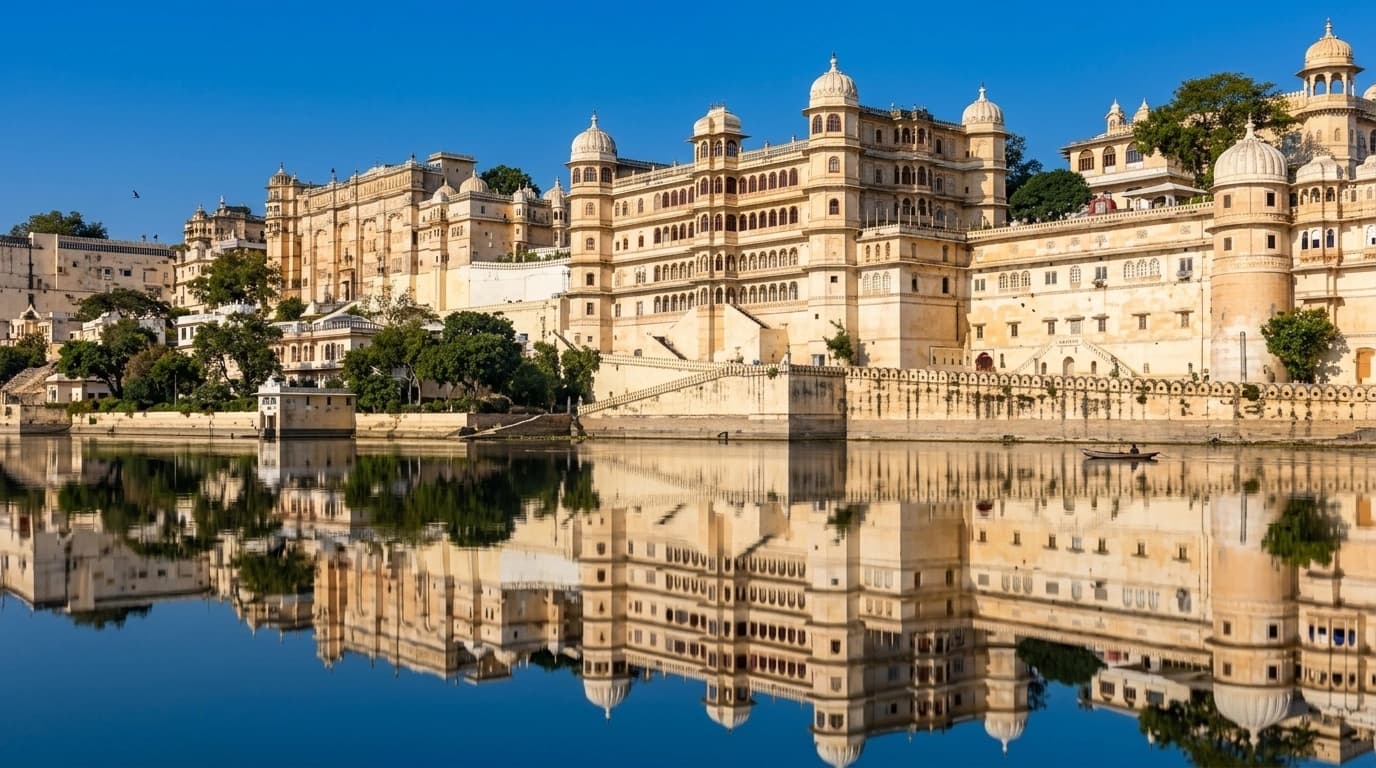
Udaipur is the southernmost of the three principal cities, and the one that most travellers find most immediately extraordinary. The city was founded in 1559 by the Maharana Udai Singh II after the sack of Chittorgarh forced him to move his capital, and it was built around a series of lakes, Lake Pichola chief among them, that the Maharana had constructed by damming the local river. The City Palace rises from the shore of Pichola in white stone across a frontage of almost a quarter of a mile, the largest royal palace complex in Rajasthan, and in the middle of the lake itself sit the Jag Niwas and Jag Mandir, island palaces built as summer retreats by later Maharanas, both of them still standing and both, in different ways, working. Udaipur is the city that most looks like the miniature paintings that come out of it. The colours, the reflections, the scale are all exactly what the paintings promised. It is one of the very rare cases in which the travel photography undersells the place.
Jodhpur is the northern Rajput capital, founded in 1459 and dominated, from any angle in the old city, by the Mehrangarh Fort, one of the largest forts in India, built on a sandstone outcrop a hundred and twenty metres above the blue city below. The fort has never been taken. Its walls are in places six metres thick. Inside, the palaces that successive Maharajas added to over five centuries have been maintained by the royal family as a museum that functions more like a residence than an institution. The current Maharaja still lives in Umaid Bhawan, the enormous art deco palace on a ridge at the other side of the city, which was completed in 1943 and is the last great palace ever built in India.
Jaipur is the commercial and administrative capital of modern Rajasthan, and the most planned of the three cities. It was laid out in 1727 by Maharaja Sawai Jai Singh II on a grid based on the ancient Indian treatises on urban planning, nine rectangular sectors, wide avenues, astronomy observatories built into the geometry of the city centre because the Maharaja was a serious astronomer. The Jantar Mantar, the enormous open-air astronomical instruments he constructed, including the largest sundial in the world, accurate to two seconds, still stands in the heart of the city. The City Palace is still occupied by the royal family. The Amber Fort, above the city on the hills, is as elaborate and visible a piece of Mughal-Rajput architecture as exists anywhere.
Between the three cities, the countryside is its own subject. The Aravalli foothills, the lakes at Pushkar, the tiger reserves at Ranthambhore and Sariska, where tigers still roam a landscape dotted with the ruins of tenth-century Chauhan forts, and the small desert towns along the way, each with its own havelis and its own aristocratic histories. The pace of movement between the cities, by road through this landscape, is often as rewarding as the cities themselves.
How it feels to be there.
The right season is narrow. October through March is the window during which Rajasthan operates at its best, cool enough in the evenings to want a shawl on a palace terrace, warm enough in the middle of the day for a swim in a lake-facing pool. April and May are for people with a high tolerance for heat and an interest in near-empty cities. The monsoon, June through September, is less useful for travel in most of the state but genuinely beautiful in the cities that catch it, Udaipur in particular, which comes alive in a way that is difficult to describe and impossible to photograph well.
Days here tend to arrange themselves around shade and transition. Mornings are early because the light is at its best and the heat has not yet arrived, walks through the old cities before the markets open, visits to the forts and the palaces before the day trippers arrive from Delhi. Late mornings and early afternoons are for the indoors, which in Rajasthan is not a hardship: the palace architecture was built precisely for these hours, and a long lunch in a jali-screened courtyard with a fan turning slowly overhead is one of the quiet pleasures of the region. Afternoons reopen onto the landscape, a drive into the Aravallis, a boat on the lake, a tiger reserve at the hour the cats move. Evenings are the best of all. The sunsets over the desert and the lakes are dramatic in a way that the flatter parts of India cannot produce. Dinner happens late and outdoors, in a courtyard or on a rooftop with one of the cities glowing below.
The food of Rajasthan is distinctive and not particularly well known outside the state. The region's aridity forced a cuisine based on preservation, on yoghurts and dried pulses and ghee, on spices rather than fresh vegetables. Dal baati churma, the desert trinity of lentils, baked wheat dumplings, and sweet crumble, is the defining regional meal. Laal maas, the fierce red mutton curry of the Mewar region. Gatte ki sabzi. Ker sangri, made from the berries and beans of desert shrubs. And across the state, the thali tradition, small metal platters carrying twenty or thirty items at once, each in its own tiny bowl, is the way the region's food is most properly eaten.
What we look for when we plan a stay here.
Rajasthan rewards an arrangement that moves without rushing. The right week is usually a triangle: three or four nights in each of two or three of the principal cities, with the country in between treated as part of the journey rather than an obstacle. The exact triangle depends on what the group wants, Udaipur-Jodhpur-Jaipur for the classic full loop; Udaipur-Jodhpur for something more contemplative; Jaipur-Ranthambhore for a combination with wildlife. The principal movements are best done by road, with a proper car and a driver who knows the region, rather than by domestic flight, because the landscape in between is much of the reason to come.
What we look for here: a stay in a palace that is genuinely one, that is, still held by the family that built it, or maintained to the standards of a family still involved, rather than a hotel decorated in the palace manner. A room with a real view, because every Rajasthani palace was built for a specific view, and taking a back room is to have misunderstood the exercise. Staff who come from the region, and who carry the local knowledge that allows the trip to move in the way it should. A private guide, particularly in the old cities, because the forts and the palaces reward the hour of proper explanation and suffer without one. And the right vehicle and driver for the country movements, again, a regional professional rather than a generic transfer.
Through our network we have access to palace stays in all three of the principal cities that sit within this standard, properties where the royal family still has a presence, or where the conservation of the building is being done with the seriousness the heritage demands. Each is arranged personally, matched to the season and the group's pace, and handled from the Delhi arrival onward, including the country movements in between.
Who Rajasthan is right for.
Not those who want India as a tropical beach with a cultural flourish. Goa and Kerala are there for that, and they do it well. Rajasthan is a different kind of trip, and it is a considerable one, the colour, the intensity, the press of a region that has been continuously inhabited by one of the world's densest civilisations for several thousand years. It is the opposite of a rest.
This is for travellers who have understood that the most serious cultural landscapes in the world tend to require a real commitment of time, and who are willing to give a region of this weight the week or ten days it deserves rather than the forty-eight hours the standard itinerary allows. For families with older children, teenagers upward, who will remember the forts and the markets and the tiger in the reserve in a way they will not remember almost anywhere else. For couples who have done India at some point in their twenties and want the version of the country they were not then equipped to see. For those who have learned that the palaces worth staying in are the ones where the family is still somewhere on the property, and who understand what that continuity means for the experience of being there.
The Rajputs have held this country for a thousand years. The palaces have stood for most of it. The families who built them are still, in a surprising number of cases, the ones who own them. Almost none of this will be true in another few generations, in the same way it has been true for the last thirty. The argument for going now is a simple one, and it is not about urgency. It is about meeting a civilisation in the moment before a version of it finally ends.
When to visit Rajasthan
The window is October through March, but the inside of that window varies considerably. October is mild, the post-monsoon greens still on the land, and the cities are beginning to fill, Diwali falls in October or early November, which transforms the palaces but also tightens availability sharply. December is the peak: cool, dry, golden, and the most heavily booked weeks of the year. January and February are the most consistent, the cool runs through the nights, the light is at its sharpest, and the desert is at its best. March is warming but still possible; the Holi festival lands in the middle of the month and is worth arranging around if the timing suits. The best rooms in the principal palaces, particularly across the Christmas-to-mid-January block, are typically booked six to twelve months in advance.
How to get to Rajasthan
Indira Gandhi International (DEL) in Delhi is the principal gateway and the start of most itineraries. Mumbai (BOM) is the alternative when the entry point is Udaipur, the southern city is closer to Mumbai than to Delhi by some hours of flying. Each of the three principal cities is also served by its own airport, Udaipur (UDR), Jodhpur (JDH), and Jaipur (JAI), with domestic connections from Delhi and Mumbai running several times a day. The country between the cities is best covered by road for the reasons set out earlier; we arrange the vehicle and the regional driver, and where time presses, we coordinate the private flight between cities directly. Private jets route into Delhi and Jaipur most easily, with Udaipur and Jodhpur accessible by mid-size aircraft.
Where to stay in Rajasthan
The triangle is the framework: between two and four nights in each of two or three of the principal cities, with the country between treated as part of the journey rather than something to skip. Each city offers a different proposition. Udaipur is the most immediately romantic, the lake palaces, the white stone, the reflections that the miniature paintings spent centuries trying to capture. Jodhpur is the austere counterpoint, the blue city below the great fort, the desert nearby, the strongest sense of the Rajput martial tradition. Jaipur is the most cosmopolitan, the pink city, the markets, the easiest of the three for shorter stays and for travellers entering Rajasthan from Delhi. Where the group is unsure, Udaipur tends to be the right opening.
We do not publish a property list. The palace stays we arrange in each city are ones where the family retains a presence, or where the conservation is being done with the seriousness the heritage demands. Each itinerary is matched to the season and the pace of the group, and arranged from the Delhi arrival onward.