Everyone who comes to Portugal for the first time goes to Lisbon. This is correct. Lisbon is one of the finest cities in Europe, trams, tiles, light that arrives off the Tagus at an angle that makes the whole place look like a painting someone forgot to finish. It earns the attention it gets, and it rewards the time given to it.
But Lisbon is the introduction. The country begins when you leave.
An hour east of the capital, the road climbs out of the coastal plain and the landscape changes entirely. The cork oaks appear first, ancient, half-stripped, their trunks the colour of rust, and then the silence. Portugal's interior is one of the least visited regions in Western Europe, which is an extraordinary thing to be true of a country that receives tens of millions of tourists a year. They arrive, they go to the coast, they leave. The Alentejo and the Douro, the two landscapes that give Portugal its genuine soul, remain, by comparison, almost entirely undiscovered.
This is where this begins.
What the Alentejo actually is.
The Alentejo is the vast, slow, sun-beaten region that covers roughly a third of Portugal south of Lisbon. Rolling plains of wheat and cork, olive groves that have been worked for centuries, medieval hilltop villages that look out over landscapes so wide the horizon curves. The light here in summer is savage and beautiful in equal measure, everything bleached by midday, then turning extraordinary colours in the hour before the sun drops behind the hills.
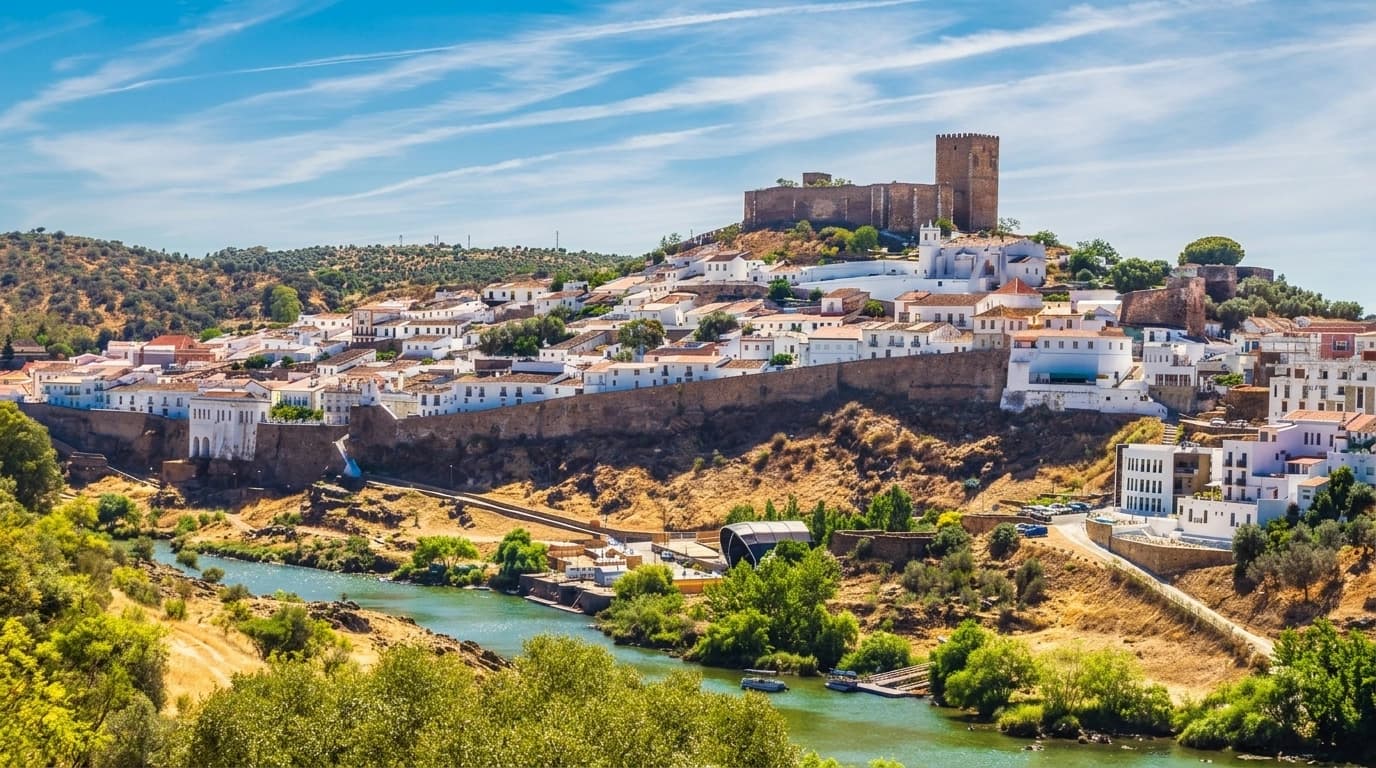
Monsaraz is the village to understand all of this from. It sits on a promontory above the Alqueva lake, a walled medieval town of white-painted houses and cobbled streets where the population numbers in the hundreds. From the castle walls you can see the lake spreading for thirty kilometres in every direction, Alqueva is the largest artificial lake in Western Europe, created in 2002 when the Guadiana river was dammed, and the landscape it created is one of the most quietly extraordinary things in the country. On clear nights the sky above it is among the darkest in Europe. The region holds a Starlight Reserve designation. There are no city lights for a long way in any direction.
“An hour from Lisbon, the silence arrives. The Alentejo is one of the least visited regions in Western Europe. Almost nobody knows it is there.
What the lake gives you.
The property we work with here sits directly above Alqueva, on a sixteen-hectare private estate that extends from the gardens down to a private dock on the water. Recently renovated, the architecture modern but settled into the landscape rather than imposed on it, it accommodates up to twenty-two guests across eleven suites, each with its own terrace and lake or countryside views.
The estate is owned by a Michelin-starred chef, which changes everything about how the food works. Full board is included, and the kitchen operates around what the season and the land produce, local olive oil, the region's wines, vegetables from the estate's own garden, the kind of cooking that understands the difference between expensive ingredients and good ones. Two pools, one infinity and one heated year-round with hydromassage. A cinema, a sauna, a wine cellar that seats eight around its own table. Kayaks and paddleboards on the lake. On still mornings, the water in front of the dock is completely flat, and the hills on the far shore are reflected in it perfectly, and there is nowhere else on earth you need to be.
What the Douro holds.
Four hours north, the landscape is different in every possible way. The Douro Valley is where port wine was born and where the best table wines in Portugal still come from, a river gorge so steep and so planted with terraced vineyards that it looks, from above, like something that should not exist. The valley was declared a UNESCO World Heritage Site in 2001. It is one of the oldest wine regions in the world, with demarcated boundaries that have been protected since 1756.
What you do not understand from a photograph is the scale of it. The terraces climb the gorge walls from the river to the ridgeline, some of them so steep they are still worked by hand because no machine can reach them. The river winds through it all, and on the traditional Rabelo boats, flat-bottomed wooden vessels that once carried barrels of wine from the quintas to the coast, you can drift through the gorge at the pace it deserves.
The harvest in September and October turns the valley gold and red, and the air smells of fermentation from every direction. But the Douro is worth visiting in any season. In early spring the almond blossom runs along the terraces. In winter the valley fills with mist that sits in the folds of the hills until the afternoon.
What the estate gives you.
The second property we work with sits within the valley itself, a wine estate with the Douro River visible from the living spaces, surrounded by vineyards on three sides. Six bedrooms for up to sixteen guests, interiors that feel genuinely considered rather than decorated, outdoor spaces positioned to understand the view rather than simply face it.
The valley is the activity. Wine tastings at the estate and at the quintas nearby, some of the finest producers in Portugal, accessible through the right introduction. Boat trips along the river at whatever pace you want. Cycling the valley roads in the early morning before the heat arrives. Dinner on the terrace as the river darkens below and the lights come on, one by one, in the village across the water.
What we look for when we plan a stay here.
Portugal rewards a longer stay than most people give it. Both the Alentejo and the Douro have a pace that takes a day or two to find, the first day you are still moving at the speed you arrived at, and the place is waiting for you to slow down. By the third day you understand what it was offering. By the end of the week you do not want to leave.
What we look for here: properties that are genuinely embedded in their landscapes rather than positioned above them. Food that comes from somewhere rather than a supplier catalogue. The right level of arrangement, everything available, nothing imposed. And enough time built into the plan for the unscheduled things, because Portugal's best moments are almost always the ones nobody planned.
Who Portugal is right for.
Not those who want the coast and the sun lounger and nothing more difficult than choosing between two beach bars. Portugal will give you that too, but this is not that version.
This is for those who travel to understand somewhere rather than simply to be in it. For families who want a week that gives everyone something different, the lake for the children, the wine for the adults, the history and the landscape for everyone. For couples who have been to the obvious places and want somewhere that still surprises. For anyone who has ever turned off the main road in southern Europe and found something extraordinary waiting, and wants that feeling guaranteed rather than left to chance.
The cork oaks are being harvested on the same cycle they have been for two hundred years. The Douro has been making wine since before Portugal was a country. The stars above the Alentejo are the same ones the Romans saw. None of it is in a hurry. Neither, if you choose correctly, are you.
When to visit the Alentejo and Douro
Spring and autumn are the most rewarding seasons in both regions. In the Alentejo, late February through April brings the almond blossom and the wildflower season, the plains are at their greenest, the heat is still mild, and the light has not yet hardened into its midsummer ferocity. October into early November is the other answer, with the warmth still present and the olive harvest beginning. July and August in the Alentejo are genuinely hot, forty degrees is not unusual, and best given to those who travel for the bleached scale of it and the long pool afternoons rather than for movement. The Douro runs on its own calendar: the September and October harvest is the dramatic window, when the terraces turn gold and red and the air carries the smell of fermentation. Spring in the Douro brings almond blossom along the river. Winter fills the valley with mist that lifts toward the afternoon, and is in many ways the most quietly beautiful season of all.
How to get to the Alentejo and Douro
Lisbon (LIS) is the principal gateway for the Alentejo and the lower country generally. Évora is about ninety minutes east by road, Monsaraz and Alqueva closer to two hours. For the Douro, the more efficient route is into Porto (OPO), with the valley itself about ninety minutes inland by road. Both airports are well connected from across Europe and from North American hubs. Trains run between Lisbon and Porto and into parts of the Douro from Porto, though most luxury itineraries are run by road for the flexibility. Private jets route most easily into Lisbon and Porto; from either, ground transfer to the property is straightforward. We coordinate the routing, the vehicle, and the timing of any transition between the two regions ourselves.
Where to stay in the Alentejo and Douro
The two regions ask for different choices. The Alentejo divides loosely into three: the high country around Évora and Monsaraz, anchored by the lake at Alqueva and the most quiet of the three; the western Alentejo near the coast, where the landscape softens toward the Atlantic; and the Beja region further south, with its cork forests and the smaller medieval towns. Each has a different rhythm, the high country for those who want stillness, the western country for those who want both the landscape and the ocean, the Beja for those who want the deeper interior. The Douro is more linear: the Baixo Corgo near Régua is the most accessible and visited; the Cima Corgo, around Pinhão, holds the densest concentration of the famous quintas; the Douro Superior beyond is wilder and quieter, the terraces older and the valley narrower.
The two estates this piece describes are examples of what we arrange rather than the limit of what is available. We do not publish a property list. Each stay is matched once the brief is clear, sometimes the lake house, sometimes a smaller quinta along the river, sometimes a stay across both regions with the country in between. What we will say is that Portugal's best houses are rarely the ones in the magazines.