Oslo is a fine city, and there are reasons to spend time in it. A harbour that was rebuilt with the kind of patience that Nordic capitals can still afford. An opera house that rises out of the fjord like a slab of ice. Museums built around a small number of genuinely extraordinary things. It is quiet, considered, and entirely itself, and most international visitors to Norway never leave it, or leave it only for the day trip to a fjord that the guidebooks have already chosen for them.
The Norway worth travelling for begins much further north.
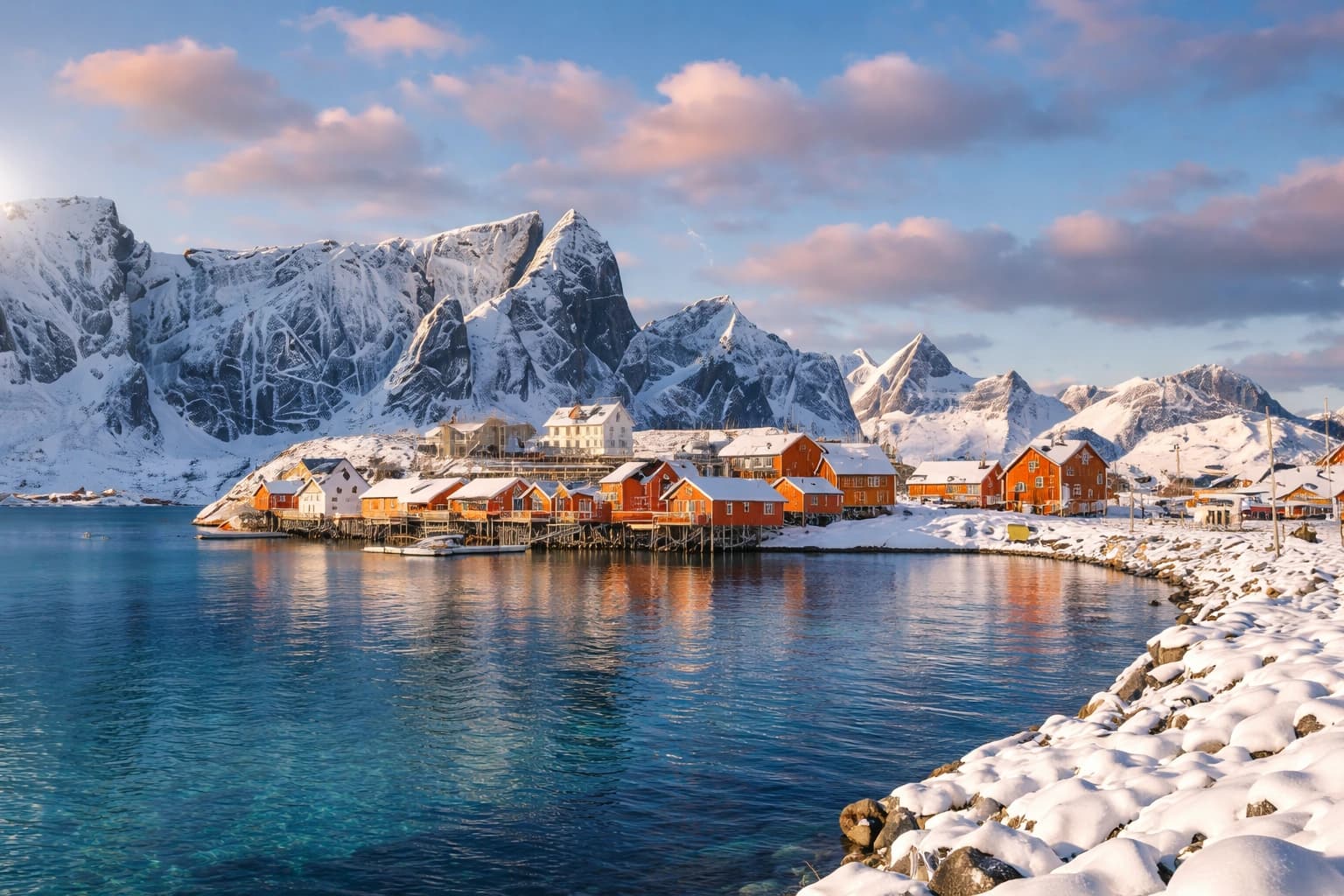
A thousand kilometres above Oslo, across the Arctic Circle at the sixty-eighth parallel, a chain of mountains rises directly out of the sea in a wall that does not resemble any other coastline in Europe. The Lofoten archipelago. An island group so vertical and so improbable that the first maps of it were widely disbelieved in the capitals of the south. The peaks are granite and gabbro, sharpened by glaciers, rising from sea level to more than a thousand metres in the space of a kilometre or two. Between them: fishing villages that have been there for longer than Norway has been a country, and light that does things above the Arctic Circle that it does nowhere else.
This is where this begins.
What the islands actually are.
The Lofoten are an archipelago of roughly eighty islands, of which seven are the principal chain, linked to each other and eventually to the mainland by a series of bridges and tunnels completed only in 2007. Before the last of those connections opened, the outer islands were reachable only by ferry or small plane. The isolation is recent. The memory of it is still there, in the way the villages are arranged and the way the people describe distance.
The rock itself is nearly three billion years old, among the oldest in northern Europe. What the glaciers did to it is more recent and entirely visible, the peaks are serrated, the valleys are U-shaped, the fjords cut in from both sides of each island in a pattern that from the air looks like a landscape that someone has deliberately over-drawn. The Trollfjord, in the strait between Lofoten and its northern neighbour Vesterålen, is barely a hundred metres wide at its entrance, with walls that rise vertically for more than six hundred metres on either side. Ships that go into it do so with some care.
The villages along the coast, Reine, Henningsvær, Nusfjord, Å, are built around the cod. This is not a historical detail. The cod fishery in these waters has been operating continuously since at least the Viking era, and the Lofot fishery of each winter, when the Arctic cod arrive from the Barents Sea to spawn in the shelter of the islands, has been the economic anchor of the coast for more than a thousand years. The red-painted rorbuer, the traditional fishermen's cabins that line the harbours, were built to house the seasonal fishermen who came from all along the Norwegian coast for the winter work. Many of them are still built the way they always were, on stilts over the water, because that is what the geography of the shore allows.
The fish itself is hung to dry on enormous wooden racks along the shore from February through to May. Stockfish, unsalted cod dried in the cold, dry Arctic wind, is one of the oldest traded commodities in Europe, exported from here to Italy and Spain and Portugal for more than seven centuries. The racks are still there. They are not a museum piece.
“A coastline above the Arctic Circle where the sun does not set for two months of the year, and does not rise for one.
What the light does.
The defining fact of Lofoten is latitude. The islands sit between sixty-seven and sixty-nine degrees north, which means the sun behaves differently here than almost anywhere most travellers have been. From late May to mid-July the sun does not set at all, the midnattsol, the midnight sun, is not a local novelty but a six-week fact of life that changes how the days are structured. Swimming at two in the morning happens because it is, by any honest measure, still the middle of the afternoon. The boats go out at midnight because the light is good. Dinner happens when the group is hungry, which may be at ten or at one.
From early December to early January, the opposite. The polar night, mørketid, the dark time, does not mean complete darkness, but a long blue dusk that holds the middle of the day, with the sun below the horizon and the sky lit from beneath by a light the Norwegians have several specific words for. And on clear winter nights above the Arctic Circle, the aurora borealis appears overhead with a frequency that makes it a regular feature of the evening rather than a once-in-a-lifetime event. Lofoten sits directly beneath the auroral oval. On a good winter, you will see it on most cloudless nights. It will appear while you are walking to dinner.
The other months, the shoulder seasons, are their own thing again. September and October bring the first snow onto the peaks while the water is still warm enough for the cod to run. February and March are for the aurora and the winter cod fishery and the kind of skiing that drops directly from a ridgeline into the sea.
How it feels to be there.
The pace here is set by weather and by light, and both of them are large forces. A day that was meant to be a boat trip may become a day indoors with a book and a view out of a window at a storm coming up the strait. A day that was meant to be indoors may become a sudden, long, quiet hike up a ridge to a summit that looks back across three islands at once. The right instinct is to hold plans lightly.
The water around the islands is protected in a way that more famous Norwegian coasts are not. Sea eagles, the largest eagles in Europe, with wingspans that exceed two and a half metres, are a daily sight rather than a rare one. Orcas and sperm whales move through the Vestfjord in winter, following the herring that follow the current. The Gulf Stream reaches this far north, which is why the islands are habitable at all and why the water, while cold, never freezes against the outer coast.
Food is built from a small number of things done with absolute seriousness. The cod, cured and fresh. The king crab from further north. The lamb, which grazes on islands where the grass grows between salt spray and tundra herbs and produces meat with a flavour that cannot be reproduced at lower latitudes. The cloudberries in August. The akevitt in the evening. The coffee, and the Norwegians have a particular, quiet relationship with coffee, at any hour of any day.
What we look for when we plan a stay here.
Lofoten rewards a property that reads the landscape correctly. The architecture here is specific and old, wooden, low, painted in the red or ochre or white that the coast has used for three centuries, pitched to shed snow and weather. What works is a building that has understood the vernacular and extended it intelligently, rather than one that has imported a Scandinavian minimalism from the catalogues of Oslo or Copenhagen. The land does not need abstraction. It needs shelter, warmth, and a position that takes the view seriously.
What we look for here: direct water access on a sheltered inlet, because the relationship with the sea is the organising fact of the trip. Glass oriented to catch the midnight sun in summer and the aurora in winter. Interiors warm in the way Arctic interiors have to be, wood, wool, dark textiles, fire. Proximity to one of the working villages so that the morning catch, the ferry, the small things a week's stay depends on are close at hand. And the right staffing: people who know the coast and the weather and the boats, and who disappear when they are not needed.
Through our network we have access to private houses and estates here that sit within that standard. Each is arranged personally, matched to the season the group wants to be inside, summer light, autumn storms, winter aurora, or spring cod, rather than to a generic calendar.
Who Lofoten is right for.
Not those who want Norway as a pleasant extension of a European city break. The flight from Oslo is two hours. The drive from the nearest city is longer. The islands do not pretend to be an easy destination, and their refusal to pretend is part of what has kept them extraordinary.
This is for travellers who have understood that the most powerful landscapes in Europe are the ones you have to commit to reaching. For families who want a week that gives children something entirely outside their usual frame of reference, a midnight swim in flat water at three in the morning, a sea eagle at eye level from a boat, an aurora appearing overhead on the walk back from dinner. For couples who have done the fjord cruise and want the version of Norway that sits a long way above it. For anyone who has learned that the most restorative weeks are the ones that happen somewhere the modern world has not quite finished arriving at.
The fishermen have been coming to these islands every winter for a thousand years. The light above them is older than any of that. Neither is in a hurry, and neither advertises.
When to visit Lofoten
For the midnight sun, plan for the window between late May and mid-July; the period from the second week of June through the first week of July is the most reliable. For the aurora, late September through early April covers the polar night season, but October through early March is the practical window, when the skies are most often clear and the chance of seeing the lights on any given night is highest, with February historically the busiest aurora month. For ski touring directly from ridgeline to sea, March and April are the months, the days are long again, the snow still holds, and the boats are running. For the cod, the Lofot fishery runs from January through March. For walking, fishing, and the working summer rhythm, July and August. Booking lead times across all seasons sit at four to six months for the better houses; January and February peak earlier, often six to nine months ahead.
How to get to Lofoten
There are four ways in. Evenes (EVE), serving Harstad and Narvik, is the largest airport, with direct seasonal flights from Oslo and a handful of European hubs, about a three-hour drive south into the principal chain. Leknes (LKN) and Svolvær (SVJ) are the two airports on Lofoten itself, with regional turboprop connections from Bodø and Oslo placing arrivals directly into the archipelago. Bodø (BOO) is the mainland gateway just south of Lofoten, with a ferry to Moskenes at the southern end of the islands running several times a day. Private jets typically route into Evenes or Bodø; smaller aircraft can land at Leknes. The road journey through the archipelago, on the E10 that strings the seven principal islands together, is itself one of the more dramatic drives in northern Europe, and we usually plan a stay around the route rather than against it. We coordinate the flights, transfers, and any boat onward to the property ourselves.
Where to stay in Lofoten
The chain has a clear character from east to west. Austvågøy and the islands closest to the mainland are the most populated end, Svolvær, Henningsvær, the easiest access to restaurants and the airports. Vestvågøy in the middle is the agricultural and cultural anchor of the chain, with the broader landscapes and the Viking history at Borg. Flakstadøy and Moskenesøy at the western end are the most dramatic, the peaks at their sharpest, the villages at their smallest, Reine and Hamnøy and Å arranged along bays the road only loosely connects. Most travellers want to be in the western half; the photographs come from there. But a base on Vestvågøy can be the right answer for longer stays, particularly for groups moving between the eastern villages and the western coasts.
We do not publish a property list. The stays we arrange in Lofoten are matched to the season and to the part of the chain that fits the brief, east for accessibility, west for drama, the middle for both. What we will say is that the right house in Lofoten is rarely the one with the most window. It is almost always the one with the most fire.