The Thailand that most people know arrives at thirty thousand feet and resolves itself into a familiar sequence: Phuket airport, the expressway south, the resort strip, the beach clubs, the cocktails in the pool. It is a well-executed production, and it delivers what it promises. The problem is that almost everyone who visits Thailand this way leaves having seen the version of it that was built for them, and not the version that was already there.
Koh Yao Noi is thirty-five minutes from Phuket by speedboat. It sits exactly halfway between Phuket and Krabi, directly in the centre of Phang Nga Bay. In the time it takes to clear a hotel check-in queue, you can be on an island that has never had a resort strip, where the fishing boats still return at the same hour they always have, and where the most celebrated birds on the island, rare Oriental pied hornbills, come to eat fruit in the gardens of local homes.
The two places are separated by one of the most dramatic bays in the world and, in every meaningful sense, by about fifty years.
What Phang Nga Bay actually is.
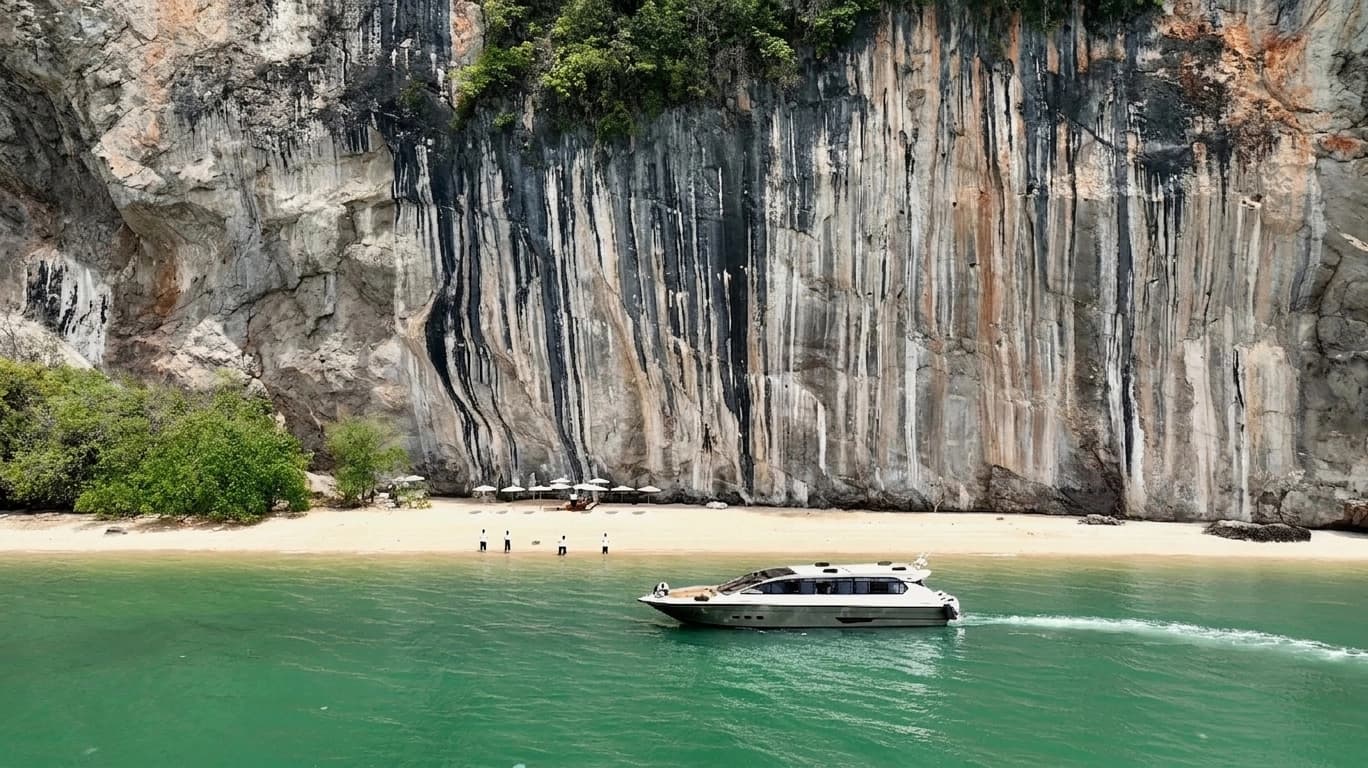
Phang Nga Bay is a UNESCO World Heritage-listed marine park containing forty-two islands. The limestone karst formations that rise vertically from the water, some of them three hundred metres tall, riddled with sunken caverns and hidden lagoons, are the result of geological processes that began three hundred and fifty million years ago. The bay is what remains after the sea rose and submerged a vast limestone plateau, leaving only the highest peaks above the surface.
From a beach chair in Phuket, you can see the shapes of these formations on the horizon. From Koh Yao Noi, you are inside them. The bay wraps around the island on three sides. The light moves across the karst peaks differently at every hour, pale at dawn, layered and complex by midday, turning colours at the end of the afternoon that landscape painters have been attempting to describe for decades without quite managing it.
“Phuket is thirty-five minutes away by speedboat. In every meaningful sense, it is about fifty years away.
What the island kept.
Koh Yao Noi has no large hotels. No nightlife infrastructure. The local community is predominantly Muslim fishing villages that have shaped the island's character for generations, and whose presence gives the place a texture entirely absent from the resort coast. The Thursday market in Koh Yao Noi town, seafood bought directly from the boats that caught it, rubber plantation workers, the smell of charcoal and sticky rice, is not a tourist attraction. It is simply where people go.
The island sits within Ao Phang Nga National Park, which has limited development and preserved the interior: emerald rice paddies, rubber plantations, jungle paths where cycling is the correct speed. The hornbills, one of the smallest members of the hornbill family, and found living alongside a local community almost nowhere else on earth, arrive in the trees in the early morning and again at dusk. This is not something that is arranged for you. It is simply what happens here.
How it feels to be there.
Days on Koh Yao Noi have a pace that is partly the island and partly the bay. The water in front of the estate is calm enough for kayaking out among the karst formations, following channels between the rocks, finding the hidden lagoons that are only accessible from the water. The bay is sheltered in a way that makes it something other than the sea; more like an enormous natural room, the walls of which happen to be ancient limestone.
Evenings arrive early and stay long. The bay catches the sunset in a way that the open ocean does not, the light crosses the water and hits the formations from the west, and the whole scene rearranges itself in the space of twenty minutes. Dinner happens at whatever pace the group wants, in whichever part of the property feels right that evening. The chef works around preferences, not menus. The bartender knows what you drank the night before.
What we look for when we plan a stay here.
Koh Yao Noi rewards a property that earns its setting. The bay is extraordinary; the architecture needs to be positioned to understand that rather than compete with it. What we look for here: a direct line of sight to the water and the karst formations from the principal living spaces. Outdoor areas that work with the bay's scale, not a single terrace, but multiple spaces at different orientations for different parts of the day. Interiors that take their cues from the island rather than importing a generic luxury aesthetic.
The property we work with here was designed around precisely this brief, its architecture drawn from the teakwood temples of northern Thailand, the rooflines following the same geometry as the Lanna structures that have stood in Chiang Rai and Chiang Mai for centuries. It sits within two acres of gardens on the island's east coast, with the bay in front and the jungle pressing in on the other sides. A team of twenty-four is there for one group alone, and everything, the meals, the water activities, the cultural excursions across the island, is arranged around who you are and what you want from the week, not a programme designed for whoever happened to book.
Who Koh Yao Noi is right for.
Not those who need the familiar infrastructure of a resort destination. There is no high street here, no beach club scene, no curated strip of restaurants. If the point of a Thailand trip is to be in Thailand as it is experienced through its tourism economy, Koh Yao Noi will feel like it is missing something. That, of course, is the entire argument for it.
This is for families who want a trip that extends beyond the pool, where the children remember the kayak into the limestone cavern, the hornbills in the morning trees, the longboat at sunset crossing the bay. For those who have been to Thailand before and want to see what was always behind the version they were shown. For anyone who has learned that the most interesting experiences are rarely in the places that have been most optimised for tourism, and who is prepared to travel thirty-five minutes by speedboat to find out what that means.
Phuket will always be there. The bay does not advertise itself.