Seoul is one of the most intense cities on earth, and it does not apologise for this. Twenty-six million people live in the greater metropolitan area, which makes the Seoul capital region one of the largest urban agglomerations anywhere. The city has rebuilt itself at least three times within living memory, flattened in 1953, rebuilt as an industrial capital in the 1970s, and rebuilt again as one of the wealthiest and most technologically advanced cities in the world in the decades since. The result is a density, a speed, and a consumer culture that genuinely has no equivalent. Twenty-four-hour bookshops. Department stores with food courts that could feed a small country. A subway system that runs at a punctuality most European railways gave up on decades ago. The best hotel concierges in Asia. Coffee shops at a density the Italians would not quite believe.
Anyone arriving in Korea for the first time should spend three or four days in Seoul, and the city will reward each of them generously. But Koreans themselves understand something about their own country that most international visitors never quite arrive at: Seoul is the city you work in. It is not the country you rest in.
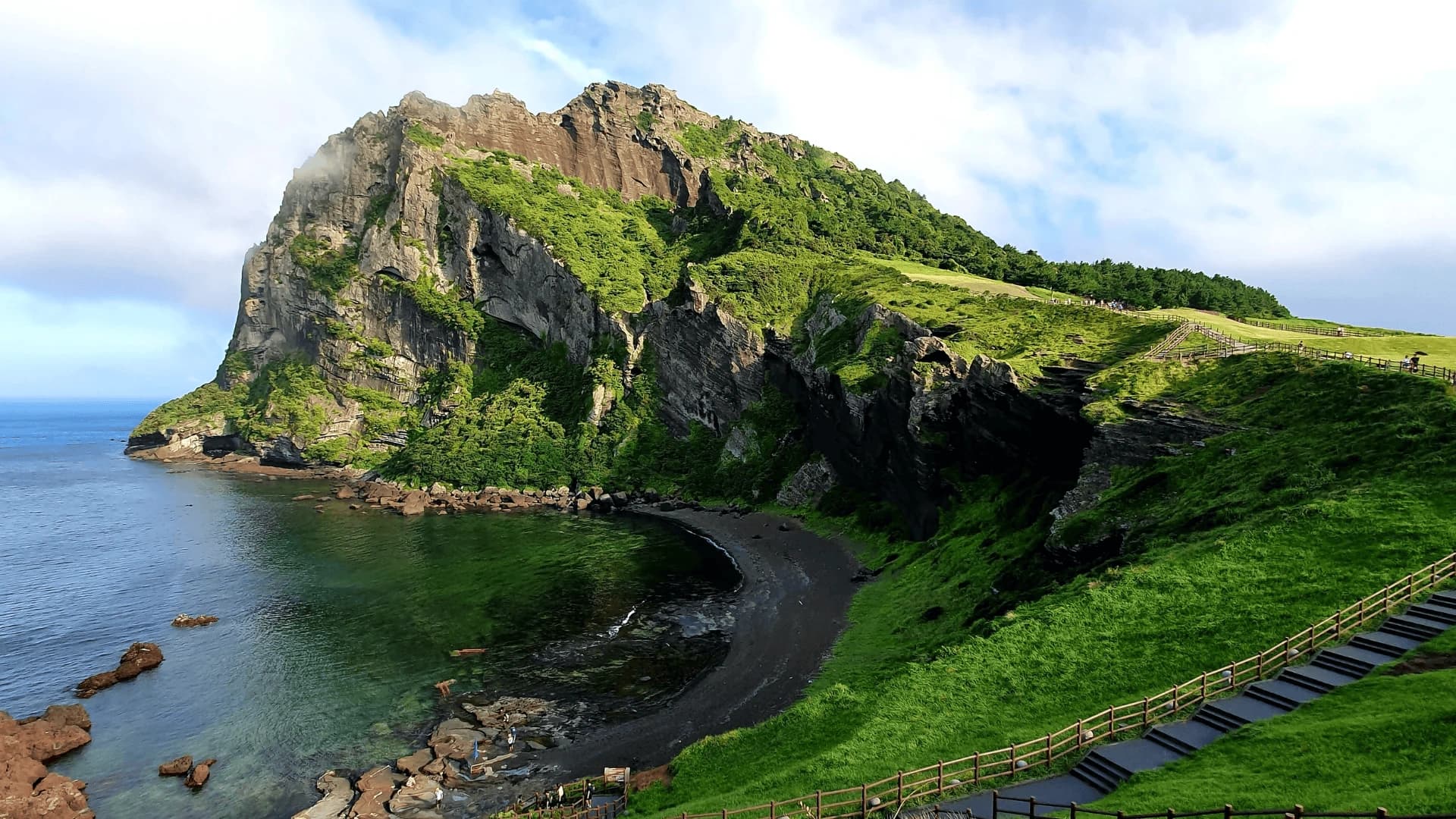
An hour south of Seoul by plane, in the middle of the Korea Strait between the peninsula and Japan, sits a volcanic island that the rest of Korea treats as its own private retreat. Jeju. Roughly one thousand eight hundred square kilometres, a single dormant volcano at the centre, a coastline of basalt cliffs and black-sand beaches, a climate distinctly warmer than the mainland, and a culture that predates the Korean state by more than a thousand years and has never quite become Korean in the way the rest of the country has.
This is where this begins.
What the island actually is.
Jeju is one of the more unusual islands in Asia, and by several measurements one of the more unusual in the world. It was formed by a series of volcanic eruptions beginning roughly two million years ago and continuing, with gradually reducing intensity, until as recently as a thousand years ago, which in geological terms is essentially the present. The central volcano, Hallasan, rises to one thousand nine hundred and forty-seven metres, making it the highest peak in South Korea and genuinely substantial by any measurement. The island is covered in more than three hundred and sixty oreum, smaller parasitic cones, each one a miniature volcano in its own right, each one a separate viewpoint and a separate walk. The landscape looks like nothing else in East Asia.
Beneath the surface of the island sits one of the most extensive lava tube systems on the planet. The Geomunoreum system, a series of caves carved by flowing lava between three hundred thousand and one hundred thousand years ago, has been designated a UNESCO World Heritage Site. The tubes extend for tens of kilometres. Some of them are walkable. The Manjanggul tube alone runs for more than seven kilometres, with chambers large enough to house a small cathedral, and it is one of the only lava tube systems in the world that contains carbonate formations, stalactites and stalagmites made from the shells of sea creatures that have filtered down through the soil over millennia, and that give the chambers a coloration no other lava cave has.
The culture of the island is distinct from the mainland's in ways that go much deeper than most regional differences. The Jeju dialect is classified by several linguists as a separate language, not mutually intelligible with standard Korean, and UNESCO lists it as critically endangered. Until the mid-twentieth century, Jeju was one of the only matrilineal societies in East Asia, the island's economy was built on the sea rather than on agriculture, and the divers who worked the sea were women. They still are.
The haenyeo, the sea women of Jeju, are one of the few living examples in the world of a female free-diving tradition. They have been diving without oxygen to depths of up to twenty metres, for octopus, abalone, sea urchin, and shellfish, for at least fifteen hundred years. The practice is matrilineal and intergenerational; grandmothers, mothers, and daughters dive together, the older ones still working into their eighties. UNESCO inscribed the haenyeo tradition on its Intangible Cultural Heritage list in 2016. On a calm morning off the rocky north coast of the island, the haenyeo still emerge from the water in wetsuits and masks, carrying baskets of seafood that will be on the restaurant tables within the hour, exactly as they have for most of recorded history.
“A volcanic island with its own language, a matriarchal free-diving tradition fifteen centuries old, and a lava cave system carved from carbonate instead of basalt. An hour's flight from Seoul.
What the southern coast holds.
Jeju's southern coast is the quieter half of the island, and the one that most rewards proper attention. The climate is warmer, the island's subtropical southern exposure produces winters that rarely see frost and summers mild enough for the beaches to remain usable into October. Citrus orchards, Jeju's famous hallabong tangerines, which exist nowhere else, cover the slopes. The coast itself alternates between basalt cliffs, which plunge directly into the sea, and occasional pocket beaches of black volcanic sand that turn warm in the sun in a way no lighter sand quite does.
The towns along the southern shore, Seogwipo, Jungmun, the small fishing villages between, are older and slower than the northern half of the island. The pace here approaches something unusual for Korea. The old village walls, built from stacked volcanic stone without mortar and still standing after centuries, line the roads between the orchards. The stone grandfathers, dol hareubang, the three-metre basalt statues that are the island's cultural emblem, stand at the entrances to villages in the same positions they have occupied for roughly a thousand years.
And back on the mainland, the southern coast of Korea itself offers its own quiet version of the country. The port city of Tongyeong, sometimes called the Naples of Korea by people who have never been to Naples but who mean something real by the comparison, sits in a network of several hundred islands, many of them uninhabited, all of them accessible by boat. The Hallyeo Marine National Park, which covers much of this area, is one of the most scenic coastlines in East Asia and sees a fraction of the tourism the country's inland attractions do. A crossing by boat through the islands, in clear weather, is one of the best-kept experiences in Korean travel.
How it feels to be there.
The rhythm of Jeju is deliberately different from the rhythm of the mainland. Koreans come here to decompress, and the island has, over several decades, organised itself around that purpose without becoming a tourist parody. Days on the island move slowly. Mornings begin with a walk along one of the olle, the Jeju Olle Trail, a network of twenty-seven coastal walking routes covering the entire perimeter of the island, each ten to twenty kilometres long. The routes were established between 2007 and 2012 by a Korean journalist who had walked the Camino de Santiago and wanted to bring something similar back to her home island. The trails are unglamorous and genuinely lovely, past oreum, along coastal cliffs, through tangerine groves, past haenyeo villages where the day's catch is being sold from plastic tubs outside the houses of the women who brought it in.
Lunch on the island is one of the reasons to come. The food of Jeju is distinct from the food of the mainland in many of the same ways the language is, it is built from what the island produces, and what the island produces is sea and stone rather than rice and grain. Black pork, from a breed of pig found only on Jeju. Raw abalone, brought up from the sea an hour earlier. Omija tea, made from five-flavour berry. A stew called galchi jorim, made from the silver hairtail fish that runs through the southern waters in late summer, cooked with daikon and chilli and the kind of patience that makes it clear the dish has not changed much for several generations. Tangerines at every meal.
Afternoons are for the oreum, a slow climb up a volcanic cone that takes an hour at most and places the walker on a summit that looks back across the island's extraordinary volcanic topography, with the sea visible on both sides. Or for the lava tubes, which are cool and strange in a way that photographs cannot quite transmit. Or for simply being where you are, which is, in the end, the whole point of the island.
Evenings are long and quiet. The sunsets on the west coast of the island, particularly at Hyeopjae and the nearby Biyangdo offshore island, are known within Korea as among the best anywhere on the peninsula. Dinner happens late and outdoors when the weather allows. And the nights, away from the small lights of the villages, are unusually dark for a country that is otherwise one of the most intensely lit in the world.
What we look for when we plan a stay here.
Korea rewards a combination. A few nights in Seoul to understand the country as it currently is, the city's extraordinary food, the galleries in the old hanok neighbourhoods, the palaces that the royal Joseon dynasty built and that still anchor the centre of the city after six hundred years, and then a flight south to Jeju for the longer, slower, considerably quieter half of the trip. The two halves together describe a country that neither half alone quite does.
What we look for here: a property on Jeju's southern coast that places the group within the volcanic landscape rather than on the tourist circuit of the northern half of the island. Direct coastal access, because the basalt cliffs and the black-sand pockets are the island's signature, and the evenings on the south-facing terraces are the week's quietest hours. Architecture that draws from the Jeju vernacular, the volcanic stone walls, the low black-tile roofs, the courtyard plans oriented to shelter against the island's strong winds, rather than importing a generic coastal luxury aesthetic. A kitchen that takes the island's own ingredients seriously. Staff who understand the island and the mainland in equal measure. And in the city, a stay in one of Seoul's older neighbourhoods, Bukchon, Seochon, Ikseondong, in a restored hanok courtyard house, rather than in one of the international towers along the Han.
Through our network we have access to stays on Jeju and in Seoul that sit within this standard. Each is arranged personally, matched to the group and the season, and handled from the Incheon arrival onward.
Who Korea is right for.
Not those who have come for the contemporary Korea they have seen through its cultural exports. The country is more than K-pop and Korean barbecue, and a trip shaped around those will miss almost everything that makes the place worth a full week.
This is for travellers who have understood that the most interesting countries to visit are usually the ones with the most compression, where a short flight moves you between entirely different climates, cultures, and centuries. For families who want a trip that combines urban intensity with rural stillness in a way that almost no other combination in Asia quite manages, Seoul at full speed, Jeju at a pace the rest of the country has almost forgotten it has. For couples who have done Tokyo and Shanghai and are ready for the East Asian country that sits, quietly and interestingly, between them. For those who have learned that the most distinctive cultural traditions, the haenyeo, the olle, the lava tubes, the hanok houses, are almost always the ones that do not translate well into photographs, and that require proper time on the ground to be understood.
Seoul has rebuilt itself three times. Jeju has not rebuilt itself at all. The island was here before the Korean state was an idea, and the women still dive the same waters their great-great-grandmothers dived, for the same reasons, in the same ways. Both things are Korea. The complete trip understands this, and gives each half the time it deserves.
When to visit Jeju and Korea
Korea has four genuinely distinct seasons, and each rewards a different kind of trip. Spring runs from late March through May, with the cherry blossom arriving on Jeju first, typically in the last week of March, then on the mainland southern coast, and finally in Seoul, usually in the first week or two of April. The exact dates shift each year by a week or so. Late April and May, after the blossom, are perhaps the most reliably pleasant weeks of the spring across the country. Summer runs June through August and is hot and humid, with the rainy season, the jangma, typically arriving in late June and lasting three to four weeks; July and August are the high domestic-tourism months on Jeju as mainland Koreans escape the city heat, with the better stays booked four to six months ahead. Autumn is the country's quiet best season, September through early November, with the fall foliage peaking on the mainland mountains in late October and on the southern coast a week or two later, and the weather clear and cool. The Chuseok holiday in mid-autumn is the country's most important traditional festival; the dates move each year by the lunar calendar. Winter is cold and dry on the mainland with reliable snow in the north for skiing, while Jeju remains the warmest part of the country, frost rare, the camellias in flower along the southern coast through January and February.
How to get to Jeju and Korea
Incheon International (ICN), the principal Seoul-area airport, is the main long-haul gateway for the country, with direct flights from across Asia, North America, Europe, and the Middle East. Gimpo (GMP), the older Seoul airport, handles most domestic traffic, including the Seoul-Jeju route, which is one of the busiest air corridors in the world, with flights departing every few minutes throughout the day and the crossing taking about an hour. Jeju International (CJU) on the island's north coast is the arrival point, about twenty minutes from the northern resort areas and an hour by road across the island to the southern coast. The KTX high-speed train service from Seoul to Busan in two and a half hours, with a connecting flight from Busan to Jeju, is an alternative for travellers including the southern mainland coast in the itinerary. Private jets route most easily into Gimpo for Seoul and directly into Jeju, with substantial business jet capacity at both. We coordinate the international arrival, the Seoul-Jeju transition, and any onward routing across the mainland southern coast ourselves.
Where to stay in Jeju and Korea
The country works around two principal bases, sometimes three. In Seoul, the article describes the older neighbourhoods where a restored hanok courtyard stay places the group within the city's historical fabric rather than its corporate one, Bukchon and Seochon on either side of the old royal palaces, Ikseondong closer to the historic centre. The international tower hotels along the Han are the more familiar option, suited to those who want a corporate-style stay; the hanok choice is for those who want the city's actual texture. On Jeju, the principal split is between the northern half of the island, closer to the airport, with the resort areas at Jungmun on the south-central coast and the more developed tourist circuit, and the southern and southwestern coasts, where the quieter villages, the citrus orchards, and the basalt cliffs offer a different rhythm entirely. A property on the southern coast places the group within the island the article describes. The mainland southern coast, Tongyeong and the Hallyeo island country, is the third option, a working coastal region for those who want to extend the trip into a longer triangle across the country's quieter half.
We do not publish a property list. The stays we arrange across Korea are matched once the brief is clear, a hanok house in old Seoul, a coastal property on Jeju's southern shore, sometimes a mainland southern-coast extension across the island country. What we will say is that the right Korea trip is the one that allows Seoul its few days and then leaves it. The country south of the capital is the country most international visitors never quite reach, and it is the country Koreans themselves choose when they are choosing for themselves.