Stockholm is extraordinary, and it does not need defending. Fourteen islands connected by more than fifty bridges, a medieval old town that has survived every century more or less intact, design culture with few equals in Europe, and water that runs through the city in a way that makes you understand why the Swedes have a different relationship to it than most nations do. Anyone visiting Sweden for the first time should go. It rewards the time given to it.
But Stockholm is not where Sweden spends its summer.
Four hundred kilometres west, between Gothenburg and the Norwegian border, a coastline of pink-grey granite runs north along the Skagerrak, and in July, much of the country decamps to it. The summer house tradition here is not a holiday preference. It is something closer to a national instinct, written into law and language. Roughly one Swedish family in five owns a sommarstuga, a figure that climbs considerably higher along this coast, where whole villages are built around the rhythm of people who arrive in June and leave in August and spend the intervening weeks doing as little as possible, with absolute seriousness.
This is where this begins.
What the coast actually is.
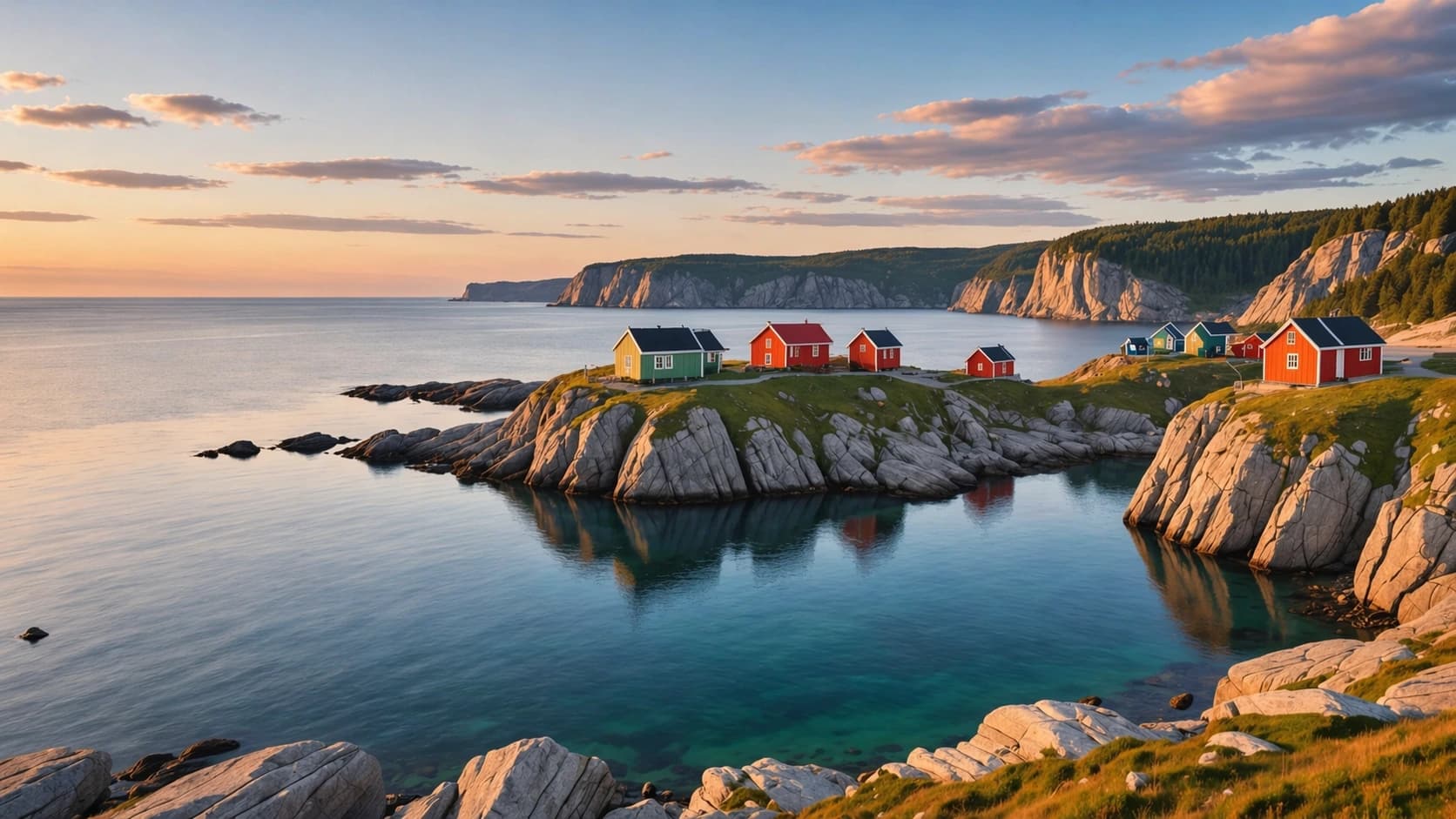
Bohuslän is the short, intense stretch of coastline that runs from just north of Gothenburg to the Norwegian border, roughly two hundred and eighty kilometres as the crow flies, several thousand if you count every skerry and island the shoreline actually contains. The granite here is among the oldest in Europe, some of it more than a billion and a half years old, and the landscape it creates is unlike anything else on the continent. The last Ice Age left it polished: huge, smooth, pink-grey domes of rock that rise out of the water as though someone had poured them into shape. There are thousands of islands. Some are inhabited, most are not. On calm days the sea between them is glass, and the rocks above and below the waterline appear to belong to the same piece of stone.
This is the coast that shaped Swedish maritime life for centuries. The fishing villages, Fjällbacka, Smögen, Grebbestad, Kungshamn, were working ports long before they were anything else, and the architecture still shows it. Red wooden boathouses built directly onto the rocks, jetties that have been rebuilt a dozen times, narrow lanes between houses that lean toward each other because the granite beneath them never left much room to plan.
The coast was inscribed into Swedish summer mythology in the twentieth century partly by accident. Ingrid Bergman spent her summers on a small island off Fjällbacka for nearly thirty years, and was buried there. The association quietly elevated a coast that had been known, until then, mostly to the Swedes themselves.
“Everyone goes to Stockholm. Swedes spend their summers on the other coast entirely.
What the water gives.
The shellfish here are the finest in northern Europe, and this is not disputed by those who know. The Ostrea edulis, the European flat oyster, a species that has largely disappeared from most of its former range, still grows on this coast, harvested by hand by a small number of divers who work the cold Skagerrak waters between September and April. The oyster from Grebbestad is to European oysters what champagne is to sparkling wine: a specific, protected thing, impossible to replicate elsewhere, and entering a complicated second act as the species recovers in waters where it has been absent for a century.
The lobster comes in autumn. The Swedish lobster season opens on the first Monday after the twentieth of September, a date that operates as a kind of unofficial public holiday along the coast. Hummerpremiär, it is called. Traps are set the night before. Boats leave before dawn. What comes up is the Homarus gammarus, the European lobster, darker and denser than its American cousin, its meat considered by many chefs to be the finest in the world. The lobster safaris that run from the coastal villages in September and October are a working activity rather than a tourist performance: you pull the traps with people who do this professionally, and what you eat for lunch afterwards came out of the water that morning.
The crayfish, the langoustines, the mussels, all of it, and all of it from water cold enough that the flavour is concentrated in a way warmer seas cannot produce.
How it feels to be there.
The days in Bohuslän in summer do not really end. By midsummer, north of Gothenburg, the sun is above the horizon for more than seventeen hours, and the few hours it is technically set are not dark so much as lit by an extended twilight that turns the granite rose-coloured and the water silver. Dinner at nine in the evening happens in broad daylight. Swimming at eleven is entirely ordinary. The concept of kväll, the evening, is flexible here in a way it is nowhere else; whole social rhythms slide later because there is no night to enforce them.
Midsummer itself, the solstice weekend in late June, is the central event of the Swedish year, and the West Coast is one of the places it matters most. The pole is raised, the flowers are woven into crowns, the herring is eaten, the schnapps songs are sung with the kind of seriousness that only makes sense if you have heard Swedes sing them. For the rest of the summer, the coast operates on a slower register. Mornings on the rocks with coffee. Afternoons on a boat, or in the boat, or watching boats. Evenings that blur into each other because the light refuses to commit to ending.
Food follows the pattern. Breakfast is long and lingering, sourdough, cured fish, strong coffee, something pickled. Lunch is often on a jetty or a flat rock with whatever came out of the sea that morning. Dinner is slow, late, and almost always outside. The rhythms are old. They are shared by nearly everyone on the coast at the same time. That synchrony is part of what makes the season feel the way it does.
What we look for when we plan a stay here.
Bohuslän rewards a base that belongs to the coast rather than observing it. The architecture here is specific, low, wooden, built to handle a climate that is glorious for three months and considerable for the other nine. What works is a property that has understood this, rather than imposing a modern idea of luxury onto a landscape that does not particularly need it.
What we look for here: direct water access, because the relationship with the sea is not a feature but the entire point. Outdoor space that handles both the long light of July and the sharper mornings of late August. Interiors that read as Swedish, considered, plain in the right way, with the warmth that comes from wood and textiles rather than ornament. And the right proximity: close enough to one of the working fishing villages that a morning's oysters and an afternoon's lobster are a matter of walking into the harbour, not booking something.
Through our network we have access to properties on this coast that sit within that standard. Each is arranged personally, matched to the group rather than the calendar, and timed to the part of the season the group wants to be inside.
Who Bohuslän is right for.
Not those who came to Sweden for the cities. Stockholm, Gothenburg, Malmö, all of them are excellent in their different ways, and a week spent in any of them is a week well spent. But the West Coast is not a city experience. The nearest restaurant may be twenty minutes by boat. The evenings are quiet. The noise of the week is boats, birds, weather, and conversation.
This is for travellers who understand that the most genuine version of a place is the one its own people go to when they want to be themselves. For families who want a summer that returns children to something closer to how summers used to feel, outside, on the water, with unstructured time the point rather than the problem. For couples who have done the Scandinavian capitals and want the coast those capitals empty into every July. For those who have learned that the best holidays are the ones that do not perform, and who are willing to cross a country to find one.
The archipelago has been here longer than Sweden itself. It does not advertise. It does not need to.
When to visit Bohuslän
The season has two quite different lives. June through August is the summer the rest of this piece describes, the long light, the swim culture, midsummer in the last week of June, the coast at its busiest from the second week of July through the first of August when most Swedish families are on it. The first weeks of June and the last of August are quieter equivalents, with the same water temperature and considerably more space. September and October are the second season, the foreign crowd has gone, the lobster premiär opens the autumn, and the granite turns from rose to copper in the lower light. The coast in late autumn and winter is striking but austere; storms come in off the Skagerrak, most of the seasonal restaurants close, and the oysters become the centre of the trip rather than an addition to it.
How to get to Bohuslän
Gothenburg-Landvetter (GOT) is the primary gateway, about ninety minutes from the southern villages, two hours from the northern coast near Grebbestad and the Norwegian border. Oslo (OSL) is the alternative for travellers entering from Norway, with a two-and-a-half hour drive south. Copenhagen (CPH) can work for European routes via Denmark, four to five hours by road via the Öresund bridge and the western motorway. The train from Gothenburg up the coast is a reasonable option for those without a vehicle, with regional services stopping at the principal towns. Private jets route into Gothenburg City Airport (GSE) and Landvetter directly. As a Swedish-based concierge, we handle the regional logistics, boats, drivers, the timing of the right ferry, ourselves.
Where to stay in Bohuslän
The coast divides roughly into two halves, and each has a different character. The southern Bohuslän, between Gothenburg and Lysekil, takes in Marstrand and the islands off Tjörn and Orust, closer to the city, somewhat busier, with the easiest access to restaurants and to Gothenburg itself for a day. The northern Bohuslän, from Fjällbacka up to the Norwegian border, holds the quieter villages, Grebbestad with its oyster bay, Hamburgsund, Smögen across its narrow harbour, and the most secluded island properties; this is where most of the serious summer residents have their places, and where the silence of the granite is most pronounced. Inland from the coast, the rolling farmland and small lakes offer a different proposition again, particularly useful as a base for the off-season trip.
We do not publish a property list. The stays we arrange on the West Coast are matched to the part of the coast that fits the brief, close to a working village for the food, set back on an island for the silence, or somewhere capable of both. What we will say is that the right house in Bohuslän is rarely the one with the most polished interior. It is the one where the rocks come up to the back door.